top of page

An end of month money checklist small business owner style is one of the most exciting rhythms you can build into your business. Each month closes with intention, and the next one opens with a plan. That is how great businesses stay great, and it is how confident women stay confident.


Woman reviews a Profit & Loss dashboard on a laptop while writing a month-end checklist in a warm home office

Here is the ten-step checklist to close September and step into October with real momentum.


The 10-step end of month money checklist

  1. Total money in for the month

  2. Total money out for the month

  3. Calculate what you kept

  4. Note your top three expense categories

  5. Move your tax set-aside for the month (use The Simple Formula: How Much to Save for Taxes Small Business Owners Should Use if you have never set a percentage)

  6. Fund your reserve with any surplus (pair this with How to Build an Emergency Fund When You're Self-Employed)

  7. Confirm owner pay happened cleanly (if this one has been slipping, read Why So Many Business Owners Skip Their Own Pay)

  8. Note any recurring charge to cancel or renegotiate

  9. Write one lesson from the month

  10. Set one focus for next month


Ten steps. About thirty focused minutes. One clear October.


Why closing the month properly feels good

  • It marks the finish line of the month

  • It gives every dollar a job

  • It leaves nothing hanging into the next month

  • It turns your business into a rhythm you trust


That is a very different feeling than the usual "I meant to look at last month" energy.


An easy monthly reference table

Cozy home desk with laptop showing a financial dashboard, checklist board, notebook, plants, and coffee in warm daylight.

Step

Where the number lives

Money in

Deposits and payment processor reports

Money out

Bank and card statements

What you kept

The Money Mastery System system's monthly breakdown

Top three categories

The Money Mastery System system's category view

Tax set-aside

Your tax holding account

Reserve

Your reserve or buffer account

Owner pay

Your personal checking

Cancellations

Recurring charge audit

Lesson learned

Your notebook or Collective journal

Next month focus

Your planner or October dashboard

How the Money Mastery System supports the checklist


Then the Collective keeps the practice alive:

  • Finance Friday Live at the end of the month is often themed around closing well

  • The Money Reset Call is designed exactly for this closing and opening rhythm

  • The daily blog carries you into the next month with intention

  • The discussion feed lets you celebrate the win and share the lesson


Inside the Collective, the Money Mastery System system helps you see what you kept last month on one screen, alongside other women doing the same work. That is why closing a month becomes fun instead of stressful.


A story of a joyful month close


Picture Priscilla, a solo consultant. She sits down on the last Sunday of the month with tea, opens the Money Mastery System system, and runs her ten-step checklist. Money in and out are already visible. She spots that she kept a healthy margin, moves her tax set-aside, funds her reserve, confirms owner pay happened, cancels one unused subscription, and writes down her lesson: "raising prices in August was the right call." Then she sets her October focus: preparing for a founding-member webinar with Donna.


By Monday morning, she is not walking into a fog. She is walking into a plan.


Three signs the checklist is working


You will know this is working when:

  1. You feel calmer at the end of every month

  2. You start October, November, and December with a clear focus

  3. You cannot imagine going back to running the business without this


A bonus October kickstart


To make the transition feel even more like a launch:

  • Day 1 of the new month: open the Money Mastery System system and write your October focus

  • Day 3: attend Finance Friday Live and align your focus with what Donna is teaching

  • Day 7: post your one lesson from September inside the Collective


That is a beautiful start to a new month.
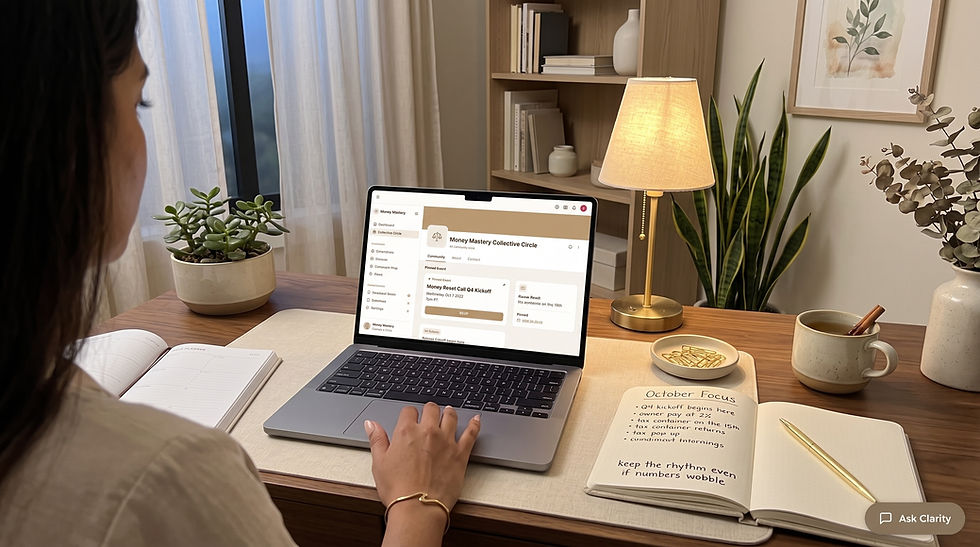
Woman works on a laptop at a cozy desk; screen shows Money Mastery Collective Circle, with planner notes and a warm lamp nearby.

What to do next

Run the ten-step checklist today, celebrate what you built in September, and step into the Collective at https://moneymasterycollective.circle.so.


FAQ


Why does an end of month checklist matter so much for a solo business?

Solo and service-based businesses tend to move quickly, and cash tends to move quickly with them. Without a defined close-out ritual, the story of one month blends into the next, and important patterns get missed. A monthly checklist gives every dollar a clear path and gives every month a proper ending. It ensures tax money moves, reserve gets funded, owner pay is confirmed, and lessons get captured. That last piece is especially valuable, because businesses grow fastest when the lessons of one month are used to design the next. When this rhythm lives inside the Money Mastery System system, it becomes fast. When it lives inside the Collective, it becomes fun. Together, they turn month-end from something women avoid into something women look forward to.


How long should this actually take?

Thirty focused minutes is the target. If you have the Money Mastery System system in place, your income, expenses, and monthly breakdown are already visible, which means the first half of the checklist happens fast. The middle portion, moving tax money, funding reserve, and confirming owner pay, takes only a few clicks if your accounts are set up cleanly. The final portion, writing a lesson and setting a focus, is the most valuable use of your time and only requires a few thoughtful sentences. The first time you run the checklist, give yourself an hour to get comfortable. From the second month on, thirty minutes is realistic and repeatable.


How does this checklist connect to bigger financial goals?

Every big financial goal you have is built on top of consistent monthly rhythm. Retirement contributions, cash reserve growth, debt reduction, and pricing decisions all get stronger when you know exactly what closed each month and how it compared to the one before. The end of month checklist gives you the working data to see those trends. Six months of consistent closes turns into a clear picture of how your business is really performing. Twelve months turns into a story you can plan around. That is how a woman goes from "I hope things are working" to "I know exactly how my business is doing and where I want it to go next," and it is exactly the kind of transformation the Money Mastery System system + the Collective is built to support.
A Money Mastery review real dashboard is what happens when your business finances stop living in five different tabs and one lost spreadsheet. Instead of hunting for numbers across apps and files, everything you need lives in one working place, and you know exactly what to look at first.


Here is what to track when you make the shift.


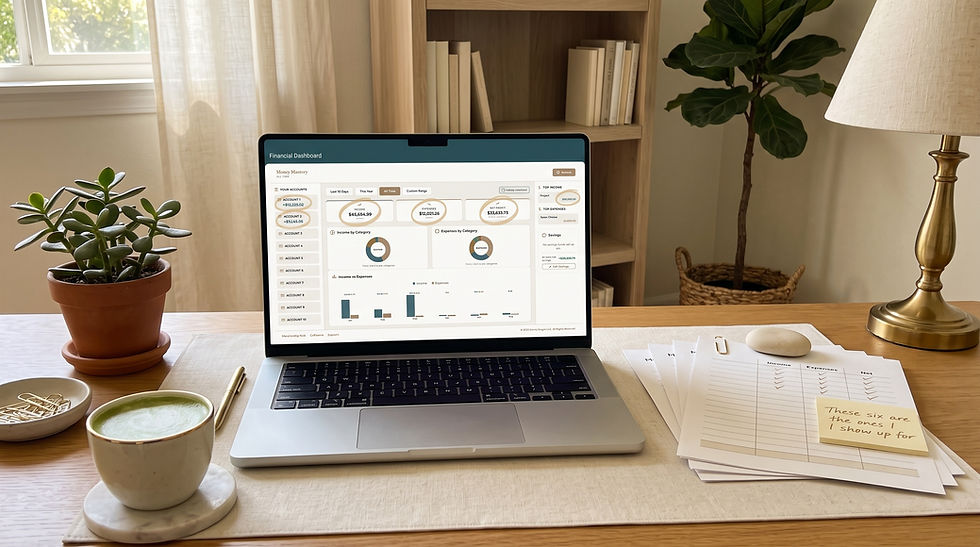
Laptop on a tidy desk shows a financial dashboard, with notes and papers beside a plant, coffee, and lamp in a calm home office.

The 6 things to track first in your dashboard

  1. Total money in for the month

  2. Total money out for the month

  3. What you kept after business expenses

  4. Top three expense categories so you can spot drift

  5. Tax money already moved so you know what is truly available

  6. Owner pay taken so your rhythm is visible


That is your operating picture. Six numbers, one screen. If categorizing expenses still feels new, 35 Business Expense Categories Every Small Business Owner Should Be Tracking will make the setup even faster.


Why one dashboard beats scattered spreadsheets

  • No more toggling between eight apps

  • No more forgetting where you saved that one document

  • No more losing context when you close the laptop

  • No more starting over every quarter


Everything lives in one place, and it stays in that one place.


A comparison to make the choice easy

Scattered spreadsheets

Money Mastery review real dashboard

Multiple files, multiple places

One working system

Manual copying

Structured categories

Guessing what matters

Six clear numbers up front

Restarting after long gaps

Ongoing monthly story

Solo work

Inside the Collective with other women

What to move first when you make the switch


If you are coming from spreadsheets or scattered apps, use this order:

  1. Move your last full month of statements

  2. Categorize the biggest ten transactions first

  3. Note your top three expense categories

  4. Mark tax money and owner pay clearly

  5. Set your weekly review time (pair this with How to Track Where Your Money Goes in 15 Minutes)

  6. Attend Finance Friday Live inside the Collective for support


Twenty to thirty minutes gets you a working dashboard. Then it only gets easier. If your business and personal money are still mixed inside one account, walk through How to Seperate Business and Personal Finances before you migrate, so the dashboard reads clearly from day one.


How the dashboard works with the Collective


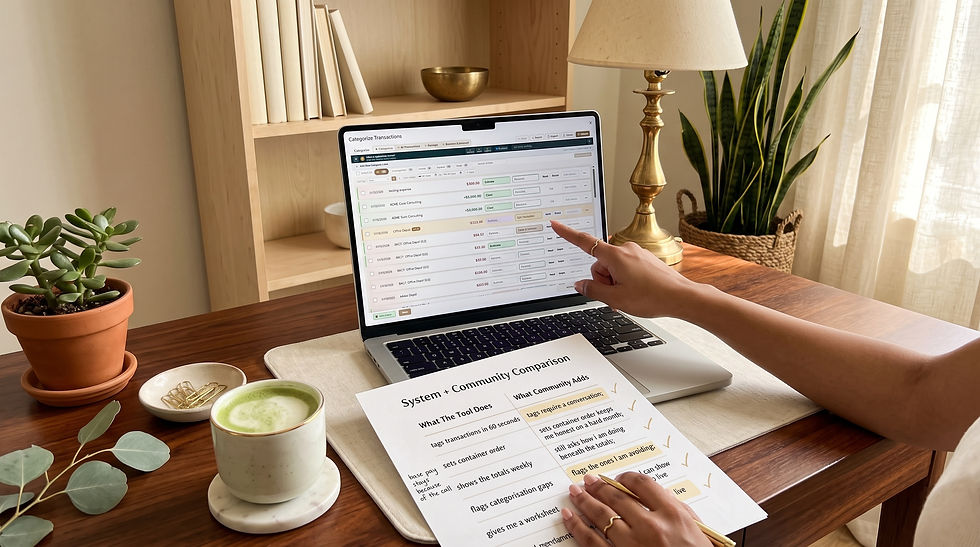
Hand points at a laptop showing Categorize Transactions, beside a worksheet, coffee, and plants on a warm home desk.

The dashboard is one piece. The other piece is the community around it. Inside the Collective:

  • The daily blog keeps you close to your numbers

  • The discussion feed turns your monthly story into a shared conversation

  • Finance Friday Live gives you Donna's live teaching each week

  • The Money Reset Call closes the month cleanly at Momentum

  • Office Hours answers specific dashboard questions at Momentum


That combination is what turns a dashboard into a life-changing money practice.


A story that shows the shift

Picture Rosa, a service business owner who has been running six spreadsheets and two apps for years. She spends the first weekend of the month rebuilding a picture that never quite matches. When she moves to a Money Mastery review real dashboard, three things happen fast. First, she sees her full monthly story on one screen. Second, she cancels three subscriptions she did not realize were still active. Third, she attends Finance Friday Live and hears Donna teach on the exact number that matters most for her current stage, which pairs beautifully with What Is Cash Flow? (And Why It's Not the Same as Profit).


By month two, Rosa is not just organized. She is in relationship with her business.


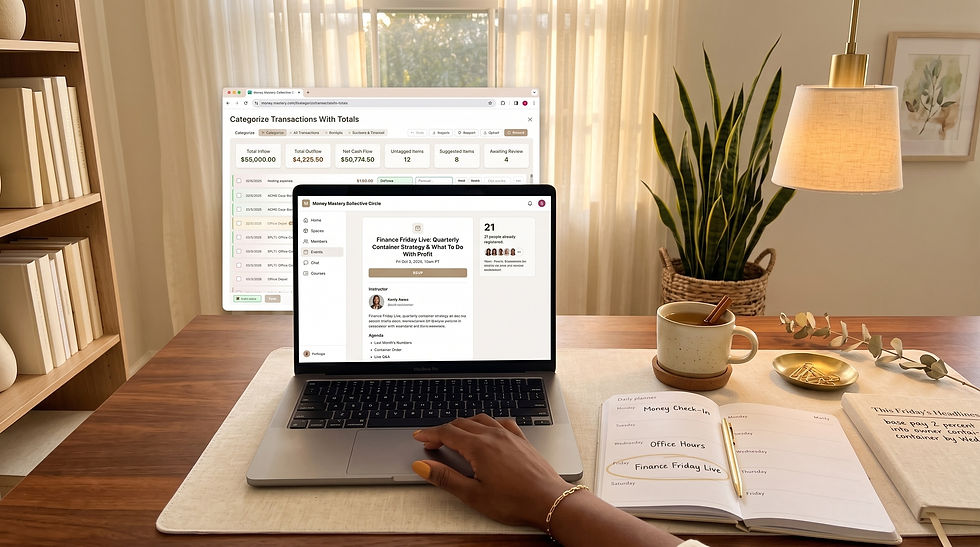
Hand on laptop in cozy home office, with monitor, planner marked Money Check-In and Finance Friday Live, mug and lamp.

A quick joy check


Ask yourself:

  • When was the last time I opened all my money files and felt calm?

  • When was the last time I answered "what did I keep last month?" in under a minute?

  • When was the last time I felt supported while reviewing my business?


If those feel rare, this is the upgrade.


What to do next

Move your first month into a Money Mastery review real dashboard this week, and step into the Collective at https://moneymasterycollective.circle.so.


FAQ


What makes this dashboard different from a spreadsheet or a budgeting app?

The biggest difference is intent. Most spreadsheets and budgeting apps were designed to record transactions or track a spending plan. The Money Mastery System dashboard was designed to give women entrepreneurs a working, decision-ready view of their business and personal money at the same time. That means the categories are relevant to how a real business runs, the monthly breakdown is easy to read, and the numbers that matter most are the ones you see first. The dashboard also lives inside the Collective, which means it is surrounded by teaching, community, and rhythm. A spreadsheet gives you cells. A budgeting app gives you a plan. The Money Mastery System dashboard gives you clarity, conte support.


Do I need to migrate every account before the dashboard is useful?

No. The dashboard is useful from the moment you have one full month of data inside it. Many women start with one business checking account and one credit card and add more later. The point is not to build a perfect data set. The point is to see your money more clearly with each passing week. As you get comfortable, you can add other accounts, refine categories, and increase the level of detail. The reason this matters is that many women delay switching systems because they think they need to overhaul everything at once. You do not. Start with one month, see what you kept, and let the value compound from there.


How do I know when the dashboard is starting to work for me?

You know it is working when three things start happening. First, you begin answering the question "what did I keep last month?" in under a minute. Second, you notice patterns from one month to the next that you never used to see, like a recurring subscription that keeps drifting up or an income stream that is quietly becoming more important. Third, you find yourself making small decisions faster and with less anxiety, because you trust the numbers you are seeing. When the dashboard is inside the Collective, a fourth signal shows up: you start bringing what you see to Finance Friday Live and the Money Reset Call, and you use the community to make the picture even sharper.

Financial software for women entrepreneurs is powerful, but on its own it only solves half the puzzle. The tool shows you the numbers. The community shows you what to do with them. Pair those two together and the entire experience of running a business changes for the better.


This is exactly why Money Mastery System is built as a system on the desk plus a room of women around it.


Woman working on a laptop showing Money Masters financial dashboard, with coffee mug and notebook on a sunlit desk.

What financial software for women entrepreneurs actually does well


Great financial software can:

  1. Bring your income and expenses into one place

  2. Show categories and monthly breakdowns

  3. Highlight what came in, what went out, and what you kept

  4. Support decisions with clean numbers

  5. Save time versus scattered spreadsheets


That is real value. But it is not the whole picture. If you want the deeper definition of what a tool like this is really solving for, What Financial Clarity Actually Means is a great next read.


What it cannot do alone


Software cannot:

  • Teach you what to prioritize this month

  • Sit with you through an emotional decision

  • Answer your specific question at 9pm on a Wednesday

  • Give you a rhythm that lasts beyond a login

  • Normalize honest money conversations with other women


Those are community jobs.


The pairing that changes everything

The Money Mastery System system does this

The Collective adds this

Holds your numbers cleanly

Holds you in real support

Shows what you kept last month

Explains what that means for your next month

Structures categories

Structures your rhythm

Provides visibility

Provides accountability

Supports individual sessions

Supports long-term change

Inside the Collective, the Money Mastery System system helps you see what you kept last month on one screen, alongside other women doing the same work. That is the whole model in one sentence.


Home office desk with laptop showing finance dashboard charts, folders, notebook, pens, and a small plant in warm daylight.

Why software feels different inside the Collective


Here is the shift you get inside the ecosystem:

Software gives you clarity. Community gives you continuity.


An uplifting story of the pairing

Picture Anna, a service business owner who has tried three different money apps. She always starts strong and then drifts. When she joins Money Mastery System + the Collective, something changes. The Money Mastery System system holds her numbers, but the Collective gives her a reason to look. She catches Finance Friday Live once a week, drops into the discussion feed a few times, and joins the Money Reset Call once a month. Within a quarter, she is not "trying a new tool." She is inside a rhythm that keeps her in relationship with her business.


The tool has finally stuck, because it is not standing alone.


Five signs your software needs a community around it


  1. You have tried tools before and drifted away

  2. You know the numbers but rarely act on them

  3. You feel unclear about which number matters most

  4. You want a place to ask specific questions

  5. You want to stop doing money alone

If two or more of those feel true, community is the missing piece.


What to do next


Choose the pairing that changes everything. Step into Money Mastery System + the Collective at https://moneymasterycollective.circle.so.


Cozy desk with laptop open to Collective Circle finance posts, surrounded by planner, notebook, coffee, and houseplants.

FAQ


Why is financial software stronger inside a community?

Software is a tool, and tools work best when they are used consistently. What most women lack is not access to a tool. It is a reliable reason to keep using it. Community provides that reason. Inside the Collective, there is a daily blog nudging you back into your numbers, a discussion feed where other women are working through similar decisions, Finance Friday Live where Donna teaches on real questions, and a monthly Money Reset Call that closes each month with intention. All of those touchpoints give the Money Mastery System system somewhere to land. Instead of being a lonely app you eventually forget about, it becomes the working tool inside a room of women doing the same work. That pairing is what makes change stick.


How is the Money Mastery System different from other financial software?

Money Mastery System is different because it was designed from the start to live inside a community, not to compete on features alone. It focuses on the numbers women actually make decisions with: what came in, what went out, what you kept, and what your monthly breakdown looks like. The interface is designed to feel calm and usable, not overwhelming. Most importantly, the tool is not sold in isolation. When you use Money Mastery System, you are stepping into the Collective, which means you have access to Donna's teaching, the community discussion feed, Finance Friday Live, and the monthly reset rhythm at higher tiers. That combination is the reason the tool actually gets used, and used with confidence.


What if I already have another accounting software?

You can absolutely keep a bookkeeping-focused tool alongside Money Mastery System. The two often serve different purposes. Formal accounting software is helpful for tax preparation, payroll, and compliance. Money Mastery System is helpful for financial clarity, decision-making, and the ongoing story of your business and personal money. Many women use their accountant-facing software for what it does best and use Money Mastery System for what they were actually missing: a working system that gives them visibility into what they kept, a rhythm for reviewing it, and a community that helps them keep going. Your accountant does not need to change anything. You are simply adding the clarity layer that most software never provides.

bottom of page