


How Much Should a Small Business Owner Save for Taxes? A Simple Formula
Updated: Sep 17
Most small business owners should set aside somewhere between 25 and 30 percent of net profit for taxes, not of revenue, and move it to a separate account the day the money lands rather than at the end of the month. That range covers federal income tax and self-employment tax for a typical owner, but your own figure depends on your profit, your state and your filing status. This guide gives you the formula, shows you how to narrow the range to your own number, and covers what to do when a quarterly deadline is close and the set-aside account is short.
The IRS does not accept "I forgot" as a payment plan.
If you have ever opened your tax return in April and felt the floor drop out, you are not alone. According to IRS data, more than 10 million taxpayers receive underpayment penalties each year, and self-employed filers are disproportionately represented in that number. The penalty is not just the tax you owe. It is the tax, plus interest, plus a separate underpayment penalty that compounds quarterly. The fix is not complicated. It is just consistent.
By the end of this post you will know the simple formula for how much to save, how quarterly estimated taxes work, where to put the money so it earns interest while it waits, and the exact habit that prevents the April panic forever.
This is educational, not tax advice. Consult a CPA or Enrolled Agent for your specific situation.

The Simple Formula: How Much to Save for Taxes Small Business Owners Should Use
Start with this baseline and adjust from there. For every dollar of net business income (revenue minus deductible expenses), set aside between 25 and 30 percent for taxes. That percentage covers three things stacked together: federal income tax, state income tax (in most states), and self-employment tax.
Here is what those three pieces actually look like for a self-employed person in 2026:
Self-employment tax is a flat 15.3 percent on net earnings up to the Social Security wage base ($176,100 in 2025, indexed slightly higher for 2026). Above that, only the Medicare portion (2.9 percent) continues. This is the part that surprises new business owners the most, because it does not exist for W-2 employees the same way (their employer pays half).
Federal income tax depends on your bracket. For most self-employed women I work with, that lands somewhere between 12 and 24 percent of taxable income after the standard or itemized deduction and the qualified business income (QBI) deduction.
State income tax varies wildly. Texas, Florida, Nevada, Washington, Tennessee, South Dakota, Wyoming, Alaska, and New Hampshire have no state income tax on earned income. California can run over 10 percent at the top. Most states fall between 4 and 7 percent.
For most people in the middle of all of this, 25 to 30 percent is the safe zone. If you are in a no-income-tax state and a lower federal bracket, you might land at 22 to 25 percent. If you are in California, New York, or another high-tax state and earning over $150,000 in net income, you might need 32 to 35 percent. When in doubt, save more. Refunds feel better than surprises.
The Set-Aside Habit That Actually Works
The formula does not matter if the money never makes it into a tax savings account. Here is the workflow that prevents every tax-time disaster I have seen in fourteen years of coaching.
The "pay yourself first into taxes" rule, adapted for variable income: the moment any client payment clears your business account, a fixed percentage moves to a separate tax savings account before anything else. Same day. Not weekly. Not monthly. Same day. The transferred money no longer exists in your operating budget.
The exact steps:
Open a dedicated high-yield savings account labeled "Taxes." Online banks (Ally, Marcus, Capital One 360, SoFi) are paying 3.5 to 4.5 percent APY as of mid-2026. Your tax money should earn money while it waits.
Pick your percentage. Start at 30 percent if you are unsure. You can always adjust downward later if your CPA confirms a lower bracket. You cannot magically conjure money you did not save.
Transfer the percentage the same day income clears. A $5,000 invoice at 30 percent means $1,500 moves immediately. Treat this like a non-negotiable bill, because the IRS treats it that way too.
Do not touch it. Ever. For any reason. This is not your savings account, your emergency fund, or your slush fund. It is the government's money you happen to be holding.
Make your quarterly estimated payments from this account. Four times a year (more on the dates below).
Reconcile in January. After your CPA calculates your actual tax bill, anything left in the account is yours to redirect to other goals. Anything short is what you would have owed in penalties anyway.
Most clients I work with who use this system get a small refund in April instead of a tax bill. Some get a meaningful refund. None get a surprise. That is the entire point.
If you have never separated business and personal income, none of this works until you do. The post on how to separate business and personal finances walks through the setup, and it is the prerequisite to any tax savings system.
Quarterly Estimated Taxes: What You Actually Owe and When
The IRS expects self-employed people to pay tax as they earn it, not all at once in April. They do this through quarterly estimated payments. Miss them, and you owe an underpayment penalty even if you pay in full by April 15.
The 2026 quarterly estimated tax deadlines (subject to IRS confirmation, this is educational not tax advice):
Quarter | Income Period | Payment Due |
Q1 | January 1 to March 31 | April 15, 2026 |
Q2 | April 1 to May 31 | June 15, 2026 |
Q3 | June 1 to August 31 | September 15, 2026 |
Q4 | September 1 to December 31 | January 15, 2027 |
A few things to notice. The income periods are not equal quarters. Q2 is only two months and Q3 is three months, which trips up a lot of business owners. The payments are due on the 15th of the month following the period (with some shifts for weekends and holidays). And the final payment is due in January of the following year, not April with your return.
How to calculate what you owe each quarter:
Take your year-to-date net business income, multiply by your tax percentage (25 to 30 percent), and subtract what you have already paid in estimated taxes for the year. The result is what you owe this quarter. If your income is steady, this is roughly one-quarter of your annual estimate. If your income is variable, your payments will be variable too.
Pay through the IRS Direct Pay portal at IRS.gov or through EFTPS (Electronic Federal Tax Payment System). Both are free. Both give you a confirmation number. Save the confirmation. Your CPA will need it.
For state estimated taxes, check your state's Department of Revenue site. Most states with income tax follow the federal quarterly schedule, but the payment portal is separate.
Where Tax Set-Aside Fits Into Your Bigger Money System
Tax savings is one of three pots every self-employed business owner should be funding from gross revenue. The other two are your operating expenses and your personal owner's pay. When all three are running on autopilot, your business stops feeling like a guessing game.
The order matters: taxes set aside first, then your personal pay, then operating expenses for the business. If you flip the order and pay expenses first, you will always find a reason the tax savings can wait. They cannot. The post on how to pay yourself as a business owner covers the owner's pay piece in depth.
Want a head start on the whole picture? Download the free Money Mastery Net Worth Tracker at https://moneymastery-system.com/free. It puts your personal and business accounts side by side across sixty account types and twelve tabs, and it stays yours.

How Money Mastery Handles Your Tax Set-Aside
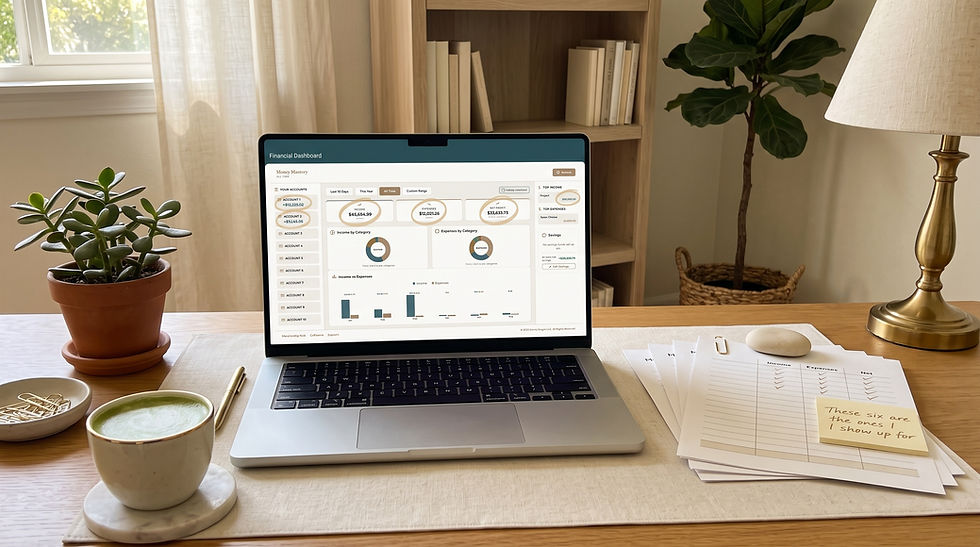
Inside Money Mastery, your tax savings lives in the Savings Funds section alongside your emergency fund, your owner's pay reserves, and any other goals. You set the yearly target, log your current balance, and the system shows you how much you need to be contributing each month to hit it. The Savings Sponge Tracker logs your monthly ending balance so you can watch the account fill without cluttering your transaction sheets. You can see the full system at moneymastery-system.com, and it pairs with your P&L so you always know whether your set-aside percentage is matching your actual tax exposure.
Common Mistakes to Avoid
These are the four mistakes I see again and again. None of them are character flaws. They are system gaps.
Saving from your personal account instead of your business account. If your tax savings is mixed with your grocery money, it will get spent on groceries. Separate account. Always.
Saving the wrong percentage based on revenue, not net income. Your tax obligation is on profit, not revenue. If you bring in $200,000 and have $80,000 in legitimate deductible business expenses, your taxable income is $120,000, not $200,000. Save your percentage on net income, or you will over-save (which is recoverable) or under-save (which is not).
Skipping a quarter "just this once." The penalty for skipping is small per quarter, but it compounds. And once you skip once, the pattern is set. Make every payment. The discipline is the system.
Forgetting to account for big one-time income. A surprise large invoice, a contract that closed, a year-end bonus from a client. Save your percentage on the same day, before that money feels like spending money.

Why Knowing Your Net Worth Changes the Tax Conversation
Here is something most business owners do not realize until they have been at this for a few years. Your tax bill is one piece of a much bigger financial picture. The reason a 30 percent tax set-aside feels painful is usually not the percentage itself. It is that you do not have visibility into your full financial position. When you can see your assets, liabilities, business equity, and savings progress in one view, taxes stop feeling like a punishment and start feeling like the cost of doing well.
If you have never calculated your full net worth as a self-employed business owner, that is the first piece I would put in place alongside your tax savings system. Visit moneymastery-system.com/free to download the free Net Worth Template, which gives you a one-page view of where you actually stand. There is also a special welcome discount on the full Money Mastery system for first-time visitors.
Your Next Step
How much to save for taxes small business owners need to set aside is not a question you answer once. It is a habit you build, starting with the next invoice that clears. Open the separate account this week. Pick 30 percent as your starting percentage. Move the first transfer the same day income arrives. Then repeat for every payment, every month, every quarter.
Get the free Net Worth Tracker here: https://moneymastery-system.com/free
What to Do When a Quarterly Deadline Is Close and You Are Short
Estimated tax payments are due four times a year, and the third-quarter deadline for the 2026 tax year is September 15, 2026. If you are reading this with days to go and the set-aside account does not cover it, there is a right order of operations.
First, pay something rather than nothing. The penalty for underpaying is calculated on the shortfall and the time it stays unpaid, so a partial payment on time costs meaningfully less than a full payment late. There is no cliff you fall off by being short; there is a meter that runs.
Second, work out what you actually owe rather than what you fear you owe. Take net profit for the quarter, apply your set-aside percentage, and subtract anything already paid. Owners routinely overestimate this number and delay because the imagined figure is frightening, which is the most expensive way to handle it.
Third, fix the mechanism, not just this quarter. Almost every shortfall traces back to the same cause: the money was never separated, so it got spent while it was still sitting in the main account looking available. A separate account and a transfer on the day income arrives removes the decision entirely.
One thing worth saying plainly: this is general information, not tax advice for your situation. The percentage that is right for you depends on facts a blog post cannot see. If your profit changed a lot this year, an hour with an accountant before the deadline is worth considerably more than the hour costs.
Frequently Asked Questions
How much should a small business owner save for taxes?
How much to save for taxes small business owners need is generally 25 to 30 percent of net business income, set aside in a separate savings account the same day revenue clears. The percentage covers federal income tax, state income tax (in most states), and self-employment tax of 15.3 percent. Higher earners in high-tax states may need closer to 32 to 35 percent. When uncertain, save more. A refund is recoverable, an underpayment penalty is not.
What is the 30 percent rule for self-employment taxes?
The 30 percent rule is a general guideline that suggests setting aside 30 percent of every dollar of net business income for taxes. It assumes a moderate federal tax bracket, a moderate state tax rate, and the full 15.3 percent self-employment tax. The rule is intentionally conservative so you over-save rather than under-save. Your actual rate depends on your bracket, your state, and your deductions, but 30 percent is a safe starting point for most self-employed business owners.
Do I need to pay quarterly estimated taxes?
Yes, if you expect to owe at least $1,000 in federal tax for the year after withholding, the IRS expects quarterly estimated payments. Payments are due in April, June, September, and January of the following year. Missing a quarter triggers an underpayment penalty even if you pay in full by April 15. Most self-employed business owners need to pay quarterly. Confirm with a CPA based on your specific situation.
Where should I keep my tax savings money?
Keep tax savings in a dedicated high-yield savings account at an online bank, completely separate from your operating and personal accounts. As of mid-2026, top accounts pay 3.5 to 4.5 percent APY and are FDIC-insured up to $250,000. Money Mastery's Savings Funds section helps you track this set-aside alongside your other goals so you can see exactly how much you have saved against what you will owe.
What happens if I don't save enough for taxes?
You owe the difference at filing, plus an underpayment penalty if quarterly payments were short, plus interest on what you owe until it is paid. The penalty rate is set quarterly by the IRS and was running roughly 8 percent annualized in recent years. If you cannot pay in full at filing, the IRS offers installment agreements, but penalties and interest continue accruing. The cheapest tax bill is the one you saved for in advance.
What percentage should I save for taxes as a small business owner?
A common starting point is 25 to 30 percent of net profit, which is revenue minus business expenses, not revenue itself. Lower profits and a low-tax state can put you under that range; higher profits, a high-tax state or additional income can push you over it. Treat the range as a default to refine, not a final answer.
When are quarterly estimated taxes due in 2026?
Estimated tax payments are due four times a year, and for the 2026 tax year the third-quarter payment is due September 15, 2026. If a due date falls on a weekend or a public holiday it moves to the next business day, and the IRS publishes the current dates on its estimated tax page.
If you would like to talk it through with someone, Donna Roggio is a business coach with fifteen years of experience helping women sort this out, and a first call with her is free.


Comments