top of page

Debt

Smiling woman at a wooden desk writes in a yellow notepad beside a mug, phone, and papers in a cozy home office.

Let me start by taking something off your shoulders. Business debt is not a moral failing. It does not mean you are bad with money or that you built the wrong business. Debt is a tool, and like any tool it can be used well or poorly, but carrying it does not make you a failure. So many women carry a quiet shame about debt that makes them either avoid looking at it entirely or attack it so aggressively that they starve the very business that is supposed to pay it off. Neither extreme works. What works is a plan.


Here is the mistake the panic approach makes. When debt feels frightening, the instinct is to throw every spare dollar at it, skipping your own pay, draining your cushion, cutting the things that actually generate income. That can feel virtuous, but it often weakens your business right when it needs to be strong, and a weak business struggles to pay off anything. Learning how to pay off business debt strategically means shrinking what you owe steadily while keeping your business healthy enough to keep earning. Let me walk you through it.


Step 1: Get the Full Picture Out of the Shadows

The first step is the one avoidance makes hardest: look at all of it, clearly, without flinching. You cannot make a plan for a number you refuse to see. Debt kept vague and scary in the back of your mind always feels worse than debt written plainly on a page.


List every debt: who you owe, the total balance, the interest rate, and the minimum payment. Line them up side by side. This single act often brings enormous relief, because the monster in the dark turns out to be a set of specific, manageable numbers. And it gives you the information the whole plan depends on, especially those interest rates, which tell you where your debt is quietly growing fastest. If you'd like a clean template to lay it all out, the free Money Mastery Net Worth Tracker gives you a simple structure to capture every debt in one place.


Step 2: Protect the Business First, Then Attack the Debt

This is the step that separates a strategic payoff from a panicked one. Before you send extra money to debt, make sure your business can keep running and earning. That means you still pay yourself something, you still cover your essential costs, and you still set aside your taxes. A business that stops paying its owner or skips its taxes to kill debt faster usually just creates a new emergency.


Decide on a sustainable amount you can put toward debt beyond the minimums, an amount that shrinks what you owe meaningfully without hollowing out your business. Slower and steady beats fast and fragile every time, because the goal is not to be debt-free next month at the cost of your business, it is to be debt-free while still standing strong.


Step 3: Choose Your Payoff Order Deliberately

Once you have your extra payoff amount, you need to decide where it goes first, because spreading it thinly across everything is the slowest path. There are two proven approaches, and both work, so choose the one that fits how you are wired.


The first is to target the highest interest rate debt first while paying minimums on the rest, which saves you the most money over time because it stops the fastest-growing debt from growing. The second is to target the smallest balance first, regardless of rate, which gives you a quick, motivating win and builds momentum. Whichever you choose, put all your extra money on that one debt until it is gone, then roll everything you were paying on it onto the next. This rolling focus is what makes debt fall far faster than scattered payments ever could.


Step 4: Stop the Debt From Growing Back

There is little point in paying off debt if new debt quietly takes its place, so part of any real plan is addressing why the debt appeared. Sometimes it was a deliberate, healthy investment in growth, and that is fine. But sometimes it is a sign of a gap, expenses outrunning income, no cushion for surprises, prices set too low to actually pay the business.


While you pay down what you owe, look honestly at the cause. If your prices do not cover your true costs, debt will keep filling the gap no matter how fast you pay. If a lack of any buffer means every surprise goes on a card, building even a small reserve alongside your payoff prevents the next round. Paying off debt and fixing its source at the same time is how you get free and stay free.


How to Pay Off Business Debt Strategically: A Real Example
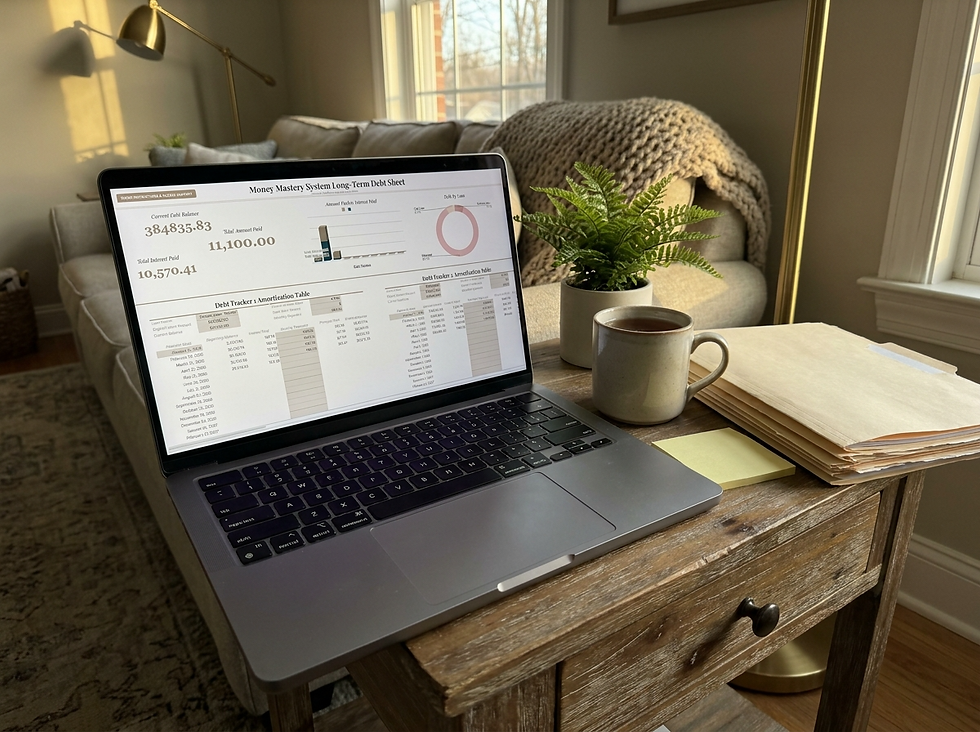
Laptop showing a debt tracker spreadsheet on a cozy living room side table, with coffee mug, plant, folders, and sticky note.

Let me put this into numbers so the plan feels real.


Say you have three business debts: a $1,000 balance at 22 percent interest, a $3,000 balance at 12 percent, and a $500 balance at 8 percent. In a panic, you might drain your cushion and skip your own pay to throw $2,000 at them this month, leaving your business gasping. Instead, you make a plan. After paying yourself a modest amount, covering essentials, and setting aside taxes, you find you can sustainably put $400 a month toward debt beyond the minimums.


You choose the highest-interest-first approach, so all $400 extra goes to the $1,000 debt at 22 percent while you pay minimums on the others. In about three months, that debt is gone, and it was the one growing fastest. Now you roll that entire $400, plus the minimum you were already paying on it, onto the $3,000 debt. Because you are now hitting it with a larger combined payment, it falls much faster than it would have. Then you roll everything onto the last debt and finish it off. Throughout, your business kept running, you kept getting paid, and your taxes stayed covered. You got free without going fragile, and that is the whole point.


A plan like this is far easier to stick to with support and encouragement, which is exactly what the Money Mastery community offers. If you would like help building a payoff plan that fits your real numbers, you can schedule a call with a coach who has 20 years of business coaching experience and map it out together.


Laptop on desk shows Money Mastery System Credit Card Debt Center, beside coffee, books, family photo, plant, and lamp.

To see how your debt fits into your whole financial picture as it shrinks, the free Money Mastery net worth tool shows you the full view, and watching your debt drop against your growing assets is one of the most motivating things you will do.


Debt handled in a panic can quietly wound your business. Debt handled with a plan becomes just another number you steadily shrink while your business keeps growing right alongside. You are not behind, and you are not stuck. You simply need a clear plan and a little support, and both are within reach. If you want help finding where to start, the upcoming Money Clarity Assessment can show you your smartest first move.

About Donna Roggio

Donna Roggio is the founder of the Money Mastery system and has spent 20 years helping women build real financial clarity and confidence in their businesses. She created Money Mastery to give women a supportive community and a simple, learnable way to understand their money, without shame, jargon, or overwhelm. Donna believes every woman can learn to run her numbers with confidence, and she is here to help you do exactly that.

Frequently Asked Questions

How do I pay off business debt strategically?

Start by listing every debt with its balance, interest rate, and minimum payment. Protect your business first by still paying yourself, covering essentials, and setting aside taxes. Then put a sustainable extra amount toward one debt at a time, and address the reason the debt appeared so it does not grow back.


Should I pay off my highest interest debt or smallest balance first?

Both work. Highest interest first saves you the most money over time. Smallest balance first gives you a quick, motivating win. Choose the one that best matches how you stay motivated, and put all your extra payment on that one debt until it is gone.


Should I stop paying myself to pay off business debt faster?

Generally no. Starving your business or skipping your own pay to kill debt quickly often creates a new emergency. A steady, sustainable payoff that keeps your business healthy usually works better than an aggressive one that weakens it.


How do I stop business debt from coming back?

Address the cause while you pay it down. If prices are too low to cover your true costs, or a lack of any buffer sends every surprise onto a card, fixing those gaps prevents the next round of debt. The free Money Mastery Net Worth Tracker helps you find and close those gaps.


Americans owe $1.69 trillion in auto loan debt as of the first quarter of 2026, according to the Federal Reserve Bank of New York, with the average new auto loan origination climbing to $33,519 by the end of 2025 according to LendingTree.


A car loan is one of the most satisfying debts to kill early, because a car is a depreciating asset you'd rather own outright than keep paying interest on. The catch is that paying early done carelessly can either waste your extra money or, on a few loans, trigger a penalty that eats the savings you were chasing.


Paying off a car loan early is only a win when your extra dollars actually reach the principal and no penalty claws them back. Otherwise you're just paying ahead for nothing.


By the end of this guide, you'll know how to check your loan for a prepayment penalty, how to make sure extra payments reduce your principal instead of just prepaying next month, why timing your extra payments early matters most, and what a real dollar example of the savings looks like.


Woman in a sunlit home office checks a laptop dashboard beside coffee, keys, a plant, and papers.

Check for a Prepayment Penalty Before You Pay Off a Car Loan Early

Before you send a dollar extra, read your loan agreement or call the lender and ask one direct question: is there a prepayment penalty? Some auto loans, particularly certain subprime or dealer-financed loans, charge a fee for paying off early or use a "precomputed interest" structure where the interest was baked in up front, so paying early saves you less than expected. Most standard auto loans use simple interest and have no penalty. But you must confirm which you have, because the answer changes your whole strategy. If there's a penalty, calculate whether your interest savings still exceed it before proceeding.


Simple Interest vs. Precomputed Interest

On a simple-interest loan (the common type), interest accrues daily on your remaining balance, so every extra dollar of principal you pay immediately reduces future interest. This is the ideal case for early payoff: the sooner you knock down principal, the less interest you'll ever pay. On a precomputed-interest loan, the total interest was calculated at the start and folded into the balance, so paying early may not save the interest you'd expect, and a rebate formula decides what you get back. Knowing which type you hold tells you exactly how much early payoff is worth.


Make Sure Extra Payments Actually Help You Pay Off a Car Loan Early

This is where good intentions leak away. When you send extra money, many lenders default to applying it as an early payment toward your next due date rather than reducing your principal balance. That advances your due date but saves you almost no interest. The fix is to explicitly instruct the lender (in the payment memo, the online payment option, or a quick call) to apply any extra amount to principal only. Then verify on your next statement that your principal actually dropped. This single instruction is the difference between shrinking the loan and just paying it ahead.


Woman in a cozy home office reads a bill beside a laptop showing financial charts, with coffee and folders on the desk.

A Real Dollar Example: What It Costs to Pay Off a Car Loan Early

Say you have a $33,000 car loan at 7% over six years, with a payment near $562. Left alone, you'd pay several thousand dollars in interest. Now add $150 a month to principal starting in year one. Because interest accrues on your balance, that extra principal early on erases future interest across the whole remaining term: you could finish roughly a year and a half early and save well over a thousand dollars in interest. The same $150 added in the final year would save only a little, because most of the interest has already been paid. Early extra payments, applied to principal, are where the real money is.


Want to see exactly how much an extra payment saves on your specific car loan and when to make it? Download the free Money Mastery Net Worth Tracker and map your payoff while this is fresh.


Time Your Extra Payments Early for the Biggest Savings

Because auto loans front-load interest just like other amortizing loans, the earlier you make extra principal payments, the more interest you destroy, a pattern you can see plainly in an amortization schedule. A lump sum or higher payments in the first year or two do far more than the same money added near the end. If you come into extra cash (a tax refund, a bonus), sending it to a young car loan's principal is one of the highest-return moves available, guaranteed at your loan's interest rate.


Common Mistakes When You Pay Off a Car Loan Early

The first mistake is paying extra without checking for a prepayment penalty. The fix is to confirm your terms before sending a dollar extra.


The second mistake is sending extra money that the lender applies to your next payment. The fix is to specify "apply to principal" and verify it on your statement.

The third mistake is waiting until the end of the loan to pay extra. The fix is to send extra early, when interest savings are largest, as an amortization schedule shows.


The fourth mistake is draining your emergency fund to pay off the car. The fix is to keep a starter cushion first, then attack the loan.


How Money Mastery Helps You Pay Off a Car Loan Early

Deciding how aggressively to pay off a car loan means seeing it against your whole picture: your cash flow, your other debts, your cushion, not in isolation. Money Mastery brings your personal and business finances into one connected view, so you can see where extra principal payments fit without starving other priorities. QuickBooks and Mint record what your loan did last month, one account at a time. Money Mastery helps you understand what's happening across everything right now, so paying off the car early is a confident, informed decision rather than a hopeful one. The tone is grounded and non-judgmental: no lectures, just clarity on what each extra dollar actually buys you.


Google Sheets budget tracker titled Personal Money Master 2026, showing January 2026 balances and expense rows for bills.

Your Next Step

This week, call your auto lender and ask two questions: is there a prepayment penalty, and how do I ensure extra payments go to principal? Then, if the answers are clear, send one extra principal payment and confirm your balance dropped on the next statement. Get your free Net Worth Tracker and plan your early car payoff in 15 minutes: Download the Net Worth Tracker


Frequently Asked Questions About Paying Off a Car Loan Early


Is There a Penalty When You Pay Off a Car Loan Early?

Sometimes. Most standard simple-interest auto loans have no prepayment penalty, but some subprime or dealer-financed loans charge a fee or use precomputed interest that reduces your savings. Always read your loan agreement or call the lender to confirm before making extra payments.


How Do I Make Sure My Extra Payment Reduces the Balance?

Instruct your lender explicitly to apply the extra amount to principal, not to your next scheduled payment. You can usually do this through an online payment option, a memo, or a quick call, then verify on your next statement that your principal balance actually dropped.


When Is the Best Time to Pay Extra on a Car Loan?

As early as possible. Auto loans front-load interest, so extra principal payments in the first year or two erase the most future interest. The same extra money added near the end of the loan saves very little because most interest has already been paid.


Should I Pay Off My Car Loan Early or Save the Money?

Keep a starter emergency cushion first, then weigh your loan's rate against other uses. Paying off a car loan gives you a guaranteed return equal to its interest rate, which is often attractive, but don't drain your safety net to do it.


What Is Precomputed Interest on a Car Loan?

It's a structure where the total interest is calculated up front and built into your balance, rather than accruing daily on the remaining balance. On precomputed loans, paying early may save less than expected because a rebate formula, not daily accrual, determines your savings.


As of the first quarter of 2026, total U.S. credit card debt has climbed to $1.25 trillion, according to Forbes Advisor. A remarkable share of it stays outstanding for years because of one quietly destructive habit: paying only the minimum. The minimum payment exists for the issuer's benefit, not yours. It's the amount engineered to keep your account in good standing while ensuring you stay a paying customer for as long as mathematically possible. Understanding how the minimum payment trap works is the first step to disarming it.


The minimum payment is not a plan to get out of debt. It's a plan to stay in it comfortably, and the discomfort is exactly what would have saved you.

By the end of this guide, you'll understand how the shrinking minimum is designed to work against you, why it feels like responsible money management, what it costs on a real mid-size balance, and the one adjustment (costing you nothing extra in the first month) that collapses the payoff timeline.


Hand using laptop with debt spreadsheet titled Money Mastery System Long-Term Debt Sheet on a home desk beside a mug and notebook

Why the Minimum Payment Trap Is Built to Shrink

Most issuers calculate your minimum as a small percentage of your balance, often 1% to 3%, plus that month's interest and any fees. The consequence is subtle but powerful: as your balance falls, the required minimum falls too. Every month you pay it, next month's minimum is a little smaller, which stretches the payoff timeline out toward the horizon. A payment that gets easier as you go feels like progress, but it's the mechanism that keeps you paying for decades. The declining minimum is the entire trap in one sentence.


Why the Minimum Payment Trap Feels Responsible

Paying the minimum on time keeps your account current, avoids late fees, and protects your credit score, so it genuinely registers as doing the right thing. That's what makes the trap so effective: it hides inside a good habit. But "current" and "making progress" are entirely different states. When nearly all of a payment goes to interest, the principal barely moves, and you can pay faithfully month after month while the balance drifts down by inches. The feeling of responsibility is real. The progress is mostly an illusion.


A Real Dollar Example of the Minimum Payment Trap

Say you're carrying $4,000 on a card at a 22% APR. Following a 2% minimum that starts around $80 and shrinks as the balance falls, that $4,000 takes well over 20 years to clear, and you pay several thousand dollars in interest along the way, often more in interest than the original balance itself. Now change exactly one thing: instead of following the minimum down, you fix your payment at that first $80 every single month and never let it drop. The payoff collapses to roughly six years, and you save thousands in interest. The money you put in during month one is identical. The outcome is a completely different life.


Want to run this exact math on your own balance and APR instead of a hypothetical one? Download the free Money Mastery Net Worth Tracker and see your real payoff timeline while this is fresh.


The Fix: Escape the Minimum Payment Trap by Freezing Your Payment

The escape is disarmingly simple: stop letting your payment shrink. Take the minimum as it stands today, and pay that same fixed dollar amount every month even as the balance falls. Because your payment no longer decreases, a steadily larger share of it attacks the principal instead of interest, and the balance falls faster and faster, the exact opposite of the trap. Layering a payoff order on top, like paying your balances in the right order, accelerates it further, but the fixed payment alone does most of the work.


Laptop on desk shows Money Mastery System credit card debt dashboard beside coffee, books, family photo, plant, and lamp.

Stop Feeding the Balance While You Pay

A fixed payment only works if you're not refilling the balance with new charges. Every new purchase on the card you're paying down resets a piece of your progress and keeps the interest engine running. The cleanest approach is to pause new spending on that card entirely until it's cleared, using a different method for everyday purchases, or better yet, taking advantage of your card's grace period only on a card you pay in full. Payoff and new spending on the same card are a treadmill.


Common Mistakes That Deepen the Minimum Payment Trap

The first mistake is treating the minimum as the expected payment. The fix is to rename it what it is (the least you can pay without penalty) and always pay above it.


The second mistake is letting the payment shrink with the balance. The fix is to lock it at today's minimum and keep it there.


The third mistake is making new charges on the card you're paying off. The fix is to pause spending on it until the balance is gone.


The fourth mistake is not knowing your APR, which keeps the cost abstract. The fix is to read it off your statement once so the number becomes real.


How Money Mastery Helps You Escape the Minimum Payment Trap

The minimum payment trap thrives because a single balance never looks urgent on its own: it's one manageable line on one statement, next to everything else. Money Mastery brings your personal and business finances into one connected view, so a carried balance stops being background noise and becomes a number you can see against your income and your goals. QuickBooks and Mint record what a card did last month, one account at a time. Money Mastery helps you understand what that balance is costing you right now, across every account, so the decision to freeze your payment finally has the context it needs. The tone is grounded and non-judgmental: not guilt over the balance, but a system that quietly clears it.


Laptop shows Money Mastery System long-term debt sheet beside a coffee mug, plant, and folders in a cozy sunlit living room.

Your Next Step

This week, pull up your highest-interest card, note today's minimum, and set an automatic payment at that exact amount that never decreases. That one change, made once, does more than years of faithfully paying whatever shrinking figure the statement asks for. Get your free Net Worth Tracker and lock in a fixed-payment payoff plan in 15 minutes: Download the Net Worth Tracker


Frequently Asked Questions About the Minimum Payment Trap


What Is the Minimum Payment Trap?

It's the cycle created by paying only the minimum each month. Because the minimum is a small percentage of your balance plus interest, most of it covers interest, the balance barely falls, and the payoff stretches over decades while you pay far more than you originally borrowed.


Why Does the Minimum Payment Get Smaller Over Time?

Because it's usually calculated as a percentage of your current balance. As the balance drops, the required minimum drops too, which continually extends your payoff timeline. Freezing your payment at today's amount is what stops this from working against you.


Does Paying Only the Minimum Hurt My Credit Score?

Paying the minimum on time keeps your account current and avoids late-payment marks, so it doesn't damage your score the way a missed payment would. The harm is financial: the interest you pay over years, plus the high utilization a large balance can cause.


What's the Fastest Way to Escape the Trap?

Fix your payment at the current minimum and never let it shrink, so more of each payment hits the principal as interest falls. Pausing new charges on the card and adding any extra amount speeds the payoff up further.


How Much Can a Fixed Payment Really Save?

On a mid-size balance at a typical APR, freezing the payment instead of following the shrinking minimum can cut a 20-plus-year payoff to around six years and save thousands in interest, using the same dollar amount you pay in the very first month.


bottom of page