


Invoice Clients to Get Paid Faster and Chase Less
Updated: Sep 17
About 67.5% of freelancers dealt with late payments in 2025, and 81.2% said it was a source of stress, according to IOUmarker's research. This makes late payment not a rare misfortune but the default freelance experience. The frustrating part is that a large share of late payments aren't about clients being unable to pay. They're about invoices that were vague, slow to arrive, or easy to deprioritize. Fix the invoice, and you fix most of the chasing.
A good invoice isn't paperwork you send after the work; it's a cash-flow tool designed to get you paid quickly and give you nothing to chase.
By the end of this guide, you'll know how to structure an invoice so it gets paid without friction, how to set payment terms that actually get honored, how to make paying you effortless, and a calm follow-up sequence that collects late invoices without damaging the relationship. No collections agency required, just a few deliberate habits.

Send Invoices Immediately: How to Invoice Clients to Get Paid Faster
The first rule is speed: send the invoice the moment the work is done (or on a set schedule for ongoing work) because an invoice that arrives days late signals that the payment isn't urgent to you either. The second rule is precision. A payment-ready invoice has a clear invoice number, the date, an itemized description of what was delivered, the exact amount due, the due date spelled out as a real date, and your payment details. Vague invoices sit in inboxes. Specific ones get processed. Every ambiguity is a reason for a client's accounts-payable team to set it aside.
Set Payment Terms That Get Honored
"Due upon receipt" sounds strong but is often ignored; a specific date gets results. State terms as "Payment due by [exact date]," typically net-14 or net-7 rather than the default net-30, since shorter terms simply get paid sooner. Put your terms in the original contract, not just the invoice, so there are no surprises. For larger projects, structure the payments: a deposit up front, a milestone payment partway, and the balance on completion. This protects your cash flow throughout and dramatically reduces the amount you're ever waiting on at once.
Make Paying You Effortless
Every extra step between the client and paying you is a chance for the payment to stall. Offer the payment methods your clients actually use (bank transfer, card, or an online payment link right in the invoice) so paying takes one click, not a trip to write a check. If a client has to log into a portal, find their checkbook, or ask you how to pay, the invoice slides down their to-do list. The easier you make it, the faster the money arrives. A "Pay Now" link often shaves days off collection all by itself.

A Real Dollar Example: What It Looks Like to Invoice Clients to Get Paid Faster
Say a freelancer typically invoices net-30 with "due upon receipt," sends invoices a few days after finishing, and offers only bank transfer with no link. Her average collection time is 38 days, and she's usually owed about $5,000 across late invoices at any moment. She changes three things: she sends every invoice the day work is done, switches to net-14 with an exact due date, and adds a one-click payment link. Her average collection time drops to 16 days, and the money she's typically owed falls to under $2,000. That's roughly $3,000 in cash flow pulled back into her account (money she'd already earned but wasn't holding) purely from how she invoices.
Want invoice templates with proven terms and a simple follow-up schedule built in? Download the free Money Mastery Net Worth Tracker and upgrade your invoicing while this is fresh.
Follow Up Without Feeling Like a Nag
When an invoice does go late, a calm, systematic follow-up collects far better than an anxious silence followed by a frustrated email. Use a simple sequence: a friendly reminder a day or two before the due date, a polite "just checking in" the day after it's missed, and a firmer but professional note a week later that references your late-payment terms. Keep every message short, warm, and matter-of-fact: you're not begging, you're running a business. A late-payment fee stated in your original terms gives these reminders real teeth without you having to raise your voice, and it's exactly the kind of protection that helps you survive a slow freelance month without going into debt.
Common Mistakes When You Invoice Clients to Get Paid Faster
The first mistake is sending invoices days after the work is done. The fix is to invoice immediately, while the value you delivered is fresh in the client's mind.
The second mistake is vague, un-itemized invoices. The fix is a clear invoice number, itemized work, exact amount, and a real due date.
The third mistake is defaulting to net-30 with no late fee. The fix is shorter terms like net-14 and a stated late-payment fee in your contract.
The fourth mistake is avoiding follow-up out of awkwardness. The fix is a calm, scheduled reminder sequence that treats collecting as routine business.
How Money Mastery Helps You Invoice Clients to Get Paid Faster
Invoicing well is really about cash flow: knowing what you're owed, what's overdue, and how it connects to the money you actually have to live and operate on. When invoices, income, and expenses live in separate places, it's easy to lose track of who owes you and to be blindsided by a thin week. Money Mastery brings your personal and business finances into one connected view, so outstanding invoices show up against your real cash position and you can see instantly when a late payment is creating a gap. QuickBooks and Mint record what happened, one account at a time. Money Mastery helps you understand what's happening right now, across every account, so your invoicing feeds a clear picture instead of a guess. The tone is grounded and non-judgmental: no shame about past late payments, just a system that gets you paid sooner.
Your Next Step
This week, upgrade your invoice template: add an invoice number, itemized work, an exact due date on net-14 terms, a one-click payment link, and a stated late fee. Then commit to sending every invoice the day the work is finished, and set two calendar reminders for polite follow-ups. Get your free Net Worth Tracker and get paid faster in 15 minutes: Download the Net Worth Tracker
Frequently Asked Questions About Invoicing Clients to Get Paid Faster
How Can I Invoice Clients to Get Paid Faster?
Send invoices immediately when work is done, use short terms like net-14 with an exact due date, and make paying effortless with a one-click payment link. Vague, slow, or hard-to-pay invoices get deprioritized; clear, prompt, easy ones get paid quickly.
What Should a Freelance Invoice Include?
A unique invoice number, the date, an itemized description of the work delivered, the exact amount due, a real due date, your accepted payment methods, and ideally a payment link. Precision removes the ambiguities that cause a client's accounts-payable team to set an invoice aside.
What Payment Terms Should Freelancers Use?
Net-14 or even net-7 rather than the default net-30, stated as an exact date, and included in the original contract, not just the invoice. For larger projects, split payments into a deposit, a milestone payment, and a final balance to protect cash flow throughout.
How Do I Follow Up on a Late Invoice Politely?
Use a calm, scheduled sequence: a friendly reminder just before the due date, a polite check-in the day after it's missed, and a firmer professional note a week later referencing your terms. Keep messages short and matter-of-fact: you're running a business, not asking a favor.
Should I Charge a Late Fee?
Yes, if you state it clearly in your original contract and on your invoices. A reasonable late-payment fee gives your reminders real weight and nudges clients to prioritize your invoice, without you having to become confrontational. It's a standard, professional business practice.
Image prompts:
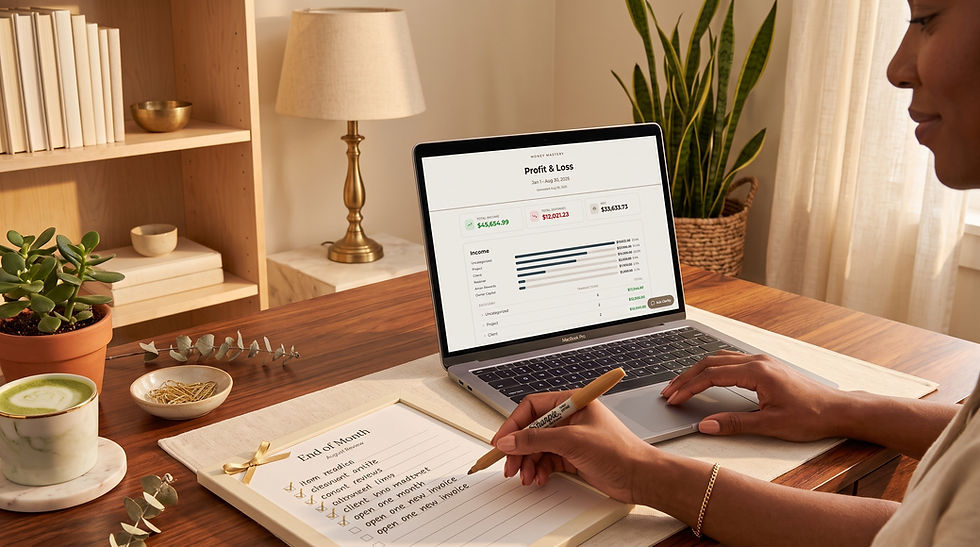
IMAGE 1 (HERO, 16:9): A freelancer in his early 30s sits at a bright home desk finalizing a clean, professional invoice on a laptop, calm and businesslike, a coffee mug and tidy notepad beside him, warm daylight through a nearby window. Photorealistic, no text overlay, no watermark.
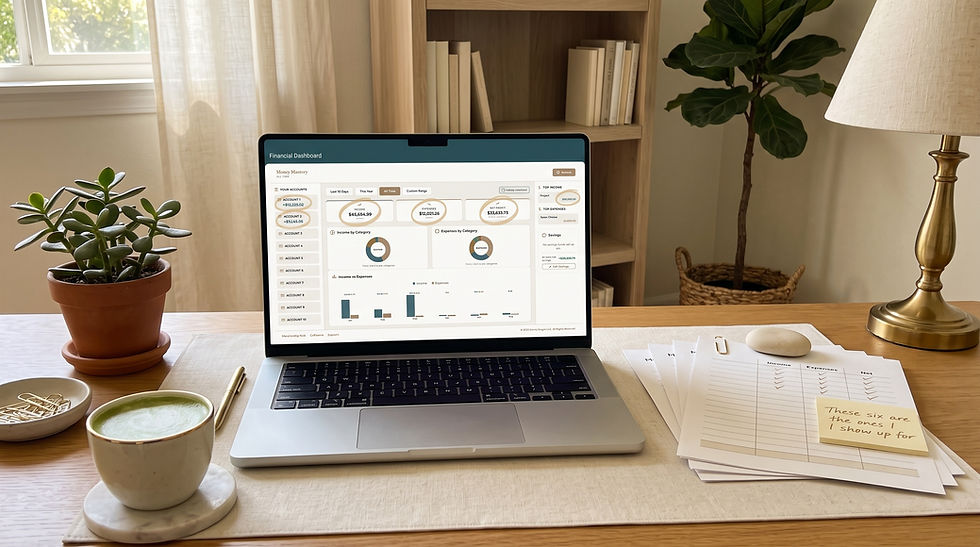
IMAGE 2 (MID-POST PRODUCT SHOT, 4:3): Close-up of hands on a laptop keyboard, screen clearly showing the Money Mastery dashboard with an "Outstanding Invoices" panel, a client's balance dropping from $5,000 to under $2,000, and a collection-time counter, phone and pen resting nearby, warm daylight across the desk. Photorealistic, dashboard should read as a real product screen, no watermark.
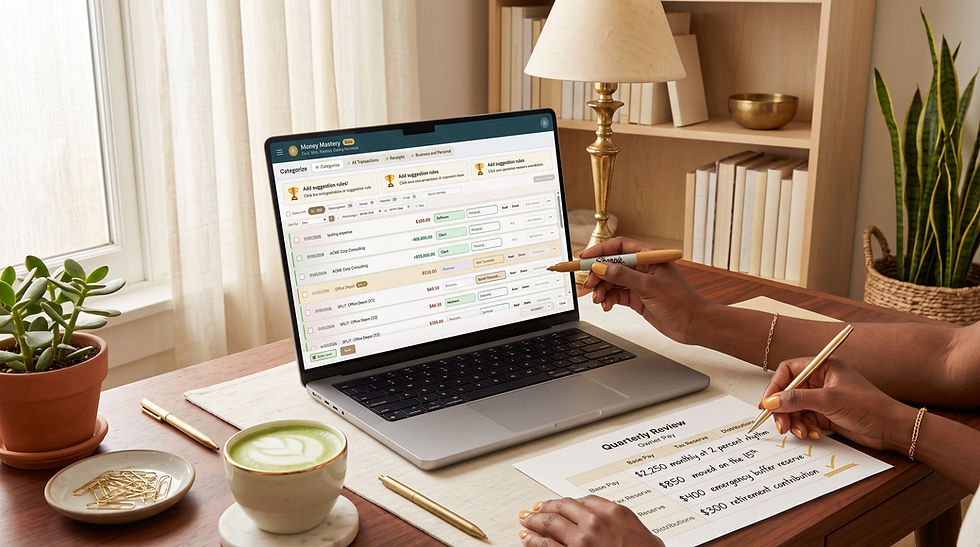
IMAGE 3 (NEAR CTA, 4:3): A woman freelancer in her 30s smiles with satisfaction at a tidy desk as a payment-received notification glows softly on her laptop, a mug of tea beside her and a neat folder of records nearby, late-afternoon light filling the calm home office. Photorealistic, no text overlay, no watermark.
Comments