


Cash Flow Management for Small Business Owners: A Beginner's Guide
Updated: Sep 17
Cash flow management for small business owners is the difference between a business that survives and one that closes, even when it's profitable. That's the part most people miss. Profit and cash flow are not the same thing. You can show a $5,000 profit on your books and still not have enough cash in your checking account to cover rent this week. According to Kaplan Group research, 29% of startups fail specifically because they run out of cash, and 88% of small businesses report experiencing cash flow disruptions in the past year.
If you've ever felt the panic of watching a big expense come due when you know a client payment is "on the way" but hasn't arrived yet, that's a cash flow problem. Not a profit problem. Not an income problem. A timing problem.
This post explains what cash flow actually means in plain language, why it's different from profit, how to track it without an accounting degree, and how to build a system that keeps cash flowing through your business instead of draining out of it. This is general financial education, not financial advice.

What Is Cash Flow? (And Why It's Not the Same as Profit)
Cash flow is the movement of money into and out of your business and personal accounts over a specific period of time. Money comes in through client payments, sales, and other revenue. Money goes out through expenses, bills, taxes, and debt payments. The difference between what came in and what went out during any given period is your net cash flow.
Profit is different. Profit is what's left after you subtract your total expenses from your total revenue over a period of time. On paper, it tells you whether your business earned more than it spent. But profit is calculated using accounting principles that don't always reflect when cash physically moves.
Here's a real example of how this creates problems. Say you're a freelance consultant. In March, you complete a $10,000 project and invoice the client with net-30 payment terms. You also have $6,000 in business expenses that month. Your profit for March is $4,000. That looks great.
But your client doesn't pay until April 28. Meanwhile, your $6,000 in expenses are due in March. Your rent is due. Your software subscriptions hit. Your quarterly estimated taxes are due. On paper, you're profitable. In your bank account, you're $6,000 short for an entire month.
As Harvard Business School Online explains it simply: "The key difference between cash flow and profit is while profit indicates the amount of money left over after all expenses have been paid, cash flow indicates the net flow of cash into and out of a business."
That gap between earning money and having money is where most cash flow crises live. Understanding this distinction is the first step toward managing cash flow instead of being managed by it.
If this concept sounds related to something we covered before, it is. In our post on financial mistakes small business owners make, ignoring cash flow timing was Mistake #3. This post goes deeper into how to solve it.
The Three Types of Cash Flow Every Business Owner Should Understand
When financial professionals talk about cash flow, they usually break it into three types. You don't need to master all three right away. But knowing they exist helps you understand where your money is actually going.
Operating Cash Flow
This is the cash generated by your day-to-day business operations. Client payments coming in, business expenses going out. For most small business owners and freelancers, this is the cash flow number that matters most. If your operating cash flow is consistently positive, your business generates enough cash from its core activities to sustain itself. If it's consistently negative, you're spending more on operations than you're bringing in, regardless of what your profit number says.
Investing Cash Flow
This is cash spent on or received from longer-term assets. Buying new equipment, upgrading your computer, purchasing a vehicle for the business. These aren't regular operating expenses. They're investments in the business's future capacity. For most solopreneurs and small service businesses, investing cash flow is sporadic rather than monthly.
Financing Cash Flow
This is cash that moves in or out through loans, lines of credit, or owner investments. When you take out a business loan, that's a cash inflow (financing). When you make loan payments, that's a cash outflow (financing). If you've read our post on why your credit card payment is not an expense, you already understand part of this concept. Debt repayments are not expenses. They're financial transactions that affect your cash position.
For most small business owners starting to learn cash flow management, operating cash flow is where to focus. It tells you whether your business can pay its own bills from its own revenue.
Why Small Business Owners Struggle with Cash Flow
The statistics paint a clear picture of how widespread cash flow problems are. Kaplan Group data shows that 39% of small businesses don't have enough cash on hand to cover even one month of operating expenses in an emergency. Only 31% actively optimize their cash flow rather than reacting week to week. And 55% of business owners have used personal funds to respond to business financial challenges.
These aren't numbers from failing businesses. These are numbers from businesses that are open, operating, and often profitable. The cash flow problem exists even when the revenue problem doesn't.
Forbes Business Council puts it directly: "Cash flow issues aren't always correlated to revenue. In many cases, they stem from a lack of visibility into inputs and outputs." That word keeps showing up in everything we talk about on this blog, and for good reason. Visibility is the foundation. Without it, you're guessing. And guessing with cash flow can shut down an otherwise healthy business.

Several factors make cash flow particularly challenging for small business owners and self-employed professionals.
Late-paying clients create gaps between when you earn and when you receive. If your biggest client pays 45 days after you invoice, that's 45 days where the money is technically yours but physically unavailable.
Irregular income means your cash inflows aren't predictable. One month brings in $12,000 and the next brings in $4,000, but your expenses don't adjust accordingly.
Seasonal fluctuations hit certain industries hard. A landscaper's March looks very different from their July, but the truck payment is the same every month.
Expense timing mismatches stack up. Quarterly taxes, annual insurance premiums, and annual software renewals all create months where cash outflows spike even though nothing unusual happened.
Download the free Money Mastery Net Worth Tracker at https://moneymastery-system.com/free. It puts your personal and business accounts side by side across sixty account types and twelve tabs, and it stays yours.
How to Start Tracking Cash Flow (Even If You've Never Done It Before)
Cash flow tracking doesn't require accounting software, a finance degree, or a complex spreadsheet. At its simplest, it's answering two questions at the end of every week: how much money came into my accounts, and how much money went out?
Here's a beginner-friendly process you can start this week.
Track Your Starting Balance
At the beginning of each week or month (pick one and stay consistent), write down the total balance across all your accounts. Personal checking, business checking, savings, credit card balances. All of it. This is your starting cash position.
Track What Comes In
Throughout the period, note every inflow. Client payments, sales revenue, refunds, transfers from savings, any money that enters your accounts. Total these at the end of the period.
Track What Goes Out
Note every outflow. Bills, expenses, transfers to savings, debt payments, tax payments, owner's draw, everything that leaves your accounts. Total these at the end of the period.
Calculate Your Net Cash Flow
Subtract total outflows from total inflows. If the number is positive, you had more cash coming in than going out. If it's negative, more went out than came in.
Neither is automatically good or bad in a single period. What matters is the trend over multiple weeks and months.
Compare to Your Ending Balance
Check your actual ending balance against your starting balance plus net cash flow. They should roughly match (small differences from timing are normal). If they don't, something is missing from your tracking.
This process takes about 10 minutes per week. And it gives you something that most small business owners don't have: a real-time understanding of how cash is moving through their financial life.
If you're already using Money Mastery, this process is built into the system.
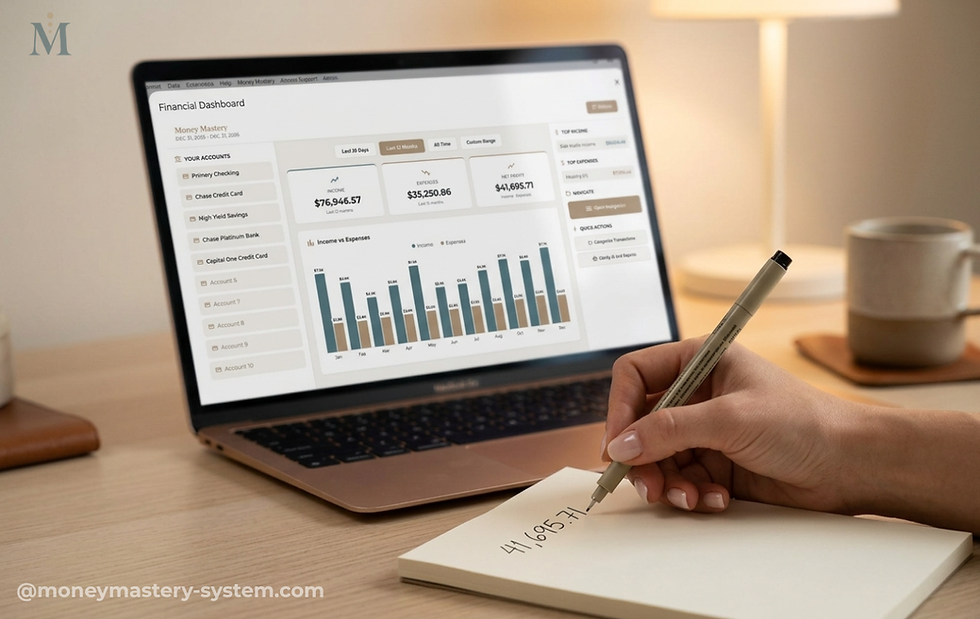
Because you upload statements from all your accounts and the system parses every transaction, your income and expenses are already organized. The monthly breakdown feature shows cash coming in and going out by category across every account you track. Your dashboard gives you the at-a-glance view, and Clarity AI can generate custom reports if you want to dig into a specific time period or category. Instead of manually tracking your starting balance and calculating net cash flow by hand, you open one view and the numbers are there.

Five Cash Flow Tips That Actually Work for Small Businesses
Once you can see your cash flow, you can start managing it intentionally. Here are five practical approaches that work for real business owners, not theoretical strategies for businesses with dedicated finance teams.
Invoice Immediately, Follow Up Consistently
The gap between completing work and getting paid is one of the biggest cash flow killers for service-based businesses. Forbes emphasizes setting clear payment expectations upfront: "Late payments are one of the most common culprits behind cash flow crunches. Your customers can only meet your expectations if they understand them."
Send your invoice the same day you deliver the work or complete the project. Not next week. Not "when you get around to it." The day it's done. Then follow up at the halfway point of your payment terms. If you invoice with net-30 terms, send a friendly reminder on day 15.
Build a Cash Buffer Before You Need It
The Kaplan Group data shows that 39% of small businesses can't cover one month of expenses in an emergency. A cash buffer of even one month of essential operating expenses changes your entire relationship with cash flow. You stop making decisions from panic and start making them from stability.
Start small. Set aside a fixed percentage of every payment you receive. Even 5-10% adds up. Keep it in a separate account so you're not tempted to dip into it for regular expenses. Money Mastery's savings goals feature lets you set a specific cash reserve target, track your progress toward it, and see it alongside your other financial data so the buffer stays visible and top of mind.
Know Your Fixed Monthly Outflows
Some expenses hit every month no matter what: rent, utilities, insurance, software subscriptions, loan payments. Add these up. That number is your baseline, the minimum amount of cash you need every month just to keep the lights on.
Knowing this number transforms how you think about incoming revenue. If your fixed monthly outflows are $4,200, then every dollar of revenue up to $4,200 is spoken for before you earn it. Anything above that goes toward variable expenses, savings, taxes, and your own pay.
This connects back to our post on doing your monthly financial review, where we talked about checking your top spending categories every month. Your fixed outflows should be one of the first things you look at.
Separate Your Tax Money Immediately
We covered this in the nine financial mistakes post, and it's worth repeating here because of how directly it affects cash flow. When revenue comes in, a portion of it belongs to taxes. If you don't separate it immediately, you'll spend it. Then when quarterly taxes are due, you'll have a cash flow crisis that feels sudden but was entirely predictable.
Set aside 25-30% of net income into a separate account the day the payment arrives. That money is no longer yours to spend. It's the government's money that happens to be sitting in your account temporarily. This is general guidance, not tax advice. Consult a tax professional for your specific situation.
Review Your Cash Flow Weekly, Not Monthly
Monthly reviews are valuable for seeing the big picture. But cash flow moves faster than monthly. A client payment that arrives three days late can create a cascade of bounced payments and overdraft fees if you're only checking once a month.
A five-minute weekly cash flow check prevents this. Look at your current account balances. Look at what's coming due in the next seven days. Look at what payments you're expecting to receive. If the math doesn't add up, you have a week to solve it instead of discovering the problem the day rent is due.
How Cash Flow Tracking Connects to Your Full Financial Picture
Cash flow tracking doesn't exist in isolation. It connects to every other financial concept we've covered in this series.
Your ability to track where your money goes determines whether you can see your cash flow at all. Your separation of business and personal finances determines whether your cash flow picture is clear or muddied. Your needs vs wants framework helps you decide which expenses are essential when cash gets tight. Your monthly review is where you actually sit down and assess your cash flow trend.
And your subscription audit, if you did one after our last post, might have already improved your cash flow by cutting charges that were draining your accounts without adding value.
This is why having a system matters more than having individual tactics. When your personal and business finances, your income, your expenses, your savings goals, your debt tracking, and your spending trends all live in one place, cash flow stops being a mystery you solve once a quarter and becomes something you can see anytime you open your dashboard.
Money Mastery was built to provide exactly this kind of integrated view. Your income and expenses across up to 10 accounts, parsed and categorized. Your P&L calculated automatically. Your savings progress tracked against your goals. Your debt balances and payoff projections visible alongside everything else. Your monthly breakdowns showing how cash moved across every account, every month. When all of that lives in one Google Sheets-based system with Clarity AI helping categorize and generate reports, managing cash flow becomes a natural part of your weekly and monthly routine rather than a separate, intimidating task.
Take Control of Your Cash Flow Starting Today
Cash flow management for small business owners starts with one simple commitment: knowing how much cash you actually have right now, and whether that number went up or down compared to last week.
Here's your action step. Open every account you have, business and personal, and write down today's balance. Add them up. That's your total cash position as of right now. Do the same thing next week. The difference between those two numbers is your net cash flow for the week. That's your starting point. Simple, concrete, and more revealing than any profit number on its own.
Tomorrow, we'll cover the practical side of staying organized: how to organize receipts for your small business using both digital and paper systems that actually work.
Get your free Net Worth Tracker and see where your money actually goes, in 15 minutes. https://moneymastery-system.com/free
Frequently Asked Questions
What is cash flow management for small businesses?
Cash flow management is the process of tracking, analyzing, and optimizing the timing of money coming into and going out of your business. It's different from profit tracking because it focuses on when cash is actually available in your accounts, not just whether revenue exceeds expenses on paper. According to Kaplan Group research, 88% of small businesses experience cash flow disruptions annually, making active management essential for survival.
Why can a profitable business still have cash flow problems?
A business can be profitable on paper while struggling with cash flow because of timing gaps. If you complete $10,000 in work but your client pays 30-60 days later, your profit exists on your income statement but the cash isn't in your account. Meanwhile, rent, payroll, and other expenses are due now. Harvard Business School Online notes that this timing difference between earning and receiving is the fundamental distinction between profit and cash flow.
How much cash reserve should a small business have?
A common starting target is one to three months of essential operating expenses. Forbes Business Council recommends aiming for three to six months as a long-term goal. Kaplan Group data shows that 39% of small businesses don't have enough cash to cover even one month of operating expenses, which leaves them vulnerable to any disruption. Start by calculating your fixed monthly outflows and working toward one month of coverage first.
How often should I check my business cash flow?
A weekly five-minute cash flow check is ideal for staying ahead of problems. Look at current account balances, what's coming due in the next seven days, and what payments you expect to receive. A monthly review provides the bigger picture view of trends and patterns. Money Mastery's monthly breakdown and dashboard features make both the weekly check and the monthly review faster by showing all accounts, income, and expenses in one organized view.
What is the difference between cash flow and profit?
Profit measures revenue minus expenses over a period and tells you whether your business earned more than it spent. Cash flow measures the actual movement of money in and out of your accounts and tells you whether you have enough cash available right now to cover your obligations. A business can be profitable but cash-poor if revenue is tied up in unpaid invoices, or cash-rich but unprofitable if it's burning through a loan or investment.
Related Posts:


Comments