


Needs vs Wants Budgeting: A Framework That Actually Works
Updated: 3 days ago
The needs vs wants framework is one of the most commonly taught money concepts, and one of the most commonly abandoned. That's not because it's a bad idea. It's because most versions of it are too rigid, too generic, and too disconnected from how people actually live. When someone tells you that coffee is a "want" and rent is a "need" and leaves it at that, they haven't really helped you make better spending decisions. They've just made you feel guilty about your latte.
A needs vs desires framework that actually works has to be personal. It has to reflect your life, your business, your values, and the season you're in right now. This post shows you how to build one that does exactly that, with real-world examples and a process you can use starting today.

Why Traditional Needs vs Wants Budgeting Doesn't Work
You've probably seen the standard breakdown before. Needs include housing, food, transportation, insurance, and utilities. Wants include dining out, entertainment, shopping, vacations, and subscriptions. Simple, right?
The problem is that real life doesn't sort that cleanly.
Consider a self-employed graphic designer who works from home. Is her internet bill a need or a want? It's both. She literally can't run her business without it, but she also uses it to stream movies at night. What about the co-working space she visits twice a week? It's not housing. It's not entertainment. But it keeps her productive and mentally healthy, which directly impacts her income.
Or think about the small business owner who pays for a gym membership. On a traditional list, that's a "want." But if that person manages a physical job, chronic stress, or uses the gym as their only mental health outlet, it's functioning as a need in their life.
The traditional list fails because it assumes everyone's life looks the same. It doesn't account for self-employment, for running a business, for being a parent, or for the hundred other variables that make your financial life different from a textbook example.
What you need instead is a personalized framework that starts with your real spending and works backward to figure out what each expense actually does for you.
Needs vs Wants Budgeting: How to Categorize Your Spending So It Actually Makes Sense
How to Build a Needs vs Wants Framework That Reflects Your Real Life
The shift from "needs vs. wants" to "needs vs. desires" is more than a word change. "Wants" carries judgment. It implies frivolity. "Desires" acknowledges that some non-essential spending is still meaningful, intentional, and worth keeping in your life.
Here's a simple three-step process to build your own framework.
Step One: List Your Actual Spending
Don't start with categories. Start with reality. Pull up your last month of transactions and write down everything you spent money on. Don't judge it. Don't organize it yet. Just get it on paper or on screen.
If you've been following along with this series, you may have already done a version of this when you started tracking where your money goes. If not, that's a good place to begin first.
Step Two: Ask "What Does This Do for Me?"
Go through each expense and ask yourself one question: what does this spending actually do for my life or my business?
Some answers will be obvious. Rent keeps a roof over your head. Your business software lets you serve clients. Groceries feed your family. Those are clearly needs.
Other answers require more thought. The $15/month meditation app might be the thing that keeps your anxiety manageable. The $200/month house cleaner might free up five hours a week that you spend on revenue-generating work. The $50/month subscription box might be something you forgot you signed up for and haven't opened in three months.
The point isn't to eliminate desires. It's to make sure every dollar you spend is doing something you actually value.
Step Three: Sort Into Three Categories, Not Two
Here's where this framework becomes more useful than the traditional one. Instead of two rigid categories, use three.
The first category is needs: expenses that keep your life and business functioning. Rent, utilities, insurance, essential software, groceries, transportation.
The second category is intentional desires: things you choose to spend on because they add real value to your life. Date nights, a gym membership, a favorite subscription, professional development.
The third category is unconscious spending: money that leaves your account without a clear purpose. Forgotten subscriptions, impulse purchases, convenience fees you didn't notice, duplicate tools that do the same thing.
That third category is where the real insights live. Not because those expenses are "bad," but because they're invisible. You can't make a conscious decision about spending you don't even realize is happening.
Download the free Money Mastery Net Worth Tracker at https://moneymastery-system.com/free. It puts your personal and business accounts side by side across sixty account types and twelve tabs, and it stays yours. desires worksheet that walks you through this exact process, plus a spending leak audit to help you find that unconscious spending.

Real-World Needs vs. Wants Examples That Go Beyond the Basics
Generic examples don't help when your financial life is anything but generic. Here are scenarios that reflect how real business owners and self-employed professionals actually spend.
The Freelancer With a Home Office
A freelance copywriter works from home five days a week. Her spending includes rent ($1,800), internet ($95), a co-working day pass she uses once a week ($120/month), coffee shop visits where she works ($80/month), and a second monitor she bought on impulse ($350 one-time).
In a traditional framework, only rent and internet are "needs." Everything else is a "want." But in her actual life, the co-working pass prevents isolation that was hurting her productivity. The coffee shops are where she does her best creative work. The monitor was an impulse buy she hasn't set up yet.
Her personalized breakdown: rent, internet, and the co-working pass are needs. Coffee shop work sessions are an intentional desire that serves her business. The monitor sitting in a box is unconscious spending worth re-evaluating.
The Couple Running a Business Together
A married couple runs a catering business. They have one joint personal account and one business account, but plenty of crossover. Their personal grocery trips sometimes include ingredients they test for new menu items. Their vehicle is used for both deliveries and family errands. They subscribe to a meal planning app personally but also use it for client menu inspiration.
Traditional needs vs. wants categories can't handle this. They need a framework that acknowledges the overlap and gives them a way to see both sides. This is where separating business and personal finances with the right categories makes a real difference.
Their approach: split the grocery bills between business and personal. Track vehicle use by purpose. Keep the meal planning app as a business tool with an honest assessment of personal use.
The Solopreneur With Lifestyle Creep
A consultant earning $12,000/month has gradually let her spending expand to match her income. She upgraded her car lease. She started ordering DoorDash three nights a week. She bought a premium Canva subscription even though she designs one social media graphic a month. None of these expenses are "wrong," but she couldn't name them if you asked her to list her monthly spending.
Her personalized breakdown: the car lease is a need (transportation) but the premium upgrade is a desire she should consciously affirm or reconsider. DoorDash at $600/month is an unconscious habit she wasn't tracking. The premium Canva subscription is unconscious spending since the free version covers her actual use.
The goal here isn't to cut everything. It's to make every expense a conscious choice.

How Spending Categories Change the Way You Think About Money
Most people think about their spending as one big number. "I spent $6,200 last month." That number doesn't tell you much. It doesn't tell you whether that spending was aligned with your priorities or whether half of it was unconscious.
When you break that $6,200 into specific categories, the picture changes completely. Maybe $3,400 was needs, $1,800 was intentional desires you're happy about, and $1,000 was spending you didn't realize was happening. That last number is where clarity creates the most value. Not because you have to cut it all, but because now you see it and can decide what stays.
Spending categories are the difference between guessing and knowing.
When your categories are specific enough, they become a mirror that shows you exactly how your money reflects your priorities.
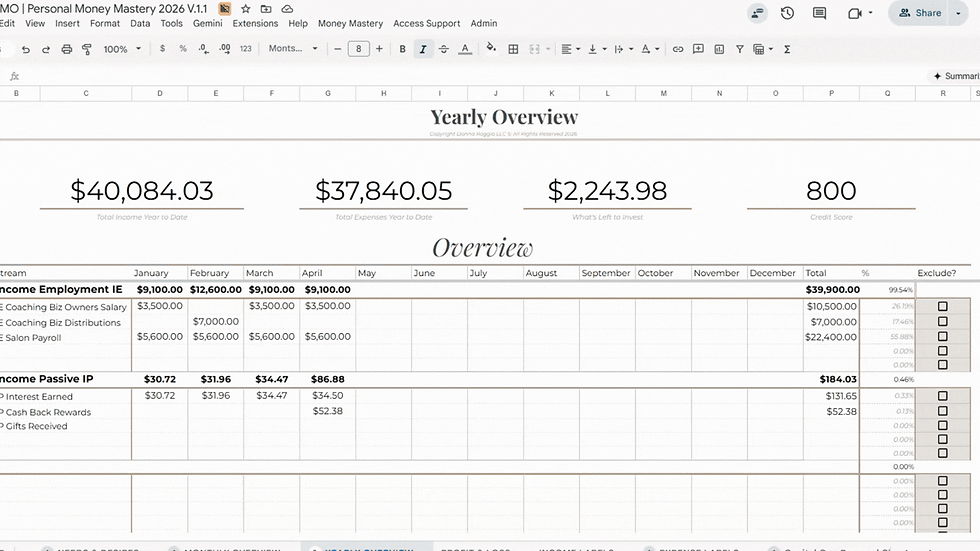
This is one of the reasons that having detailed categories matters so much. A system with 10 broad categories will tell you a very different story than one with 400 specific categories. Money Mastery uses over 400 expense categories with a built-in needs vs. desires framework specifically because that level of detail turns vague feelings about money into clear, actionable information. Clarity AI can even help suggest which categories fit your spending patterns so you're not starting from scratch.
When Your Needs vs. Desires Framework Should Change
Your framework isn't a set-it-and-forget-it tool. It should evolve as your life does.
A new baby changes your needs dramatically. Childcare, diapers, pediatrician visits, and a bigger vehicle all shift from "not applicable" to essential overnight. At the same time, some desires might temporarily move to the back burner because your time and energy are going elsewhere.
A business pivot changes things too. If you shift from in-person services to online delivery, your office rent might move from need to unnecessary expense. Your software stack might expand. Travel costs might drop.
Seasonal changes matter as well. A landscaper's needs in July look nothing like their needs in January. A retail business owner's spending profile shifts dramatically between the holiday rush and the quiet months of February.
The framework works best when you revisit it quarterly. Look at your categories, look at your spending, and ask whether the sorting still reflects your current reality. If it doesn't, adjust. That's not failure. That's the system working exactly as it should.

How to Categorize Spending When Everything Feels Like a Need
This is where most people get stuck. When you sit down to sort your spending, it's tempting to label everything as a need because, in the moment, each expense feels justified.
Here's a simple test that helps. For each expense, ask: "If I lost my income tomorrow, would I still pay for this within the first 30 days?"
Rent? Yes. Groceries? Yes. Business insurance? Yes. Your favorite streaming service? Probably not in the first 30 days. The premium version of an app when the free version works fine? Probably not.
This isn't about creating a stressful scenario. It's a thought exercise that helps you distinguish between essential expenses and comfortable ones. Both are allowed. Both have a place in your financial life. But knowing the difference is what makes your conscious spending plan actually work.
If you find that the sorting process brings up a lot of uncertainty or emotional resistance, that's completely normal. Money decisions are personal, and there's no objective "right answer" for many of these calls. What matters is that you're making the call consciously instead of letting it happen by default.
For business owners who want structured guidance through this process, Money Mastery's Fierce Financials plan includes personal coaching calls where you can work through these decisions with real support. Sometimes having a second perspective on your own numbers makes the sorting clearer than trying to do it alone.
The Connection Between Values and Spending Categories
Here's the part that most financial advice skips entirely. Your spending categories should reflect your values, not someone else's rules.
If health is a top priority for you, then spending on quality food, a gym membership, and supplements isn't indulgent. It's aligned. If family time matters more than anything, then the vacation fund isn't a luxury. It's a values-based allocation.
The problem most people run into is that they've never actually defined their top three to five financial values. So they default to cultural assumptions about what's "responsible" and what's "wasteful." They feel guilty about spending on things that genuinely matter to them and give themselves a pass on things that don't, simply because one category sounds more acceptable than the other.
Try this exercise. Write down the three things that matter most to you in your life right now. Not what should matter. What actually does. Then look at your spending from last month and see how much money went toward those three things versus everything else.
For most people, this reveals a gap. Their money isn't going where their values are. And once you can see that gap, you can start closing it. Not by spending less overall, but by redirecting spending toward what genuinely matters to you.
Your Conscious Spending Plan Starts Here
You don't need to recategorize your entire financial history tonight. You need one month of spending data and 30 minutes to sort through it using the three-category framework: needs, intentional desires, and unconscious spending.
Here's your action step for today. Pick your five largest non-bill expenses from last month. For each one, ask yourself: is this a need, an intentional desire, or unconscious spending? Just five. That's enough to start seeing the pattern and building the muscle of conscious categorization.
Once you've done that, you'll have a clearer sense of how to categorize spending in a way that reflects your real life. That's not restriction. That's clarity. And clarity is where every good financial decision starts.
Tomorrow, we'll look at the monthly financial review checklist every business owner needs to make these kinds of insights a regular part of your routine.
Get your free Net Worth Tracker and see where your money actually goes, in 15 minutes. https://moneymastery-system.com/free
Frequently Asked Questions
What is the difference between needs and wants in a conscious spending plan?
Needs are expenses required to maintain your basic life and business operations, like housing, utilities, insurance, and essential software. Wants, or desires, are expenses that add value and enjoyment to your life but aren't strictly required for survival or business function. A personalized framework adds a third category, unconscious spending, for charges that happen without active decision-making. This three-category approach gives you a much more accurate and useful picture than the traditional two-column list.
How do I categorize spending that is both personal and business?
When a single expense serves both personal and business purposes, the most accurate approach is to split the transaction. Assign the business portion to a business category and the personal portion to a personal category. Systems like Money Mastery include split transaction functionality that makes this process straightforward, so your records stay clean without forcing you to choose one or the other.
How often should I review my needs vs. wants categories?
A quarterly review is a good rhythm for most people. Your life circumstances, business needs, and financial priorities shift throughout the year, and your spending categories should reflect those changes. Revisiting your framework every three months gives you enough data to see meaningful patterns while keeping your categories current and accurate.
Is it okay to spend money on wants and desires?
Absolutely. The goal of a needs vs. desires framework isn't to eliminate all non-essential spending. It's to make sure your spending is intentional. When you know exactly what each dollar is doing for your life, you can spend on desires with confidence instead of guilt. Conscious spending means every purchase reflects a deliberate choice, and that includes the things that bring you joy.
What is the best way to track needs vs. wants spending?
The most effective way is to use a system with detailed, specific categories that can separate needs from desires at the transaction level. Money Mastery, for example, has over 400 expense categories with a built-in needs vs. desires framework, so every transaction gets sorted automatically into the right bucket. This gives you a clear monthly view of exactly how much goes to each category without manual calculations.
Related Posts:


Comments