


Which of Your Services Actually Make Money
Your most popular service might be the one that pays you the least.
Not always, but often enough that it's worth an hour to find out. The service you're best known for is usually the first one you ever priced, back when you knew the least, and it has probably never been revisited.
Popularity and profitability are two different measurements, and only one of them pays you. This post shows how to rank your services by what they really pay per hour, what usually turns up, and what to do about the one at the bottom.

Income sorted by where it came from is the starting point. Example data.
The short version
Your most-booked service often isn't your best-paid one.
Rank each service by what it pays per hour, counting the time around the appointment as well as the appointment itself.
Add-ons usually pay the most per hour. The biggest ticket rarely does.
For the service at the bottom: raise the price, trim the time it takes, or make it a step toward something better.
What a ranking looks like
Service | Price | Total hours | Pays per hour | Share of bookings |
|---|---|---|---|---|
The signature service | $120 | 2.5 | $48 | 44% |
The quick one | $45 | 0.6 | $75 | 21% |
The big one | $400 | 6.0 | $67 | 9% |
The custom one | $250 | 5.5 | $45 | 12% |
The add-on | $35 | 0.3 | $117 | 14% |
Read the first and last rows together. The signature service makes up nearly half of all bookings, and it's the second-lowest rate in the business. The add-on nobody thinks about pays more than twice as much per hour.
This pattern is very common, and almost nobody notices it, because you see your bookings every day but you never see your rate per hour.
How to work out the real rate for one service
Here's the signature service from the table, worked through step by step. Repeat it for each of your services.
The price you actually charge. $120. Not the package price or a discounted price, but what actually lands in your account for this service.
The hours with the client. 2.0 hours. This is the part everyone counts.
The hours around it. 0.5 hours. The consultation, preparation, setup, cleanup, follow-up message, and this service's share of rescheduling and chasing invoices. Track one ordinary week and you'll find this is bigger than you think.
What it costs to deliver. Products, materials, disposables and the card fee. Say $12, or 10% of the price.
The real rate. Take the price, subtract the delivery cost, and divide by the total hours. ($120 − $12) ÷ 2.5 hours = $43 an hour.
The table above shows $48 for this service because it leaves delivery costs out, to keep all five rows simple to compare. With costs included, it's $43.
Then compare that rate with your other services, and only then form an opinion. A rate on its own means very little. Next to the other rates in your own business, it means a lot.
One note: that $43 is before tax and before the hours of your week that no service pays for at all. If you want the figure that actually reaches you, our post on your true hourly rate covers the rest. For ranking your services, though, this number is exactly right, because every service is measured the same way.
Why the hours around the appointment matter so much
The whole exercise depends on counting every hour a service takes, and this is where most people go wrong.
A service that takes two hours in the chair and forty minutes everywhere else is really a 2.7-hour service. Price it as a two-hour service, and you've quietly given away a quarter of your rate.
What usually stands out
The signature service is usually near the bottom. It was priced first, when you knew the least, and it's been carried forward out of habit ever since. It's also the hardest one to change, which is why it stays the same.
Add-ons are almost always the best rate in the business. A small price, very little time, no setup and no separate booking. Most owners give them away or forget to offer them.
The biggest ticket is rarely the best rate. A $400 service that takes six hours pays less per hour than a $45 service that takes thirty-six minutes. Revenue per booking and revenue per hour point in different directions, and only one of them is your life.
The gap between best and worst is usually more than double. In the table above, it's $45 to $117. When people expect a small spread and find that, it changes the conversation from pricing to which services they really want to offer.
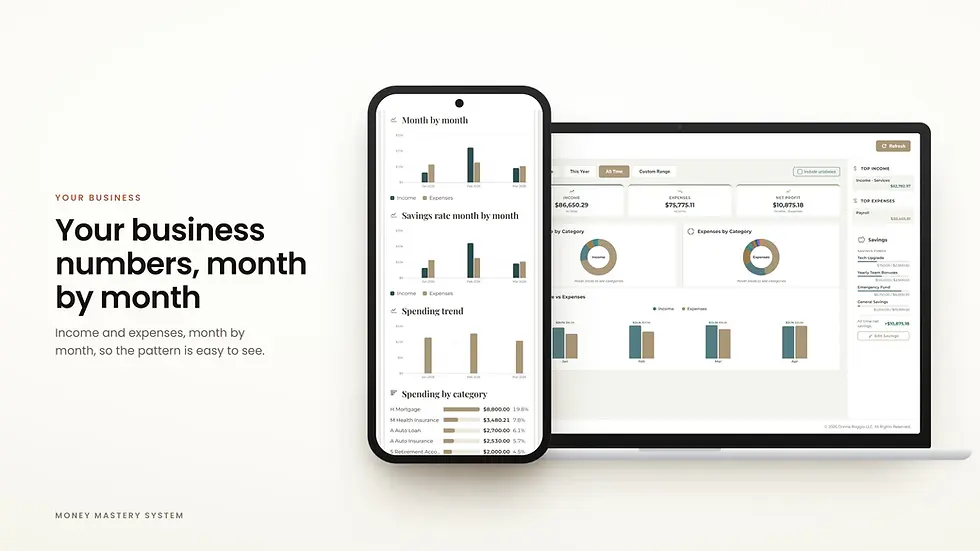
A business month at a glance. Example data.
What to do with the one at the bottom
There are four options, listed in order of how often they're the right answer.
Raise its price. The most common answer, and the most avoided. If a service is popular and its rate is low, it's underpriced.
Reduce what it takes to deliver. A shorter consultation, a tighter scope, fewer unpaid revisions.
Make it a step rather than a destination. A low-rate service that reliably leads clients to a higher-rate one is doing a different job, and it should be judged on what comes after it.
Stop offering it. This is the rarest answer, and occasionally the only honest one.
What you shouldn't do is keep it unchanged just because it's what you're known for. Being known for your lowest-paid work is a slow problem.
Five easy mistakes when ranking services
Counting only the hours with the client. The hours around the appointment are where the ranking is decided, and leaving them out flatters exactly the services that need the closest look.
Using your list price instead of the average price you actually got. Discounts, packages and friend rates all belong in the number you divide.
Ranking by total revenue. That only tells you what's popular. Popular and profitable are different things, and that difference is what this whole post is about.
Leaving out the services you no longer want to do. Resentment isn't data, but it's often pointing at some. Rank those too and find out.
Doing it once and never again. Supplier prices change, you get faster, and a service that ranked third two years ago might rank last now.
Where the numbers come from
You need two things: your income split by service, and an honest count of the hours around each one.
Counting the hours takes one week of paying attention, and nobody can do that for you. Splitting your income by service is a sorting job. That's what Rise, at $49.99 a month, does: it sorts your income by service and keeps it sorted, because Clarity remembers how you labeled things last time. Its income-by-service report is this post's table, built from your own bookings.
La Soglia, the free membership, holds everything you own and everything you owe, with no bank connection and no card. That's useful too, but for this particular job, the paid membership is the one that does it.
Bring it to the Collective
The bottom row of your table can be hard to look at alone, and almost everyone has one. Share yours in the Money Mastery Collective. The discussion feed is open on the free membership.
Questions we hear
What if a low-rate service brings in new clients?
Then it's marketing, and it should be measured as marketing. Track how many of those clients come back for something else. If they don't, it isn't a way in, it's just a discount.
Should I count my own time if I am the business?
Yes, especially then. Unpaid owner time is how a business can look profitable while the owner isn't really being paid.
How often should I redo this?
Once a year is plenty. October is a good month for it, because you still have time to change prices before January.
How do I know which of my services is most profitable?
Divide what each service brings in, after its delivery costs, by every hour it takes, including preparation and follow-up. Then compare the results side by side.
References
There are no outside figures in this post. Every number is our own worked example.
Start free with La Soglia
La Soglia is the free membership of the Money Mastery System. It gives you the Net Worth Tracker, where everything you own and everything you owe sits in one place, and the Money Mastery Collective. There is no card to enter and no bank connection.
Keep in touch
Donna shares a short version of posts like this one on Instagram and LinkedIn. Follow along there, or find everything in one place on our links page.
A note on what this is
This article is educational. The Money Mastery System is an educational tool, not financial software, and nothing here is legal, tax, investment or financial advice. The table is a worked example, not a typical business. For guidance on your own circumstances, please speak with a qualified professional who knows them.


Comments