


Break-Even Point for a Service Business: How Many Clients You Need
Your break-even point is the number of sessions, clients or jobs it takes to cover your costs. The sum is fixed costs divided by what each session leaves you after its own costs.
In the example below, that is 24 sessions a month to cover the business, and 59 to cover the business and pay the owner.
Most owners know roughly what they earn. Far fewer know the number of clients at which the month starts working, and that number changes how you see a quiet week.
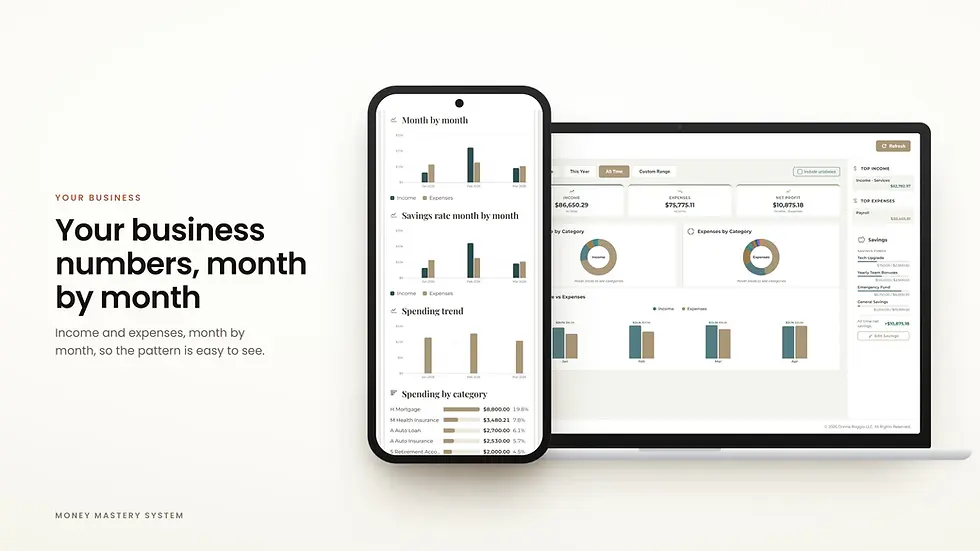
Fixed costs are the ones that show up every month whatever you earn. Example data.
The short version
Break-even = fixed costs ÷ (price − cost of delivering one session).
Work it out twice: once for the business alone, once with your own pay included.
A small price change moves the number more than you expect.
Everything past break-even is where tax, savings and growth come from.
The three figures you need
Fixed costs. What the business costs each month even if nobody books: rent, insurance, software, phone, licenses.
Price. What a client pays for one session.
Cost per session. What it costs you to deliver that one session: product, supplies, card fees.
Price minus cost per session is what each session leaves you. Accountants call it the contribution, because it contributes to covering the fixed costs.
The worked example
Figure | Amount |
|---|---|
Fixed costs each month | $1,900 |
Price per session | $95 |
Cost per session | $15 |
Each session leaves | $80 |
Break-even: $1,900 ÷ $80 | 23.75, so 24 sessions |
At 24 sessions the business has paid for itself. It has not yet paid you.
The version that includes you
A business that covers its own costs and leaves nothing for the owner is not breaking even in any sense that matters. So add your own pay to the fixed costs and run it again.
Figure | Amount |
|---|---|
Fixed costs each month | $1,900 |
Your own pay | $2,800 |
To cover | $4,700 |
Each session leaves | $80 |
Break-even: $4,700 ÷ $80 | 58.75, so 59 sessions |
Fifty-nine sessions a month is about fourteen a week. That is the real line. Below it, the shortfall comes out of your own pay. Above it, each session adds $80 toward tax, a cushion and whatever comes next.
This figure is before tax. Your set-aside comes out of what is left, which is one more reason the line is higher than it first looks.
What a price change does
Price | Each session leaves | Sessions to cover $4,700 |
|---|---|---|
$85 | $70 | 68 |
$95 | $80 | 59 |
$105 | $90 | 53 |
Ten dollars more on the price means six fewer sessions every month to reach the same place. Ten dollars less means nine more. A discount does not cost you ten dollars. It costs you nine extra sessions.
If you are weighing a price change, our post on your true hourly rate is the companion to this one.

Fixed costs and cost per session both come from sorted expenses. Example data.
The same sum works in the other direction for costs. If rent rose by $160 a month, that is two more sessions every month at $80 each, before anything else changes. Knowing that turns a rent increase into a question about bookings, which is one you can do something about.
If you do not charge by the session
The same sum works with any unit.
By the project. Use your average project price and the average cost of delivering one.
By the hour. Use your hourly rate, and count only hours you can bill.
By retainer. Use the monthly retainer, and the answer is the number of clients you need.
Three mistakes
Leaving out annual costs. Divide insurance, licenses and yearly software by twelve and include them.
Calling your own pay optional. If it is not in the sum, the sum describes a hobby.
Working it out once. Rent rises, prices change. Run it again every quarter.
What to do with the number
Write it somewhere you will see it. On the day you pass it each month, everything after is different money, and it is worth knowing which day that is. If it falls in the last week, the business is tight. If it falls in the second week, you have room.
It also pairs well with your profit margin, which tells you how much of each dollar stays once you are past the line.
Start with the whole picture, free
La Soglia, the free membership of the Money Mastery System, holds everything you own and owe in one place, personal and business together, with no bank connection and no card. The monthly expense totals that give you your fixed costs come from the paid membership, which sorts your transactions for you.
Bring it to the Collective
What counts as a fixed cost in your kind of business? The Money Mastery Collective has a discussion feed open on the free membership, and it is a good question to ask there.
Questions we hear
How do I calculate my break-even point?
Divide your monthly fixed costs by the amount each sale leaves after its own costs. The answer is the number of sales you need.
Should I include my own pay in break-even?
Yes. Work it out once without your pay and once with it. The second figure is the one that tells you whether the business supports you.
What is a fixed cost?
A cost you pay whether or not you have clients that month, such as rent, insurance and software.
How does a discount affect break-even?
It lowers what each sale leaves, so you need more sales to cover the same costs. In the example, $10 off means nine more sessions a month.
References
There are no outside figures in this post. Every number is our own worked example.
Start free with La Soglia
La Soglia is the free membership of the Money Mastery System. It gives you the Net Worth Tracker, where everything you own and everything you owe sits in one place, and the Money Mastery Collective. There is no card to enter and no bank connection.
Keep in touch
Donna shares a short version of posts like this one on Instagram and LinkedIn. Follow along there, or find everything in one place on our links page.
A note on what this is
This article is educational. The Money Mastery System is an educational tool, not financial software, and nothing here is legal, tax, investment or financial advice. The figures are illustrations, and your own costs, prices and tax position will differ. For guidance on your own circumstances, please speak with a qualified professional who knows them.



Comments