


Profit Margin for a Service Business: How to Calculate Yours
Profit margin is profit divided by income, times 100. If $9,200 came in and $3,900 was left after expenses, your margin is 42.4%.
It tells you something income alone cannot: how much of each dollar you keep. A business can take in more every month and keep less, and the margin is where that shows first.
Here is the sum, three months of it worked through, and the two versions worth knowing when you are the one doing the work.

Income, expenses and what is left, on one page. Example data.
The short version
Profit margin = profit ÷ income × 100.
Work it out for the month and for the quarter. One month alone can mislead.
Know it twice: before you pay yourself, and after.
Compare it with your own past months, not with someone else's business.
The sum, step by step
Add up everything the business received in the month. That is income.
Add up everything the business spent to operate. That is expenses.
Income minus expenses is profit.
Divide profit by income, and multiply by 100.
Line | Amount |
|---|---|
Income | $9,200 |
Expenses | $5,300 |
Profit | $3,900 |
Profit margin | 42.4% |
So for every dollar a client paid, a little over 42 cents was left once the business had covered its costs.
Three months, side by side
Month | Income | Expenses | Profit | Margin |
|---|---|---|---|---|
January | $7,000 | $4,900 | $2,100 | 30.0% |
February | $9,200 | $5,300 | $3,900 | 42.4% |
March | $11,500 | $6,100 | $5,400 | 47.0% |
The quarter | $27,700 | $16,300 | $11,400 | 41.2% |
Two things to notice. Income rose 64% from January to March, and expenses rose only 24%. That is what a service business with steady costs looks like: once rent, software and insurance are covered, more of each extra dollar stays.
And the quarter's margin is not the average of the three months. It is the quarter's profit over the quarter's income. Always work from the totals.
The two versions every owner should know
If you are a sole proprietor, what you take out of the business is not an expense on your tax return. It comes out of profit. So the figure above is your margin before paying yourself.
That is the right number for tax. It is a flattering number for judging the business, because it treats your work as free.
February | Before your pay | After your pay |
|---|---|---|
Income | $9,200 | $9,200 |
Expenses | $5,300 | $5,300 |
Your pay | not counted | $2,800 |
What is left | $3,900 | $1,100 |
Margin | 42.4% | 12.0% |
The second column asks a better question: after the business has paid for itself and paid you, is there anything left for tax, for a slow month, for growing? Here there is $1,100, or 12 cents of every dollar.
If that second figure is at or below zero, the business is paying you and nothing else. That is worth knowing before a tax bill tells you. Our post on how to pay yourself as a business owner covers setting that pay figure.
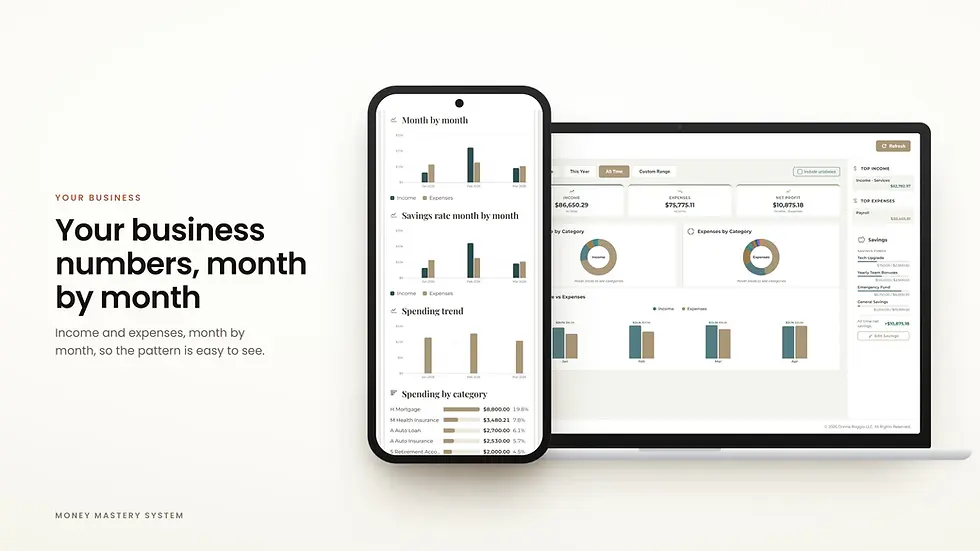
Margin is a trend, so it needs months beside each other. Example data.
What is a good margin?
There is no single honest answer. A consultant working from home and a salon with a lease and product costs are different businesses, and their margins should be different.
The comparison that helps is with yourself. Is this quarter above or below the last one, and do you know why? A margin that slips three months running while income holds steady is telling you that costs are creeping.
Five things that move it
Price. A rise in price with the same costs goes straight to margin.
Unbilled time. Hours you worked and did not charge for.
Subscriptions. Small, monthly, and easy to stop seeing.
Discounts. Ten percent off the price can be a quarter off the profit.
The mix of work. Some services cost you more to deliver than others.
Three mistakes
Using deposits as income. A transfer from your savings or a loan is not income. Count only what clients paid.
Leaving out annual costs. Insurance paid once a year still belongs to every month.
Judging from one month. A single month catches a big bill or a late payment. Use the quarter.
A fourth, quieter one: working the margin out once and never again. The number matters less than its direction, so put ten minutes in your calendar at the end of each month and write the figure down next to last month's.
Where the figures come from
Margin needs only two totals, and both come from sorted transactions. If your records are a month or more behind, start with the monthly bookkeeping minimum, which takes about an hour.
Start with the whole picture, free
La Soglia, the free membership of the Money Mastery System, holds everything you own and owe in one place, personal and business together, with no bank connection and no card. The Profit and Loss report that gives you income, expenses and profit for any period is part of the paid membership.
Bring it to the Collective
Margins are easier to talk about with people who also run a business on their own. The Money Mastery Collective has a discussion feed open on the free membership.
Questions we hear
How do I calculate profit margin?
Divide profit by income and multiply by 100. Profit is income minus business expenses.
What is a good profit margin for a service business?
It depends on the kind of business and its costs. The useful comparison is your own margin over time.
Does profit margin include what I pay myself?
For a sole proprietor, owner pay comes out of profit. Work the margin out both before and after your pay.
Why did my margin fall when income went up?
Costs rose faster than income. Discounts, new subscriptions and unbilled time are the usual places to look.
References
There are no outside figures in this post. Every number is our own worked example.
Start free with La Soglia
La Soglia is the free membership of the Money Mastery System. It gives you the Net Worth Tracker, where everything you own and everything you owe sits in one place, and the Money Mastery Collective. There is no card to enter and no bank connection.
Keep in touch
Donna shares a short version of posts like this one on Instagram and LinkedIn. Follow along there, or find everything in one place on our links page.
A note on what this is
This article is educational. The Money Mastery System is an educational tool, not financial software, and nothing here is legal, tax, investment or financial advice. The figures are illustrations, and how owner pay is treated depends on how your business is set up. For guidance on your own circumstances, please speak with a qualified professional who knows them.


Comments