top of page

An end of month money checklist small business owner style is one of the most exciting rhythms you can build into your business. Each month closes with intention, and the next one opens with a plan. That is how great businesses stay great, and it is how confident women stay confident.


Woman reviews a Profit & Loss dashboard on a laptop while writing a month-end checklist in a warm home office

Here is the ten-step checklist to close September and step into October with real momentum.


The 10-step end of month money checklist

  1. Total money in for the month

  2. Total money out for the month

  3. Calculate what you kept

  4. Note your top three expense categories

  5. Move your tax set-aside for the month (use The Simple Formula: How Much to Save for Taxes Small Business Owners Should Use if you have never set a percentage)

  6. Fund your reserve with any surplus (pair this with How to Build an Emergency Fund When You're Self-Employed)

  7. Confirm owner pay happened cleanly (if this one has been slipping, read Why So Many Business Owners Skip Their Own Pay)

  8. Note any recurring charge to cancel or renegotiate

  9. Write one lesson from the month

  10. Set one focus for next month


Ten steps. About thirty focused minutes. One clear October.


Why closing the month properly feels good

  • It marks the finish line of the month

  • It gives every dollar a job

  • It leaves nothing hanging into the next month

  • It turns your business into a rhythm you trust


That is a very different feeling than the usual "I meant to look at last month" energy.


An easy monthly reference table

Cozy home desk with laptop showing a financial dashboard, checklist board, notebook, plants, and coffee in warm daylight.

Step

Where the number lives

Money in

Deposits and payment processor reports

Money out

Bank and card statements

What you kept

The Money Mastery System system's monthly breakdown

Top three categories

The Money Mastery System system's category view

Tax set-aside

Your tax holding account

Reserve

Your reserve or buffer account

Owner pay

Your personal checking

Cancellations

Recurring charge audit

Lesson learned

Your notebook or Collective journal

Next month focus

Your planner or October dashboard

How the Money Mastery System supports the checklist


Then the Collective keeps the practice alive:

  • Finance Friday Live at the end of the month is often themed around closing well

  • The Money Reset Call is designed exactly for this closing and opening rhythm

  • The daily blog carries you into the next month with intention

  • The discussion feed lets you celebrate the win and share the lesson


Inside the Collective, the Money Mastery System system helps you see what you kept last month on one screen, alongside other women doing the same work. That is why closing a month becomes fun instead of stressful.


A story of a joyful month close


Picture Priscilla, a solo consultant. She sits down on the last Sunday of the month with tea, opens the Money Mastery System system, and runs her ten-step checklist. Money in and out are already visible. She spots that she kept a healthy margin, moves her tax set-aside, funds her reserve, confirms owner pay happened, cancels one unused subscription, and writes down her lesson: "raising prices in August was the right call." Then she sets her October focus: preparing for a founding-member webinar with Donna.


By Monday morning, she is not walking into a fog. She is walking into a plan.


Three signs the checklist is working


You will know this is working when:

  1. You feel calmer at the end of every month

  2. You start October, November, and December with a clear focus

  3. You cannot imagine going back to running the business without this


A bonus October kickstart


To make the transition feel even more like a launch:

  • Day 1 of the new month: open the Money Mastery System system and write your October focus

  • Day 3: attend Finance Friday Live and align your focus with what Donna is teaching

  • Day 7: post your one lesson from September inside the Collective


That is a beautiful start to a new month.
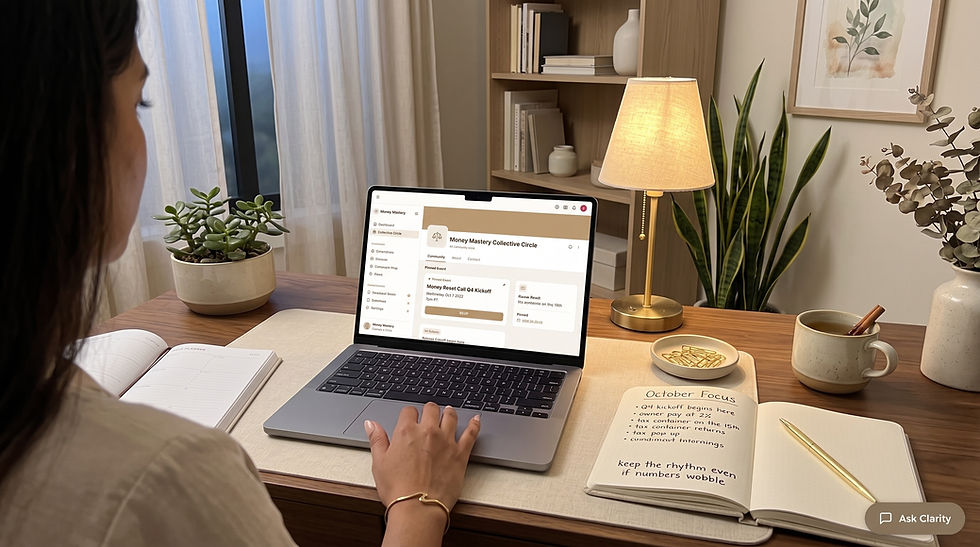
Woman works on a laptop at a cozy desk; screen shows Money Mastery Collective Circle, with planner notes and a warm lamp nearby.

What to do next

Run the ten-step checklist today, celebrate what you built in September, and step into the Collective at https://moneymasterycollective.circle.so.


FAQ


Why does an end of month checklist matter so much for a solo business?

Solo and service-based businesses tend to move quickly, and cash tends to move quickly with them. Without a defined close-out ritual, the story of one month blends into the next, and important patterns get missed. A monthly checklist gives every dollar a clear path and gives every month a proper ending. It ensures tax money moves, reserve gets funded, owner pay is confirmed, and lessons get captured. That last piece is especially valuable, because businesses grow fastest when the lessons of one month are used to design the next. When this rhythm lives inside the Money Mastery System system, it becomes fast. When it lives inside the Collective, it becomes fun. Together, they turn month-end from something women avoid into something women look forward to.


How long should this actually take?

Thirty focused minutes is the target. If you have the Money Mastery System system in place, your income, expenses, and monthly breakdown are already visible, which means the first half of the checklist happens fast. The middle portion, moving tax money, funding reserve, and confirming owner pay, takes only a few clicks if your accounts are set up cleanly. The final portion, writing a lesson and setting a focus, is the most valuable use of your time and only requires a few thoughtful sentences. The first time you run the checklist, give yourself an hour to get comfortable. From the second month on, thirty minutes is realistic and repeatable.


How does this checklist connect to bigger financial goals?

Every big financial goal you have is built on top of consistent monthly rhythm. Retirement contributions, cash reserve growth, debt reduction, and pricing decisions all get stronger when you know exactly what closed each month and how it compared to the one before. The end of month checklist gives you the working data to see those trends. Six months of consistent closes turns into a clear picture of how your business is really performing. Twelve months turns into a story you can plan around. That is how a woman goes from "I hope things are working" to "I know exactly how my business is doing and where I want it to go next," and it is exactly the kind of transformation the Money Mastery System system + the Collective is built to support.

A steady weekly money routine for women business owners is one of the most freeing habits you will ever build. Fifteen focused minutes on the weekend can make Monday feel bright, informed, and calm. That is not a stretch. It is what happens when your numbers have a regular home.


Hand on laptop in cozy home office; planner shows Money Check-In, Office Hours, and Finance Friday Live.

Ready to make weekends feel lighter, not busier? Here is the exact reset.


The 15-minute weekly money routine for women business owners at a glance


  • Minutes 1-5: Look back at last week

  • Minutes 6-10: Look ahead at next week

  • Minutes 11-15: Move money and make one decision


That is it. Small, powerful, repeatable.


Minutes 1-5: what to review from last week

  1. Money in

  2. Money out

  3. One unfamiliar or surprising charge

  4. One transfer you meant to make


Minutes 6-10: what to see about next week

  1. Bills coming due

  2. Tax transfer to schedule

  3. Savings or reserve moves

  4. Owner pay plan


Minutes 11-15: one decision that makes next week easier

  1. Move money to the right account

  2. Cancel or renegotiate one charge

  3. Follow up on an invoice

  4. Schedule your Finance Friday Live attendance


Why this routine feels so good

  • It replaces vague dread with clear structure.

  • It replaces catch-up with consistency.

  • It replaces guessing with knowing.


Fifteen minutes on Sunday can lift the entire week that follows.


Use this simple table every weekend

Review area

Question to ask

Income

Did what I expected land?

Expenses

Was anything a surprise?

Upcoming bills

Anything I need to prepare cash for?

Tax and savings

Do I need to move money?

Owner pay

Is my rhythm still working?

One decision

What one move will improve next week?

How the Money Mastery System makes it easier


Laptop and tablet show financial charts beside a Spending Audit notebook, coffee mug, and pen on a tidy desk.

Inside the Money Mastery System system, this fifteen-minute routine becomes smooth because:

  • Your income and expenses live in one place

  • Your monthly breakdown updates as you go

  • You can see what you kept without hunting through statements

  • You can review categories at a glance


Then inside the Collective, the community keeps you accountable:

  • The daily blog gives a small nudge back into your numbers

  • The discussion feed helps you share and hear how others are doing the same work

  • Finance Friday Live gives you weekly teaching from Donna

  • The Money Reset Call helps close each month cleanly


Inside the Collective, the Money Mastery System system helps you see what you kept last month on one screen, alongside other women doing the same work. That is why the routine sticks.


An uplifting story of one Sunday reset

Picture Layla, a coach and salon business owner. She sits down at her kitchen table on Sunday morning with tea and her laptop. She opens the Money Mastery System system, glances at last week's income and expenses, spots one subscription she does not need, marks the Wednesday tax transfer she wants to make, and pays herself for the week. Fifteen minutes. Two decisions. One weekend calm.


Monday morning arrives, and Layla starts the week from a settled place instead of a scattered one. That is the difference this rhythm makes.


Bonus: a first-week starter plan

If this is new to you, use this three-week onboarding:

  1. Week 1: Do the fifteen-minute reset. Do not aim for perfect. Aim for done.

  2. Week 2: Add the tax transfer step and the one-decision step.

  3. Week 3: Attend Finance Friday Live to reinforce what you are seeing.


By week four, this becomes part of who you are.


Cozy desk with laptop showing Money Mastery, planner and notes open, coffee mug, plants, and a calm home office setup.

What to do next

Choose your weekend time, open your Money Mastery System system, and step into the Collective at https://moneymasterycollective.circle.so.


FAQ


Why is a weekly routine more effective than an occasional deep dive?

Occasional deep dives feel productive in the moment, but the gap between them is where money slowly gets away from women. A weekly rhythm keeps everything current, small, and manageable. Instead of trying to reconstruct three months of context every once in a while, a fifteen-minute weekend reset means the story is always fresh in your mind and current in the Money Mastery System system. Consistency also protects your nervous system. You never have to face a giant pile of catch-up, which means you never have to talk yourself into starting. The work becomes a low-effort habit that supports every decision you make during the week that follows.


What if my income and schedule are unpredictable?

Unpredictable income and schedules are exactly why a weekly rhythm matters even more. When cash flow moves around, having a steady reset gives you a place to notice patterns, protect your tax set-asides, and adjust owner pay before the month is over. If you cannot commit to the same day every week, choose a two-day window instead, such as Saturday or Sunday morning. If you miss a weekend, do it Monday morning. The point is not perfection. The point is that the numbers never go longer than about a week without your attention, which is what keeps them workable.


How does this routine connect to bigger goals like retirement and savings?

The weekly reset is the on-ramp to every big financial goal a woman can set for herself. Retirement, savings, buying a home, expanding the business, and building a legacy all require consistent small choices, not occasional huge ones. When you know each week that your tax money is protected, your savings is growing, and your owner pay is happening, you build the trust with yourself that bigger decisions require. Over the course of a year, fifty-two of these small weekly resets add up to a completely different financial life. That is the compounding effect of rhythm, and it is exactly what the Money Mastery System system + the Collective are designed to support.

Salon owner bookkeeping does not have to feel like a mountain you are always climbing. When the books are behind, the trap is trying to fix everything before you know what actually matters. There is a lighter, faster place to start, and it can transform how you feel about your business in a single afternoon.


Hand writes salon reconciliation beside laptop showing profit and loss report in a warm, tidy beauty salon.

The goal today is not perfect books. The goal is clarity you can build on.


The 3 numbers that make salon owner bookkeeping useful again


Focus on these three, in this order:

  1. Total money in last month. Deposits, tips, retail, add-ons, and every payment channel.

  2. Total money out last month. Product, rent, education, subscriptions, merchant fees, contractors, and any real business spend.

  3. What you kept last month. What was left after the business took what it needed.


These three numbers create the story. Everything else is detail.


Why these 3 numbers change how salon owner bookkeeping feels


Before this exercise, the month feels like a blur. After this exercise, you can answer the questions that matter most:

  • Did the business actually produce enough last month?

  • Are expenses drifting higher than they should be?

  • Is there room for a healthier owner-pay rhythm?

  • What needs my attention first?


That is a completely different starting point than "I need to categorize every transaction going back six months."


A quick table to make the review even easier

Number

Where to find it

Why it matters

Money in

Payment processor + deposits

Real revenue picture

Money out

Bank + card statements

Where the business is spending

What you kept

Money in minus money out

The number that tells the truth

The exact 30-minute workflow


Person writing on a receipt beside a laptop showing Categorize Transactions in a chic salon with product shelves and warm lights.

Give yourself thirty focused minutes. Not perfect. Focused.


  1. Open your bank statements and payment processor reports for the last full month.

  2. Write down the three totals.

  3. Note the top three expense categories.

  4. Note any recurring charge that surprised you.

  5. Mark tax money that still needs to move.

  6. Note whether you paid yourself in a clean way.

  7. Write one sentence about what the month actually meant.

That single sentence is where clarity turns into confidence.


How Money Mastery makes salon owner bookkeeping feel doable

This is where the system + the community shift the experience.

Doing this alone

Doing this inside Money Mastery + the Collective

Statements scattered across tabs

Numbers gathered into one working place

Categories fuzzy or missing

Structured categories inside the system

Cleanup feels heavy

Finance Friday Live gives it teaching and rhythm

No one to ask

Discussion feed and Money Reset Call give you support

The Money Mastery system helps you see what you kept last month on one screen, alongside other women doing the same work. That is what makes catch-up feel less lonely and more possible.


Salon receptionist works at laptop with spreadsheet; notebook says Walk-ins welcome here; flowers and latte on marble counter.

A story that shows this in real life


Picture a salon suite owner named Trina. She has been telling herself she will "really sort the books" when things slow down. They never really do. When she uses the three-number method, she spends one Sunday afternoon totaling last month, sees exactly where the business is stronger and weaker than she thought, and walks into Monday with three clear priorities: raise one service price, cancel one subscription, and move next week's tax set-aside on the same day the deposit hits.


Nothing about that day was dramatic. Everything about that week was different.


Three easy wins after the first pass


Once you have the three numbers, look for:

  • one price that is due for a raise

  • one recurring cost that is quietly bloating

  • one habit that would make next month easier


Those three tweaks are usually where the biggest early gains live.


What to do next


Take thirty minutes today, run the three-number pass, and step into the Collective at https://moneymasterycollective.circle.so if you want a place to keep going.


FAQ


Can I really make good decisions when my salon owner bookkeeping is not fully up to date?

Yes, and this is one of the most important mindset shifts a service business owner can make. The purpose of the three-number pass is not to replace formal bookkeeping. It is to give you enough real information right now that you can stop making decisions in the dark. Waiting for perfectly clean books before you look at what came in, what went out, and what you kept usually delays clarity by months. Meanwhile, prices, subscriptions, owner pay, and tax habits keep shaping the business every single week. A first-pass view gives you actionable insight today and lets the deeper cleanup happen alongside better weekly decisions.


What if my income comes from multiple places, like retail and services?

That is exactly why the three-number approach works so well. Instead of trying to reconcile every stream into a formal accounting close, you total the money that landed in your business accounts and note the sources at a high level. You can add sub-categories once you have a working monthly view. Retail add-ons, service revenue, tips, and one-off products all count as money in during your first pass. The point is to see the size and shape of the month clearly, then refine. Once the Money Mastery system is on your desk, categorizing across income streams becomes much easier and much less intimidating.


How does the Collective make salon owner bookkeeping feel less isolating?

The Collective changes the emotional experience of money work. Instead of sitting alone with piles of statements and a low-grade dread, you have a room of women doing the same numbers work at the same time. Finance Friday Live gives you a weekly space to hear Donna teach on real service-business money questions. The daily blog gives you a small nudge back into your numbers. The discussion feed lets you ask a question and get answers from women who understand the salon and service world. And the Money Mastery system holds the working data, so the community is not talking in abstractions. Salon owner bookkeeping stops feeling like a private failure and starts feeling like a shared practice.

bottom of page