


What Makes a Small Business Sellable: Seven Things a Buyer Looks For
A buyer is not paying for what your business earned. She is paying for what it will keep earning after you have gone. Everything that makes a small business sellable comes back to that one idea.
Most businesses of one are never sold, and that is perfectly fine. But the same seven things that would make yours sellable also make it steadier, easier to run and less dependent on your being well every single day. They are worth building whether or not you ever sell.
Here are the seven, a simple way to score yourself, and which one to work on first.
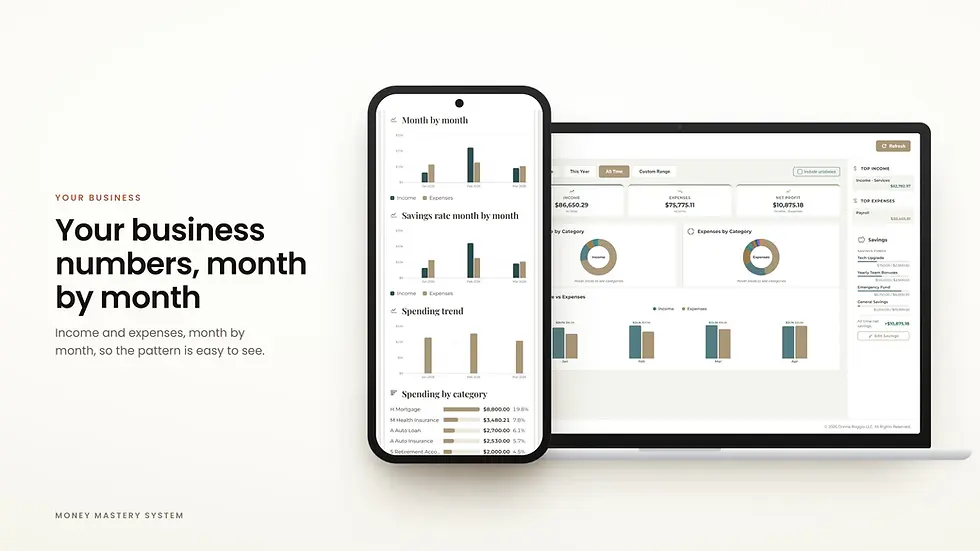
Steady months, visible on one page, are the first thing a buyer asks to see. Example data.
The short version
Buyers pay for income that continues without the owner.
Clean records for three years or more are the entry ticket.
One client or one person carrying the business is the biggest risk a buyer sees.
Each of the seven also makes the business better to own.
The seven
What a buyer looks for | Why it matters | A sign you have it |
|---|---|---|
1. Income that repeats | It will still arrive next year | Retainers, memberships, regulars on a schedule |
2. Clean records | The numbers can be trusted | Three years of profit you can show on a page |
3. No single client carrying it | One departure cannot sink it | No client above about a fifth of income |
4. Work written down | Someone else could do it | Steps for your main services on paper |
5. It runs when you are away | It does not depend on you | You can take two weeks off and income continues |
6. Agreements that carry over | The clients come with it | Contracts in the business name, a lease that transfers |
7. A steady or rising trend | It is going somewhere | This year is at or above last year |
Score yourself
Give yourself one point for each you can honestly say yes to today.
Score | What it suggests |
|---|---|
0 to 2 | The business is an income. Plan your retirement saving outside it. |
3 to 4 | Parts could have value. Choose one more of the seven to build. |
5 to 7 | A buyer might be interested. It is worth a conversation with an adviser. |
A low score is not a failing. Many of the best small businesses score two, because they were built around one skilled person, and they have paid that person well for years. The point is to know which kind you have.
Where to start
With number two, clean records. It costs the least, takes the least time, and everything else depends on it. A buyer who cannot see three clear years will not look at the other six.
It is also the one that pays you back straight away, at tax time, with a lender, and every month you want to know how you are doing.
The hardest one
Number five. In a service business where clients come for you in particular, the business does not run when you are away, and no amount of paperwork changes that.
There are still ways to lean in that direction, even alone.
Sell something that is not an hour of you. A recorded course, a product, a guide.
Train one other person to deliver part of what you do.
Move regulars to a schedule or a membership, so income is booked ahead.
Write down how you do things, so a helper could step in for a fortnight.
Our earlier post on how to make your business run without you goes further into this.

Income by client shows at a glance whether one of them is carrying the rest. Example data.
What each one does for you today
Build this | And you also get |
|---|---|
Repeating income | Months you can plan around |
Clean records | A calm tax season and easier borrowing |
A spread of clients | A business that survives one goodbye |
Written steps | The freedom to delegate |
Time away that works | Rest, and proof the business is real |
Proper agreements | Fewer disputes |
A steady trend | Confidence in your own decisions |
Read down the right-hand column. That is a description of a business that is pleasant to own. Selling is almost a side effect.
If you never sell
Then your retirement has to be built from what the business pays you along the way. That is the ordinary case, and there is nothing second best about it.
What matters is deciding which case you are in while there is time to act. An owner who assumes the business is her nest egg and finds at sixty that nobody will buy it has lost the years in which she could have saved.
Three mistakes
Valuing it by what you put in. A buyer values what will come out.
Leaving it to the last year. Clean records and repeating income take years to show.
Assuming a low score is a problem. It is information, and it tells you where to put your savings.
See both sides, free
La Soglia, the free membership of the Money Mastery System, holds everything you own and everything you owe in one place, personal and business together, with no bank connection and no card. Keeping the two as separate lines is how you see what the business is worth to you and what you have built outside it.
Bring it to the Collective
What did you score out of seven? The Money Mastery Collective has a discussion feed open on the free membership, and it is a far more useful number to share than income.
Questions we hear
What makes a small business sellable?
Income that continues without the owner: repeating revenue, clean records, a spread of clients, written processes, transferable agreements and a steady trend.
Can I sell a business that depends on me?
It is difficult. A buyer is paying for future income, so a business that stops when you stop usually has little sale value.
How do I make my business more valuable?
Start with clean records for three years, then build repeating income and reduce your dependence on any one client.
What if my business cannot be sold?
Then treat it as an income and build your retirement saving outside it, from what it pays you.
References
There are no outside figures in this post. The list and the scoring are our own, offered as a way of thinking and not as a valuation.
Start free with La Soglia
La Soglia is the free membership of the Money Mastery System. It gives you the Net Worth Tracker, where everything you own and everything you owe sits in one place, and the Money Mastery Collective. There is no card to enter and no bank connection.
Keep in touch
Donna shares a short version of posts like this one on Instagram and LinkedIn. Follow along there, or find everything in one place on our links page.
A note on what this is
This article is educational. The Money Mastery System is an educational tool, not financial software, and nothing here is legal, tax, investment or financial advice. What a business is worth depends on the business and the buyer, and nothing here is a valuation. For guidance on your own circumstances, please speak with a qualified professional who knows them.


Comments