


Receipts: What to Keep, How Long, and Where
If you can't show what a business expense was, you usually can't deduct it. That's the whole reason receipts matter.
Here's what that costs. Say you spent $4,000 on real business expenses this year but kept nothing to back them up. At a 25% tax rate, losing those deductions means about $1,000 more in tax, on money you genuinely spent on your business.
The good news is that the rules are simpler than most people think. Most records need keeping for three years. A few need seven. And some, like records for equipment, you keep for as long as you own the thing. This post covers how long to keep what, a system that takes about a minute a week, and what doesn't need a receipt at all.

Every transaction in one list, with its category. This is where a receipt is most useful. Example data.
The short version
Keep most business records for three years from the date you filed.
Some claims need seven years, and equipment records last as long as you own the equipment.
A receipt only helps if you can find it, so keep it with the transaction it belongs to.
Photograph anything over $75 when you buy it, and let your bank statement cover routine items.
How long to keep what
Record | Keep for | Why it matters |
|---|---|---|
Receipts for everyday expenses | 3 years from filing | They show the deduction was real |
Bank and card statements | 3 years | Everything else hangs off these |
Invoices you sent | 3 years | They show your income if it's ever questioned |
Records for a bad debt or worthless investment you claimed | 7 years | They support the loss you claimed |
Payroll and employment tax records | 4 years | They show what you withheld and paid |
Records for property and equipment | As long as you own it, plus 3 years | They decide the gain or loss when you sell |
Your tax returns | Keep them for good | They prove you filed |
Three years is the general rule because that's normally how long the IRS has to question a return. The longer periods apply to specific situations, not to everything.
One exception to know about: if income was significantly underreported, the IRS has longer, and if no return was filed there's no time limit at all. Those are the situations the "keep everything for seven years" habit is really protecting against.
A receipt only helps if you can find it
A shoebox with seven years of paper in it isn't really a record. If someone asks what a $340 charge was, you'd spend an afternoon looking.
What makes a receipt useful is that it's attached to the transaction it belongs to, so finding it takes seconds. That's the real advantage of keeping receipts digitally, and it's the only one that matters.
A system that takes about a minute a week
Photograph anything over $75 when you buy it. Don't save it for the end of the week.
Attach it to the transaction, not to a folder sorted by date. A folder by date is just a tidier shoebox.
Let your bank statement do most of the work. It already shows what you paid, when and to whom. Receipts are for purchases that need more detail than one line can give.
Take extra care with the tricky ones: cash, anything that's partly personal, meals, travel and equipment. These are the expenses that get questions.
Close each month and stop thinking about it.
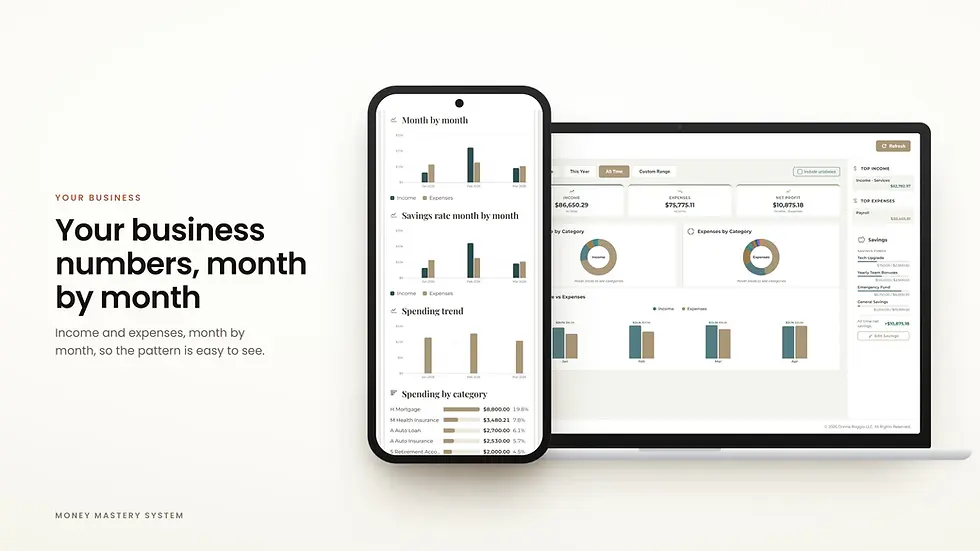
A business month, closed out. Example data.
What doesn't need a receipt
More than you might think. A subscription that appears on your card statement, a supplier you pay every week, a standing monthly payment: the statement already shows what it was, when, and who you paid.
Giving every transaction the same effort is how the habit dies. Save your effort for the ones that would be hard to explain later.
Where Money Mastery helps
Everything above comes down to one thing: whether the receipt stays with the transaction it belongs to.
In the Money Mastery System, it does. You attach the receipt to the transaction itself, so it sits right there next to its category, its business or personal label and any split, and it's there nine months later when someone asks what the $340 was. That's the difference between a minute a week and a lost afternoon in April. Receipts are part of Rise, which is $49.99 a month.
La Soglia, the free membership, holds everything you own and owe in one place, with no bank connection and no card. It doesn't store receipts. We'd rather you know that up front.
Keeping receipts this way is also what decides whether Q4 turns into a crisis, and whether catching up on your books takes eleven hours or twenty.
Bring it to the Collective
Everyone has a receipts system, and most people think theirs is the worst one. Share yours in the Money Mastery Collective. The discussion feed is open on the free membership.
Questions we hear
Is a photo of a receipt as good as the paper?
Generally, yes, as long as it's clear and readable.
What about receipts under $75?
Keep them when you can, and rely on your bank statement when you can't. The $75 line is a practical habit, not a legal rule.
Do I need to keep receipts for something I deducted years ago?
Yes, until the period for that tax return has passed. The table above shows how long.
What if I lost a whole year of receipts?
Your bank and card statements are records too. Rebuild what you can, note what you can't, and don't let a missing year stop you from keeping this one.
References
Retention periods follow the IRS guidance How long should I keep records?
Related guides: How to do your own bookkeeping, step by step · Home based business bookkeeping: a one-page checklist · Where does my money go? A simple money tracker.
Start free with La Soglia
La Soglia is the free membership of the Money Mastery System. It gives you the Net Worth Tracker, where everything you own and everything you owe sits in one place, and the Money Mastery Collective. There is no card to enter and no bank connection.
Keep in touch
Donna shares a short version of posts like this one on Instagram and LinkedIn. Follow along there, or find everything in one place on our links page.
A note on what this is
This article is educational. The Money Mastery System is an educational tool, not financial software, and nothing here is legal, tax, investment or financial advice. Retention periods depend on your situation, your entity and your state, and the longer periods exist for specific circumstances. For guidance on your own circumstances, please speak with a qualified professional who knows them.


Comments