


Product Cost Percentage in a Salon and Why It Drifts
Product should run about 8% of service revenue. Plenty of salons are at 12% and do not know it.
On $120,000 of revenue that gap is $4,800 a year. Nobody stole it. It went down the bowl a quarter ounce at a time.
Product cost is the most forgiving number in a salon, which is exactly why it drifts. Nothing breaks when it rises. It simply takes the difference out of what you keep.

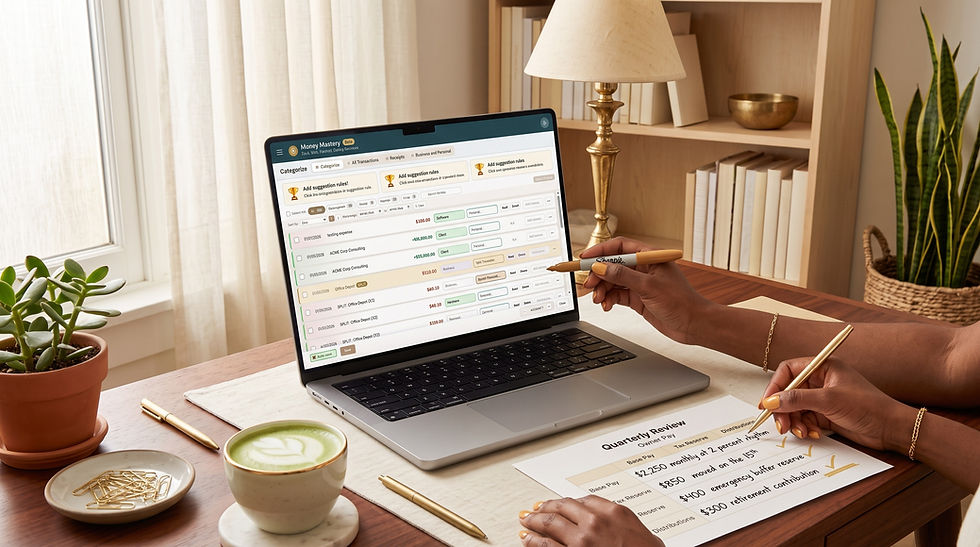
The Money Mastery System dashboard showing product cost as a share of service revenue. Example data.
The short version
Each point of product cost is worth 1% of your service revenue, every year.
At $120,000 of revenue, running at 12% when you could be at 8% costs $4,800 a year.
Count monthly, keep back bar and retail apart, and weigh color.
When a supplier raises prices, look at your own.
What the drift is worth
Service revenue | At 8% | At 10% | At 12% | Four points costs |
|---|---|---|---|---|
$60,000 | $4,800 | $6,000 | $7,200 | $2,400 |
$90,000 | $7,200 | $9,000 | $10,800 | $3,600 |
$120,000 | $9,600 | $12,000 | $14,400 | $4,800 |
$180,000 | $14,400 | $18,000 | $21,600 | $7,200 |
Every single point of drift is worth 1% of your service revenue, every year, forever. At $120,000 that is $1,200 a point.
Where it actually goes
Five places, in the order they cost you most.
Over-mixing. The most expensive habit in the building, and the one nobody sees, because the excess goes down the drain rather than onto a shelf.
Back bar and retail counted together. Two different businesses with two different margins. Mixed, neither can be managed.
No count. If nobody counts, the percentage is a guess, and a guess drifts in one direction only.
Price rises absorbed. Your supplier raised prices in March and your service prices did not move. The difference came out of your margin silently.
Colour waste on corrections. Sometimes unavoidable. Worth tracking separately so you know what it costs rather than letting it hide in the total.
The five habits that put it back
Count once a month, the same day. Ten minutes.
Separate back bar from retail in your categories, permanently.
Weigh colour. Weighing shows you exactly what each service uses, and nothing else on this list changes the number as quickly.
Re-check your prices when a supplier raises theirs. A supplier increase is a pricing event, not a cost event.
Track corrections separately so the number tells you something rather than just being high.

The categorization screen with product costs separated from retail. Example data.
Why this matters more if you rent your chair
If you rent, product is entirely yours, and booth rent vs commission assumed 8% when it worked out where the line falls between the two models.
At 12%, that line moves against you. The grid in that post uses 0.893 as what a renter keeps before rent. At 12% product it is 0.853, and every break-even number rises by about 10%.
So product drift does not only cost you $4,800. It can quietly make renting the wrong answer when it was the right one.
How to work out your own percentage
You need three figures for the same period: what you had on the shelf at the start, what you bought, and what was on the shelf at the end. A quarter works well, because it smooths out one large order.
Line | Amount |
|---|---|
Back bar stock at the start of the quarter | $1,200 |
Back bar product bought | $3,450 |
Back bar stock at the end | $1,050 |
Product used: start plus bought minus end | $3,600 |
Service revenue for the quarter | $30,000 |
Product cost percentage | 12.0% |
At 8% this salon would have used $2,400 of product. The difference is $1,200 for the quarter, which is the $4,800 a year from the table at the top.
Leave retail out of every line. Retail product is bought to be sold at a markup, and it belongs in its own sum against retail sales.
Do the sum once and write the result where you order product. The next time you place an order, you will be looking at the number it moves, and that alone tends to change what goes in the basket.
See your own percentage, free
You cannot manage a number you cannot see, and product cost is invisible until somebody separates it out. La Soglia, the free membership of the Money Mastery System, is free with no bank connection and no card. Rise, at $49.99 a month, is what keeps back bar and retail apart automatically, because Clarity remembers how you sorted something last time.
Salon owner bookkeeping starts with three numbers, and this is the second of them.
Bring it to the Collective
Product percentages are the most useful thing salon owners compare, and almost nobody posts them publicly. The Money Mastery Collective discussion feed is open on the free membership.
Questions we hear
Is 8% right for every salon?
No. Colour-heavy salons run higher and dry-styling salons run lower. What matters is your own number, tracked, and which way it is moving.
Should retail be in the percentage?
No. Keep them separate. Retail has its own margin and mixing them hides both.
What about a product charge on the ticket?
It works if it is honest and itemised. It does not fix over-mixing, it just moves who pays for it.
How do I calculate product cost percentage in a salon?
Divide the back bar product you used in a period by your service revenue for the same period, then multiply by 100. Product used is opening stock plus purchases minus closing stock.
How often should I check product cost?
Once a month, on the same day, with a stock count. A quarterly figure smooths out large orders.

Start free with La Soglia
La Soglia is the free membership of the Money Mastery System. It gives you the Net Worth Tracker, where everything you own and everything you owe sits in one place, and the Money Mastery Collective. There is no card to enter and no bank connection.
Keep in touch
Donna shares a short version of posts like this one on Instagram and LinkedIn. Follow along there, or find everything in one place on our links page.
A note on what this is
This article is educational. The Money Mastery System is an educational tool, not financial software, and nothing here is legal, tax, investment or financial advice. The 8% benchmark is a common industry figure, not a rule, and your own number depends on your services and your suppliers. For guidance on your own circumstances, please speak with a qualified professional who knows them.


Comments