


Pay Yourself a Steady Salary From Irregular Freelance Income
Updated: Sep 17
Pay yourself a steady salary, not whatever happens to be sitting in the account this month. That one shift is what turns freelance income from an emotional roller coaster into something you can actually plan a life around.
Roughly 67.5% of freelancers dealt with late payments in 2025, according to IOUmarker's research. Even freelancers earning plenty on paper regularly face weeks where the money simply isn't there yet. That gap between earning and receiving is what makes freelance income feel so unstable, and it's why paying yourself whatever happens to be in the account each month keeps you permanently reactive. A steady self-paid salary breaks that link.

Paying yourself a steady salary isn't a luxury for freelancers who've "made it." It's the mechanism that converts unpredictable income into a life you can actually plan.
By the end of this guide, you'll understand why owner pay should be fixed rather than fluctuating, how to calculate a salary number your income can actually sustain, how a business buffer account absorbs the ups and downs so your personal life doesn't feel them, and how to raise your salary responsibly as you grow. No corporate payroll system needed. Just two accounts and one number.
How to Pay Yourself a Steady Salary From Irregular Income
Three moving parts make this work: the number, the buffer, and the schedule.
Why Paying Yourself a Steady Salary Beats Taking Whatever's Left
Most freelancers pay themselves by sweeping whatever's in the business account into their personal one, which means their personal cash flow mirrors every swing in the business. A monster month feels like abundance. The quiet month that follows feels like failure, even when the two average out perfectly fine. Paying yourself a fixed salary flips this. Your business absorbs the volatility so your personal life doesn't have to. You get a boring, predictable paycheck, which is exactly what a household budget needs to function.
Calculate a Salary Your Income Can Sustain
The right salary number isn't your best month or even your average month. It's a figure your income can reliably cover through the lean stretches. Start by looking at your total take-home income over the last 6 to 12 months, after taxes and business expenses. Divide by the number of months to get your true monthly average, then set your salary slightly below it, often 80% to 90% of that average. Setting it a notch under your average is what leaves surplus in strong months to fund the buffer that carries you through the weak ones. Conservative here means sustainable.
Build the Buffer Account That Funds Your Salary
The engine that makes a steady salary possible is a business buffer: a holding account that all client income flows into, and that your salary is paid out of on a fixed schedule. In a big month, income piles up in the buffer above your salary. In a slow month, the buffer covers the gap. This is closely related to building a 3-month cash cushion on irregular income, and the two systems reinforce each other. Aim to build the buffer to at least one, ideally two, months of salary before you start relying on it, so it has something to draw from when the first slow month arrives.
Raise Your Salary Responsibly as You Grow
A fixed salary shouldn't be frozen forever. The right time to give yourself a raise is when your buffer has consistently stayed full for several months and your trailing average income has climbed, not after a single great month. When both are true, nudge the salary up modestly and watch whether the buffer holds. This disciplined approach lets your income grow into your lifestyle rather than the reverse, and it protects you from the lifestyle-creep trap of expanding spending on the strength of one lucky quarter.
Real Dollar Example: Paying Yourself a Steady Salary
Say a freelance developer's take-home income over the past year, after taxes and expenses, totaled $72,000, a true monthly average of $6,000. Rather than paying herself $9,500 in a boom month and $2,800 in a dead one, she sets a fixed salary of $5,000, about 83% of her average. Every client payment lands in her buffer account. On the 1st of each month, exactly $5,000 transfers to her personal checking. In strong months the buffer swells. In the two slow months she had last year, the buffer quietly covered the full $5,000 both times. Her business income still swung wildly. Her personal life felt completely steady.
Want a simple calculator to set your sustainable salary and size your buffer? Download the free Money Mastery Net Worth Tracker and set your paycheck while this is fresh.
Mistakes That Wreck a Steady Salary System
The first mistake is setting the salary at your best month's level. The fix is to base it on your trailing average and set it slightly below.
The second mistake is paying yourself directly from client payments as they arrive. The fix is to route all income through a buffer and pay a fixed amount from it.
The third mistake is starting the salary before the buffer exists. The fix is to build at least one month of salary in the buffer first, so the first slow month is covered.
The fourth mistake is raising your pay after one big month. The fix is to raise it only when the buffer has stayed consistently full and your average has genuinely risen.
How Money Mastery Helps You Pay Yourself a Steady Salary
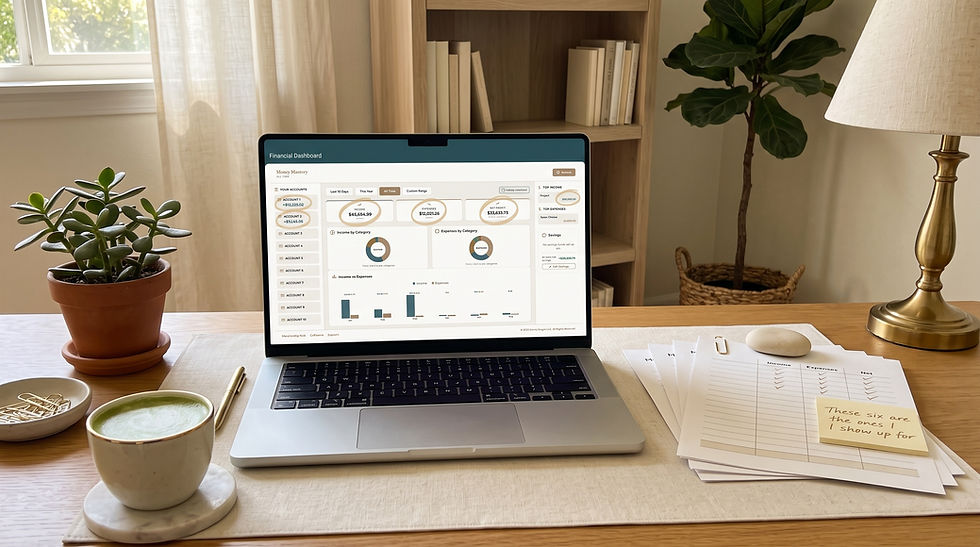
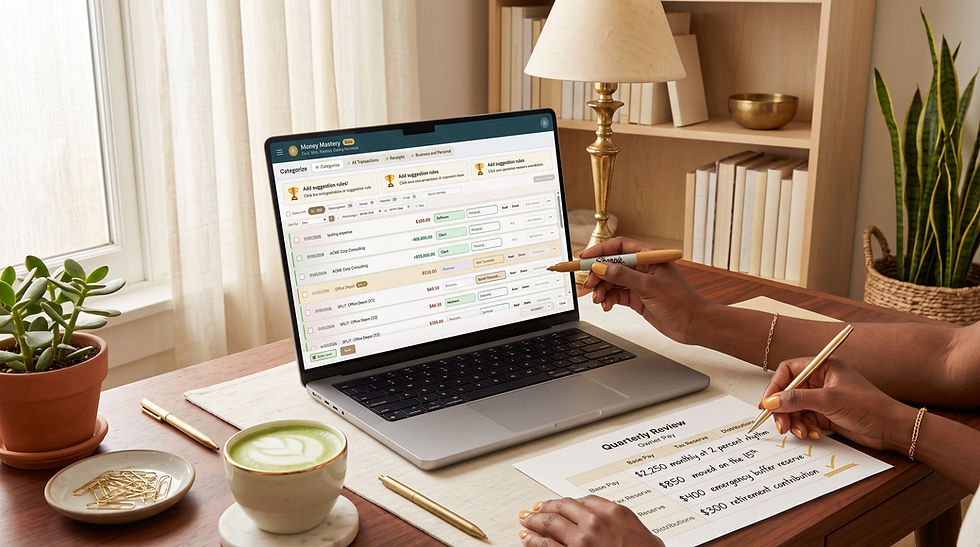
Paying yourself a steady salary depends on seeing the boundary between business money and personal money clearly: what the business earned, what it must hold for taxes and costs, and what's genuinely available to pay you. Money Mastery brings your personal and business finances into one connected view, so you can see how full your buffer is and whether your salary is truly sustainable, in real time.
QuickBooks and Mint record what happened, one account at a time. Money Mastery helps you understand what's happening right now, across every account, so your salary is set on reality instead of hope. The tone here is grounded and non-judgmental. No shame about lumpy income, just a system that smooths it into a paycheck.
Your Next Step
This week, add up your take-home income over the last 6 to 12 months, divide by the months to find your true average, and set a fixed salary at roughly 80% to 90% of it. Open a business buffer account, route your client income into it, and schedule that fixed amount to transfer to your personal account each month.

Frequently Asked Questions
How do I decide how much to pay myself as a freelancer?
Base it on your take-home income over the last 6 to 12 months, after taxes and expenses. Find the true monthly average, then set your fixed salary at roughly 80% to 90% of it. Setting it slightly below your average leaves surplus in good months to fund the buffer that covers the slow ones.
What is a business buffer account?
It's a holding account that all client income flows into and that your fixed salary is paid out of on a schedule. In strong months, money accumulates above your salary. In slow months, the buffer covers the gap. It's the mechanism that lets you pay yourself steadily despite irregular income.
Should I pay myself before or after setting aside taxes?
Set aside taxes first. Your salary should come from income that's already had its tax portion skimmed off into a separate account, so paying yourself never spends money you owe the IRS. Taxes, then buffer, then a fixed salary is the reliable order.
How big should my buffer be before I start paying a salary?
Aim to build at least one month of salary in the buffer, ideally two, before relying on it. That way, when your first slow month arrives, the buffer has something to draw from and your paycheck doesn't skip.
When should I give myself a raise?
Only when your buffer has stayed consistently full for several months and your trailing average income has genuinely climbed, not after a single great month. Then nudge the salary up modestly and confirm the buffer still holds before making it permanent.

Comments