


Estimated Taxes When Your Income Jumped This Year
If your income rose sharply this year, there's a rule that can protect you from an IRS penalty even if you've underpaid your estimated taxes. Most people who need it have never heard of it.
The IRS puts it plainly: you generally avoid the underpayment penalty if you paid at least 90% of this year's tax, or 100% of the tax on last year's return, whichever is smaller.
It's worth reading twice. In a year when your income jumped, last year's number is the smaller one, and it's a number you already know. This post shows how to use it, what it doesn't do, and what to do in the last quarter of the year.
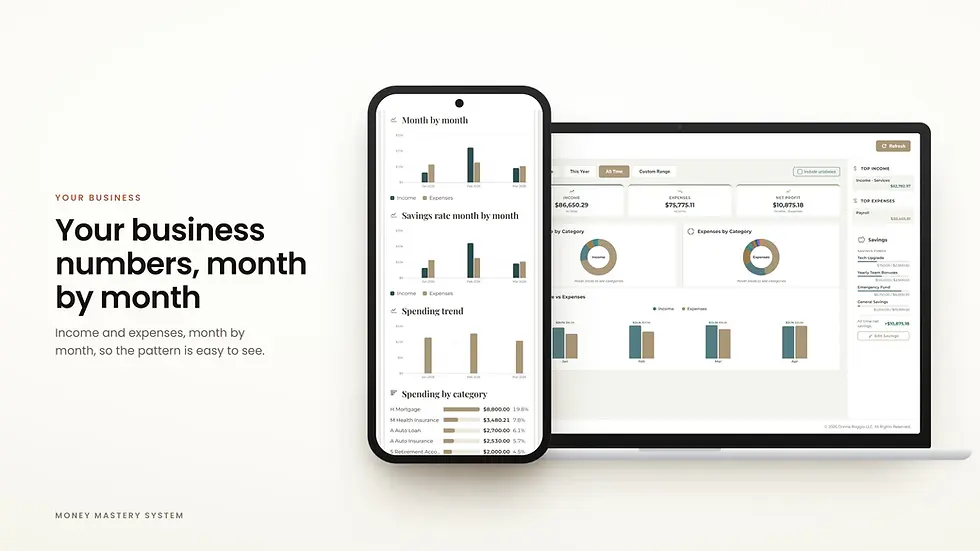
A strong year shows up in the monthly bars long before it shows up in your tax bill. Example data.
The short version
You generally avoid the underpayment penalty by paying 90% of this year's tax or 100% of last year's, whichever is smaller.
In a year when your income jumped, last year's figure is the smaller one.
This "safe harbor" prevents a penalty. It doesn't reduce the tax you owe when you file.
Higher incomes need a higher percentage, so check which one applies to you.
Who this applies to
The IRS says individuals, including sole proprietors, partners and S corporation shareholders, generally need to make estimated payments if they expect to owe $1,000 or more when they file.
You generally avoid the penalty if either of these is true:
you owe less than $1,000 after withholding and credits, or
you paid at least 90% of this year's tax, or 100% of last year's, whichever is smaller.
One thing to check: the IRS has special rules for farmers, fishermen and some higher-income taxpayers. Above a certain income, the percentage is higher than 100%. If your income is high, confirm which percentage applies to you rather than assuming.
What this means in a year your income jumped
Say last year's total tax was $9,000, and this year you're on track to owe $16,000.
Option | Amount to pay during the year |
|---|---|
90% of this year's tax | $14,400 |
100% of last year's tax | $9,000 |
The safe harbor, the smaller of the two | $9,000 |
So $9,000 is the number that protects you from the penalty.
You'll still owe the other $7,000 when you file. The safe harbor prevents a penalty, but it doesn't forgive the tax. What it does is turn an overwhelming quarterly demand into a known bill with a date on it, and that's a much easier problem to plan for.
What to do in the last quarter
Find last year's total tax. It's one line on last year's return, and the whole safe harbor depends on it.
Add up what you've paid so far this year, including any tax withheld from a job, or from a spouse's job if you file jointly.
Work out how far you are from the safe harbor, not from what you'll eventually owe.
Pay that difference with your fourth-quarter payment.
Set the rest aside separately, so April is a planned payment rather than a shock.
Our post on how to set next year's tax set-aside percentage is the version of this you do ahead of time instead of catching up.

Your tax set-aside, sitting beside everything else you own. Example data.
Why a jump year catches people out
Estimated payments are usually set at the start of the year, based on last year. Nothing recalculates them when March turns out to be extraordinary.
The money arrived, it felt like a great year, and it was. But the amount set aside for tax stayed at last year's level while income rose, and the difference got spent on ordinary things in an ordinary way.
That isn't carelessness. It's a system that was right in January and that nobody revisited.
Know your number before January, free
All of this depends on one figure: what your profit is actually running at this year. La Soglia, the free membership of the Money Mastery System, holds everything you own and everything you owe in one place, personal and business together, with no bank connection and no card.
Rise, at $49.99 a month, turns nine months of transactions into that profit figure without you adding up statements by hand.
This is the same work as what to do in Q4 so tax season isn't a crisis, done with a specific number attached.
Bring it to the Collective
A jump year is a good problem that can feel like a bad one, and it helps to hear from someone who's had one. Ask in the Money Mastery Collective. The discussion feed is open on the free membership.
Questions we hear
Is it too late if I missed earlier quarterly payments?
No, but paying now won't erase everything. The penalty is worked out quarter by quarter, so a late payment stops it growing from that point but doesn't undo earlier quarters. If you or your spouse have a job, raising your withholding can help, because withholding is generally treated as paid evenly through the year.
Does withholding help if I also have a job?
Yes, more than you might expect. Withholding is generally treated as paid evenly through the year, so increasing it late can cover earlier quarters in a way an estimated payment can't.
What if next year is quieter?
Then this year's big number works against you, because 100% of a big year is a lot to prepay. That's the year to use the 90% of the current year's tax instead.
Do I need an accountant for this?
For the safe harbor math, not necessarily. For a very large jump, a new business structure, or income in more than one state, yes.
What is the safe harbor for estimated taxes?
Paying at least 90% of this year's tax or 100% of the tax on last year's return, whichever is smaller, generally avoids the underpayment penalty. A higher percentage applies to some higher incomes.
Do I still owe tax if I meet the safe harbor?
Yes. The safe harbor prevents a penalty. Any remaining tax is still due when you file.
References
The $1,000 threshold, the 90% and 100% safe harbor, and the special rules for higher-income taxpayers are from the IRS page Estimated taxes, updated 25 September 2026.
Start free with La Soglia
La Soglia is the free membership of the Money Mastery System. It gives you the Net Worth Tracker, where everything you own and everything you owe sits in one place, and the Money Mastery Collective. There is no card to enter and no bank connection.
Keep in touch
Donna shares a short version of posts like this one on Instagram and LinkedIn. Follow along there, or find everything in one place on our links page.
A note on what this is
This article is educational. The Money Mastery System is an educational tool, not financial software, and nothing here is legal, tax, investment or financial advice. Estimated tax rules depend on your income, your entity, your state and your filing status, and a higher safe harbor percentage applies above certain incomes. For guidance on your own circumstances, please speak with a qualified professional who knows them.


Comments