


Cash Stuffing for Business Owners: Does the Envelope Method Work on Irregular Income?
Yes, with one change. Fill your envelopes with a percentage of each deposit, not a fixed amount.
Cash stuffing is the envelope method with a new name. You divide your money into labelled envelopes and spend only what is inside each one. It is everywhere online, and almost every version assumes the same paycheck every two weeks.
If you work for yourself, that is the one thing you do not have.
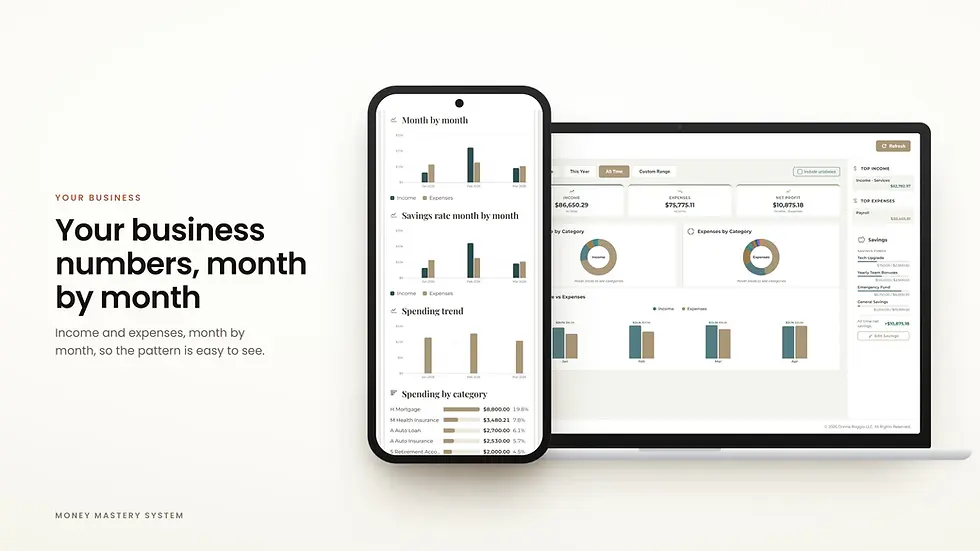
A business month by month, where no two deposits are the same. Example data.
The short version
Envelopes work because the decision is made before the money is spent.
Fixed amounts need a fixed income. Percentages do not.
Four envelopes cover most one-person businesses: tax, your pay, business costs and a cushion.
The envelope does not have to hold cash. A category does the same job and leaves a record.
What is cash stuffing?
You take your pay out as cash, sort it into envelopes named for what it is for, such as groceries, fuel and fun, and when an envelope is empty, that spending stops until the next payday.
The idea is far older than the videos. It works for a simple reason: you decide what the money is for before you are standing at the till, and you can see how much is left without opening an app.
Why it fails on irregular income
Three reasons, and only the first is about cash.
A fixed amount needs a fixed income. If the plan says $500 to each envelope and a slow week brings in $1,200, the plan breaks in the first month, and most people stop there.
Business costs do not arrive weekly. Insurance, software and tax come in lumps. A weekly envelope is the wrong shape for them.
Cash leaves no record. The IRS asks for a system that clearly shows your income and expenses. An empty envelope shows neither.
Filling envelopes when every deposit is different
Decide the shares once. Then every deposit, large or small, is divided the same way. Here are three uneven deposits split four ways. The percentages are an example to show the method, not a recommendation.
Deposit | Tax 25% | Pay myself 40% | Business costs 25% | Cushion 10% |
|---|---|---|---|---|
$1,200 | $300 | $480 | $300 | $120 |
$4,800 | $1,200 | $1,920 | $1,200 | $480 |
$2,000 | $500 | $800 | $500 | $200 |
$8,000 in total | $2,000 | $3,200 | $2,000 | $800 |
The slow week still fills every envelope. It just fills them less. And the good week does not vanish into a general feeling of having money, because $1,200 of it already belongs to tax.
How to set your own shares
Choose four to six envelopes. Fewer is better. Tax, your own pay, business costs and a cushion cover most one-person businesses.
Take the shares from your own history. Add up the last three months of income, and what went to each envelope in those months. Each envelope's total divided by the income is its starting share.
Split every deposit the day it lands. Not at the end of the month. The method works because the decision is already made.
Look again every three months. If one envelope keeps running dry, the share is wrong, not you.
The tax share is the one worth working out properly. Our post on how to set your tax set-aside percentage shows how, and how to pay yourself with irregular income covers the pay envelope.
When an envelope runs out
With a personal envelope, spending stops. With a business envelope it is not always that simple, because the insurance is still due.
That is what the cushion is for. It is the envelope you borrow from on purpose, and refill first. If you are borrowing from it most months, raise the share of the envelope that keeps falling short and lower another. The method is doing its job when it shows you that.
Do the envelopes have to hold real cash?
No. The envelope is a decision made in advance, and paper is only one way to hold it. Categories do the same job, and they leave a record, which cash does not.

Each category is an envelope you can see filling and emptying through the month. Example data.
If you like physical cash for everyday spending, keep it for that. It is a good tool for groceries and a poor one for a tax bill. Let the business envelopes live where they can be counted and backed by a statement.
Keeping the part people enjoy
Keep the ritual. Choose one evening a week, sit down with a cup of something, and sort that week's deposits into their envelopes. It takes ten minutes and gives the same small satisfaction as the paper version.
Some people print a simple tracker and colour in each envelope as it fills. If that keeps you coming back, it is doing real work.
So, does it work?
The idea does. Deciding in advance what money is for is the oldest good advice there is. The internet version needs two changes before it fits someone who is paid unevenly: percentages in place of fixed amounts, and a record in place of a pile of notes.
See your envelopes in one place, free
Envelopes only help if you can still see the whole picture. La Soglia, the free membership of the Money Mastery System, holds everything you own and owe in one place, personal and business together, with no bank connection and no card. Sorting each deposit and expense into categories is the paid membership.
Bring it to the Collective
Which envelopes, and what share for each, is the kind of thing that is easier with other owners to compare against. The Money Mastery Collective has a discussion feed open on the free membership.
Questions we hear
How many envelopes should I have?
Four to six. Every envelope is a decision each time money arrives, and a method with twelve decisions gets skipped on a busy day.
What percentages should I use?
Your own, taken from your last three months of income and spending. The percentages in the table are an example of the method.
Can I do this with one bank account?
Yes. Separate accounts make it easier to see, but one account with every transaction labelled gives you the same envelopes.
Is cash stuffing a good idea for tax money?
Keep tax money somewhere it can be counted and backed by a statement. Cash is better suited to everyday spending.
References
The recordkeeping standard is from the IRS page What kind of records should I keep. General budgeting guidance is from the Consumer Financial Protection Bureau. The deposit table is our own worked example.
Start free with La Soglia
La Soglia is the free membership of the Money Mastery System. It gives you the Net Worth Tracker, where everything you own and everything you owe sits in one place, and the Money Mastery Collective. There is no card to enter and no bank connection.
Keep in touch
Donna shares a short version of posts like this one on Instagram and LinkedIn. Follow along there, or find everything in one place on our links page.
A note on what this is
This article is educational. The Money Mastery System is an educational tool, not financial software, and nothing here is legal, tax, investment or financial advice. The percentages are illustrations of a method, not advice on what to set aside. For guidance on your own circumstances, please speak with a qualified professional who knows them.


Comments