


Yearly Business Bills: How to Turn Six Surprises Into One Monthly Amount
The bills that hurt most in a small business are rarely the large ones. They are the ones that come once a year, at a time you had forgotten about, and land in a month that was already tight. Add them up, divide by twelve, and they stop being surprises.
In the example below, six yearly bills come to $5,064. That is $422 a month. Moved into a separate account as you go, it means the insurance renewal in March is already paid for in February.
Here is how to find your own yearly bills, the sum, and where to keep the money so it is there when the bill arrives.
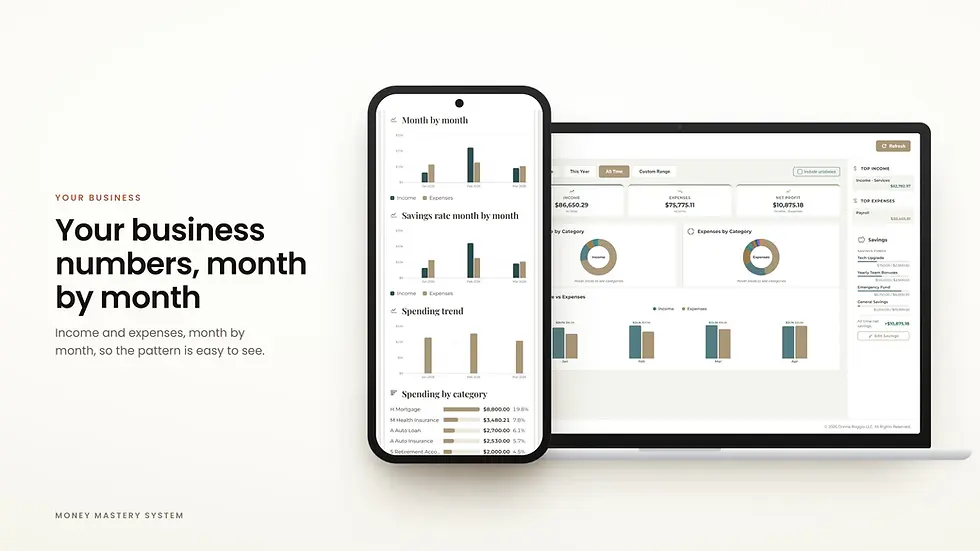
A month with a yearly bill in it stands out from the others. Example data.
The short version
List every business bill that comes once or twice a year.
Add them up and divide by twelve.
Move that amount each month into its own account.
When a bill arrives, pay it from there. The month it lands in does not change.
Finding them
Yearly bills are easy to miss because they appear in only one statement out of twelve. The reliable way to find them is to look back over a whole year of business spending and pick out anything that did not repeat monthly.
Insurance. Liability, professional and property cover are often billed yearly.
Licenses and registrations. Professional licenses, business registration, permits.
Software on a yearly plan. Often cheaper than monthly, and easy to forget.
Your accountant. Tax preparation comes once, usually in spring.
Domain names and hosting.
Equipment you replace on a cycle. A computer every four years is a yearly cost when you average it.
The sum
Yearly bill | A year | A month |
|---|---|---|
Business insurance | $1,440 | $120 |
Professional license | $360 | $30 |
Software on yearly plans | $948 | $79 |
Accountant | $900 | $75 |
Domain and hosting | $216 | $18 |
Equipment replacement | $1,200 | $100 |
Total | $5,064 | $422 |
So the real monthly cost of running this business is $422 higher than her ordinary months suggest. That is not new spending. It was always there, hiding in two or three bad months a year.
What changes when you set it aside
Without a set-aside | With $422 a month set aside | |
|---|---|---|
An ordinary month | Feels comfortable | Feels slightly tighter, and is accurate |
The month insurance renews | $1,440 from that month's income | Already covered |
Your sense of what the business costs | Too low | Correct |
Your pricing | Based on eleven easy months | Based on the whole year |
The last row matters most. If you set your prices by looking at an ordinary month, you are leaving $5,064 a year out of the calculation. Every yearly bill then comes out of your own pay.
Where to keep it
In a business savings account of its own, separate from your tax set-aside and from your cushion. Three pots with three jobs.
Pot | What it is for | When it is used |
|---|---|---|
Tax set-aside | Tax you already owe | Four times a year |
Yearly bills | Bills you know are coming | When each one arrives |
Cushion | Things you cannot predict | A slow month or a surprise |
Keeping them apart stops one from quietly paying for another. A known bill should never have to come out of the money you kept for an unknown one.

Yearly costs belong in every month of the report, not in one. Example data.
If you are starting partway through the year
Some of your bills may be due before twelve months of setting aside have passed. For each one, divide by the months that remain.
Bill | Amount | Due in | Set aside each month until then |
|---|---|---|---|
Insurance | $1,440 | 5 months | $288 |
Accountant | $900 | 6 months | $150 |
License | $360 | 9 months | $40 |
The first year costs more each month because you are catching up. From the second year on, it settles to the simple figure of the total divided by twelve.
Monthly or yearly plans?
Many services offer a discount for paying yearly, often equal to two months free. That is a real saving, and worth taking if two things are true: you are sure you will use the service all year, and the yearly payment is in your set-aside.
A yearly plan paid from a tight month is a cheap price bought with expensive stress. Take the discount once the pot exists.
Three mistakes
Listing from memory. Look at twelve months of statements. Memory misses the ones that hurt.
Keeping it in the main account. Money that sits there gets spent.
Forgetting equipment. It is the largest line for many businesses and the least regular.
If the idea of separate pots is new, our earlier post on what sinking funds are covers the same habit on the personal side.
See the whole picture, free
La Soglia, the free membership of the Money Mastery System, holds every account you have in one place, personal and business together, with no bank connection and no card. Give the yearly bills pot its own line and you can see at a glance whether March is covered.
Bring it to the Collective
Which yearly bill catches you out every time? The Money Mastery Collective has a discussion feed open on the free membership. Name yours, and borrow someone else's list.
Questions we hear
How do I budget for annual business expenses?
List every bill that comes once or twice a year, add them up, divide by twelve, and move that amount each month into a separate account.
What are common annual business costs?
Insurance, licenses and registrations, software on yearly plans, tax preparation, domains and hosting, and equipment you replace on a cycle.
Where should I keep money for yearly bills?
In a business savings account of its own, apart from your tax set-aside and your cushion.
Is it better to pay for software monthly or yearly?
Yearly is often cheaper. Take the discount when you are sure you will use the service all year and the money is already set aside.
References
There are no outside figures in this post. Every number is our own worked example.
Start free with La Soglia
La Soglia is the free membership of the Money Mastery System. It gives you the Net Worth Tracker, where everything you own and everything you owe sits in one place, and the Money Mastery Collective. There is no card to enter and no bank connection.
Keep in touch
Donna shares a short version of posts like this one on Instagram and LinkedIn. Follow along there, or find everything in one place on our links page.
A note on what this is
This article is educational. The Money Mastery System is an educational tool, not financial software, and nothing here is legal, tax, investment or financial advice. The figures are illustrations, and your own bills and their dates will differ. For guidance on your own circumstances, please speak with a qualified professional who knows them.


Comments