top of page

If you are comparing Money Mastery vs QuickBooks, start by asking a better question than “Which one is better?” Ask which one is built for the problem you are actually trying to solve.


Cozy home office desk with laptop showing Personal vs Business finances, candle, iced coffee, notebook, plants, and books.

That matters because these two tools are not trying to do the same job.


QuickBooks is built first as accounting software. Intuit says QuickBooks connects bank and credit card transactions, helps track income and expenses, runs reports, and includes a built-in cash flow statement. QuickBooks accounting overview QuickBooks expense tracking If what you need most is bookkeeping infrastructure, automatic transaction syncing, receipt capture, and tax-ready record organization, QuickBooks is a logical option.


Money Mastery, based on your internal strategy and source-of-truth documents, is positioned differently. It is built around full-picture financial clarity, behavior change, and community-led follow-through. In other words, it is not trying to replace accounting logic alone. It is trying to help women understand their money, stay connected to it, and make decisions from a calmer, more complete view.


That distinction is exactly where many buyers get confused. They choose a tool that is competent at storing information when what they actually need is a system that helps them stay engaged with the information.


Start by deciding what job you need done first


If you are a sole owner trying to choose between the two, do this before comparing features.


Hands hold bookkeeping and money clarity notes before a laptop showing Money Mastery dashboard on a cozy desk.

Write down which of these problems is most true right now:

  • My books are messy and I need accounting structure.

  • I avoid my numbers and need a better money habit.

  • I know what came in, but I do not know what I kept.

  • I want transaction syncing and standard business reports.

  • I want more support, context, and consistency around money decisions.


If your biggest problem is bookkeeping infrastructure, QuickBooks likely solves that problem more directly. Intuit’s own language emphasizes synced accounts, imported transactions, categorized expenses, and reporting. QuickBooks accounting overview QuickBooks expense tracking


If your biggest problem is that you do not trust yourself to stay close to the numbers, the answer may not be more automation. It may be more structure, more interpretation, and more accountability around the money itself.

That is where Money Mastery becomes different.


Choose QuickBooks if you need accounting automation first


Choose QuickBooks first if you need:

  • automatic bank and credit card syncing

  • a system designed to keep the books current for tax and accounting purposes


That is not a knock on Money Mastery. It is simply the right tool for a particular job.

If someone is several months behind on transaction organization, wants a direct accounting backbone, and needs a bookkeeper-friendly environment, QuickBooks is usually easier to justify.


This is also where a post like What Is a Profit and Loss Statement? becomes helpful. If the person needs to understand reports once the books are organized, that post is a natural internal next step.


Choose Money Mastery if you need full-picture financial clarity and follow-through


Choose Money Mastery first if you need:

  • visibility into how business and personal money interact

  • a system that supports behavior change, not only recordkeeping

  • help knowing what to review and what it means

  • more consistency around weekly and monthly money habits

  • community or guided support so the numbers do not stay abstract


This is where many women business owners discover that the problem is not software capability. It is follow-through capability.


They may already have access to statements, reports, or even bookkeeping. What they still do not have is a rhythm that helps them look regularly, interpret calmly, and decide confidently.


That connects directly to What Financial Clarity Actually Means and Why Every Business Owner Needs a Monthly Financial Review Checklist. If you want someone to use the information better, not just collect it better, that is a different kind of solution.


Hands count cash at a laptop showing a Profit & Loss dashboard on a cozy desk with coffee, notebook, and scissors.

Use this test if you are still unsure

Ask yourself these five questions.


  1. Can I already access my numbers, but I still do not feel clear?

  2. Do I have reports, but I am not regularly using them to make decisions?

  3. Do I want a tool that helps me organize transactions, or a system that helps me stay engaged with money?

  4. Am I trying to solve bookkeeping, or am I trying to solve avoidance?

  5. Would I benefit more from automation, or from accountability and interpretation?


Your answers usually tell you which direction to go.


A better example of how this shows up in real life

Picture a salon owner named Brianna who has been saying she needs “better software.” When she looks more closely, what she really means is that she does not know what to review every week, she is inconsistent about checking expenses, and she feels emotionally behind every time she logs in. If she buys software that automates transactions but never changes her money rhythm, she may end up with cleaner records and the same anxiety.


Now picture a consultant named Alina whose transactions are spread across cards, receipts, and memory. Her accountant needs a cleaner system, and she is tired of catch-up bookkeeping. In her case, a bookkeeping-first tool may solve a very real pain point quickly.


Both women need help. They do not need the same kind of help.


What not to do

  • Do not choose QuickBooks because it is the most recognizable name if your real problem is financial avoidance.

  • Do not choose Money Mastery expecting it to replace every accounting workflow if what you truly need is a tax-ready bookkeeping engine.

  • Do not buy either tool based only on features. Buy based on the decision bottleneck you need to remove.


What to do next

If you want automation and bookkeeping infrastructure, compare QuickBooks against the exact accounting workflows you need.


If you want clarity, consistency, and a more supported money rhythm, start with Money Mastery and the Collective.


If what you really need is to stop feeling alone with your numbers, join the Collective at https://moneymasterycollective.circle.so.


FAQ

Is Money Mastery supposed to replace QuickBooks completely?

Not necessarily. Based on your needs, Money Mastery is solving a broader and more behavioral problem than bookkeeping alone. For some business owners, the right answer may be Money Mastery instead of QuickBooks. For others, it may be Money Mastery alongside an accounting tool. The key is being honest about whether the immediate issue is recordkeeping, money clarity, or both.


Who should choose QuickBooks first?

Choose QuickBooks first if your books are behind, you need automatic transaction imports, your accountant or bookkeeper needs standardized records, or your immediate pain point is accounting cleanup. QuickBooks is explicitly built around syncing accounts, categorizing expenses, and generating business reports, so it makes the most sense when those functions are the main bottleneck.


Who is more likely to benefit from Money Mastery first?

A woman business owner who already has access to her numbers but still avoids them, feels unclear about what the numbers mean, or wants a more supportive and whole-life financial system is more likely to benefit from Money Mastery first. If the real issue is follow-through, interpretation, or feeling disconnected from money decisions, a bookkeeping-only fix may not be enough.

A monthly net worth check for women business owners sounds more intimidating than it really is.


Person using a calculator at a desk with an open finance planner and laptop showing Net Worth, Assets and Liabilities charts.

Most people hear “net worth” and picture a wealth metric meant for investors, financial planners, or people who feel far more polished than they do. But in real life, net worth is a visibility tool. It answers one simple question: what do I own, what do I owe, and what does the full picture look like right now?


That question matters for women business owners because money is rarely sitting in one clean place. It is spread across checking, savings, business cash, retirement accounts, debt, property, equipment, maybe business equity, and whatever emotional meaning you have attached to all of it.


If you only look at one balance at a time, you can misread your whole life.


Why a monthly net worth check for women business owners matters more in midlife


The older and more layered your financial life becomes, the less helpful a single account balance is.


You may be running a business and supporting a household.


You may be catching up on retirement while also paying down debt.


You may be building assets in one part of life while still carrying pressure in another.


This is exactly why net worth becomes so useful. It shows the full picture, not just the loudest number in the room.


The Federal Reserve’s 2025 household well-being report found that among adults ages 45 to 59, 70% said they were doing okay financially or living comfortably. That sounds strong at first, until you remember it also means a meaningful minority were not. Federal Reserve household well-being data At the same time, the Federal Reserve found that among adults 45 to 59, 54% had rainy-day savings covering three months of expenses, and among women overall, 53% had that level of savings. Federal Reserve savings data


That is exactly the kind of reality net worth helps you hold.


You may be functioning.

You may be earning.

You may even be improving.


But if you cannot see the whole picture, it is hard to know.


What a monthly net worth check for women business owners helps you see more clearly


The power of this habit is not just in the number itself. It is in what the number makes visible over time.


When you review net worth monthly, you start to see:

  • whether debt is actually shrinking

  • whether savings are becoming more stable

  • whether the business is building real equity or just creating motion

  • whether retirement is getting attention

  • whether your life is getting sturdier, even when one month feels messy


That is also why How to Calculate Your Personal Net Worth is such a valuable internal resource. It gives readers the step-by-step framework. This post adds the behavioral layer: why the habit matters, especially for a woman trying to build a more stable second chapter.


Keep the monthly version simple enough to repeat


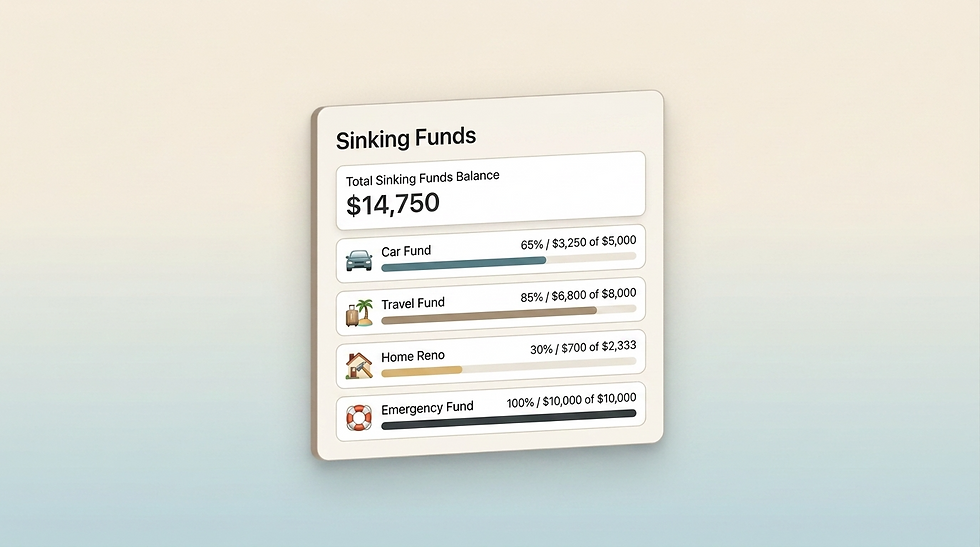
Dashboard card shows Sinking Funds balance $14,750 with progress bars for car, travel, home reno, and emergency funds.

The mistake most people make is turning net worth into an occasional project instead of a regular practice.


You do not need to do a full financial deep dive every month.


You need a short repeatable check-in.


  1. List the major assets you own.

  2. List the major liabilities you owe.

  3. Update the balances.

  4. Compare them with last month.

  5. Then write one sentence about what changed.


That last step is the one many people skip, and it matters more than they expect.

A note like “cash dipped, but debt also dropped” or “business cash improved, but savings stayed flat” gives context to the numbers. It keeps you from reacting emotionally to one balance without understanding the full movement behind it.


This is also where Why Every Business Owner Needs a Monthly Financial Review Checklist fits naturally into the reader journey. The monthly review helps you see the month. Net worth helps you see the bigger arc.


A real example of how this changes the story

Picture Renee, a 52-year-old service-based business owner.


She checks her bank balance often, but every glance tells a different emotional story. If it is lower than she hoped, she feels behind. If it is higher than usual, she feels temporary relief. Neither feeling tells her whether her overall life is becoming more secure.


Then she starts a monthly net worth habit.


Now she can see that while cash moves around, debt is slowly declining, savings are growing more consistently, and retirement contributions are reappearing after a long stretch of neglect. The business may still have uneven months, but the full picture is stronger than her worst-day thoughts suggested.

That changes how she makes decisions.


She becomes less reactive to a single number and more responsive to the real trend.


Why this is especially important for second-chapter planning


Money Mastery is speaking to women who are not just trying to survive the month. They are trying to shape the next decade.


That makes net worth more relevant, not less.


The Federal Reserve found that 67% of adults had assets specifically designated for retirement income, and among adults 55 to 64, 70% had a tax-preferred retirement account while 77% had either a retirement account or pension. Federal Reserve savings and investments data That is not a reason to compare yourself to strangers. It is a reminder that retirement, debt, savings, home equity, and business value are all part of the same financial picture.


When you review net worth monthly, you stop treating those areas like unrelated categories and start seeing them as one integrated life.


If you want a steadier, less emotionally noisy way to stay connected to that bigger picture, join the Collective.


FAQ


What belongs in a monthly net worth check?

Major personal and business assets, major liabilities, and balances that meaningfully affect your financial picture.


Do I need exact numbers every month?

No. Useful and repeatable is better than perfect and avoided.


Why is net worth more helpful than income by itself?

Income tells you what came in. Net worth helps you see what you have built, what you still owe, and whether your overall position is improving.

Financial clarity is total visibility into your money: every dollar that comes in, every dollar that goes out, the patterns inside those flows, and how all of it connects to where you want your business to go. It's the level above budgeting. A budget tells you what you're allowed to spend. Financial clarity tells you what's actually happening, why it's happening, and what to do next.


Clarity is the data. The budget is just one decision you make with it.


If you've ever built a budget, stuck to it for two weeks, then quietly abandoned it because real life didn't fit inside the spreadsheet, you're not undisciplined. You're under-informed. Most business owners I work with don't need stricter rules. They need a clearer view.


By the end of this post you'll know exactly what financial clarity means for a woman running a business, how it differs from budgeting, the five pillars that make it work, and the specific signs that tell you whether you have it yet.


Business owner calmly reviewing finances in warm-lit home office, building money clarity

What Financial Clarity Actually Means


Financial clarity isn't a feeling. It's a measurable state. You have it when you can answer five questions in under sixty seconds without opening QuickBooks, calling your bookkeeper, or staring at the ceiling.


How much did your business make last month. How much did it actually keep. What are your three largest expense categories. How much you personally took home. What you're saving toward and how close you are.


If any of those answers require digging, guessing, or apologizing, you don't have clarity yet. You have records. Records are historical. Clarity is current. That distinction is the entire point.


According to a U.S. Bank study widely cited by SCORE and the SBA, 82% of small business failures trace back to poor cash flow management or a poor understanding of cash flow. Not poor revenue. Not bad ideas. Understanding. That gap between "I'm making money" and "I know where my money is" is what closes businesses, and it's exactly the gap financial clarity fills.


Why a Budget Isn't Enough


Budgets are predictions. You decide in advance what you'll spend, you assign categories, you draw a line, and then you try to live inside it. The problem is that running a business is not predictable in the way a budget assumes it is. Income arrives irregularly. Expenses spike when a client opportunity shows up. Software renewals hit on a Tuesday you weren't watching.


A budget fails the moment reality deviates from the forecast, which is week one. So you feel like you failed. You didn't. The tool was wrong for the job.


Financial clarity is a different model entirely. Instead of predicting and constraining, you observe and respond. You see what's happening in real time, you understand the patterns underneath, and you make the next decision from a position of knowing rather than guessing. If you're new to seeing your money in patterns rather than line items, our walkthrough on how to track where your money goes is a good place to start.


A budget says no. Clarity asks why. That difference changes everything.


The Five Pillars of Financial Clarity


Clarity isn't one practice. It's five interlocking ones. If any pillar is weak, the whole structure wobbles. Here's the framework I use with every Money Mastery client.


1. Separation

Your business money and your personal money live in different accounts, on different cards, with different rules. No mixing. No "I'll figure it out at tax time." This is the foundation, and most business owners skip it. Our guide on how to separate business and personal finances walks through the exact setup.


2. Visibility

Every transaction, business and personal, is captured in a system you actually look at. Not buried in a bank app, not filed in a shoebox of receipts. Captured, categorized, and visible at a glance.


3. Categorization

Money is sorted into categories that match how you actually live and work, not generic ones a bank assigned. Your categories should answer real questions: where does my marketing budget actually go, what am I paying in subscriptions, how much of my income is going to me versus the business.


4. Pattern Recognition

You review weekly, not yearly. You start to see the patterns: the months that run lean, the categories that bloat, the income rhythms that repeat. Pattern recognition is what turns data into decisions.


5. Goal Alignment

Every dollar has a job that connects to a goal you actually care about. Pay yourself more. Build a six-month buffer. Invest in the next hire. Without this pillar, clarity becomes accounting. With it, clarity becomes strategy.


Clarity vs. Budgeting: A Side-by-Side Breakdown


Here's what the difference looks like in practice, across the moments that actually matter in a business owner's week.

Situation

Budget Approach

Financial Clarity Approach

Unexpected $400 expense

"I'm over budget." Guilt.

"That came from category X. Here's what it shifts." Decision.

Client pays $5,000 early

Money sits, gets absorbed.

Allocated to pre-defined buckets within 48 hours.

Slow month

Panic and cut everything.

Check buffer, see how many months of runway, adjust calmly.

Tax season

Frantic catch-up.

Numbers are already organized. Hand off and move on.

Considering a new hire

"Can I afford it?" Unclear.

Run the actual numbers against last 6 months of data. Clear.

Pricing a new offer

Guess based on what feels right.

Price against real cost data and profit goals.

The pattern across every row is the same. A budget reacts. Clarity informs. You stop making money decisions from fear or guesswork and start making them from data.


Modern financial clarity dashboard on laptop showing clean data visualization for business owners

Signs You Have Financial Clarity (and Signs You Don't)


You don't need a CPA's report card to know where you stand. The signs are felt before they're seen.


You have clarity when you can open your bank app on a Tuesday morning and feel curious rather than nauseous. When your accountant emails you and you respond the same day instead of avoiding it for a week. When someone asks what you charge and you can explain the reasoning behind the number. When a credit card statement arrives and there are no surprises on it (and if you're still confused about what a credit card payment actually is on your books, this post clears it up).


You don't have clarity yet when you avoid checking balances. When tax season requires three weekends of catch-up. When you can't say what you paid yourself last month without looking. When subscriptions you forgot about hit the account and surprise you. If that last one sounds familiar, walk through our guide on how to find and cancel subscriptions this week. It usually frees up $100 to $300 a month for clients I work with.


None of those signs are character flaws. They're system gaps. Systems are fixable.


How Money Mastery Creates Clarity Without Spreadsheets


This is the gap I built Money Mastery to close. Most financial tools give you data.


QuickBooks gives you reports. Mint gives you charts. YNAB gives you envelopes. Those tools do what they do well, but the gap is the translation layer between data and decision. None of them tell a woman running a business what the numbers mean for her life.


Money Mastery is a clarity system, not a software replacement. It's the weekly rhythm, the category framework, the review template, and the decision flow that turns raw bank data into actual confidence. You can use it alongside any tool you already have. The result is the same: you stop hoping you're okay financially and start knowing.


Download the free Money Mastery Net Worth Tracker at https://moneymastery-system.com/free. It puts your personal and business accounts side by side across sixty account types and twelve tabs, and it stays yours.


How to Start Building Financial Clarity This Week


You don't build clarity in a weekend. You build it in fifteen-minute increments, repeated. Here's the smallest viable starting point.


Open your bank account today and write down three numbers: current business balance, current personal balance, total income that landed in the last 30 days. That's it. That's day one. Tomorrow, categorize the last 30 days of transactions into five buckets: income, fixed expenses, variable expenses, owner pay, and savings. Day three, look at the buckets and notice one pattern that surprises you. Day four, decide one thing to do differently based on that pattern.


That's a clarity practice. Not a budget. Not a punishment. A practice. The full sequence for new business owners is laid out in our post on how to do your own bookkeeping for a small business, and once you've done one month, the monthly financial review checklist keeps the rhythm going.


Your Next Step

Financial clarity isn't a personality trait. It isn't something some women just have and others don't. It's the natural result of having a system that fits your actual life. You don't need to be good with money. You need a structure that makes money behave.


Start with the assessment. See where your five pillars stand right now. Then pick the weakest one and spend a week there.


Get the free Net Worth Tracker here: https://moneymastery-system.com/free


Frequently Asked Questions


What is financial clarity in simple terms?

Financial clarity is the ability to see and understand exactly what's happening with your money in real time. It means knowing what's coming in, what's going out, why it's moving the way it is, and how each dollar connects to a goal. It's different from budgeting because clarity is about visibility and understanding, while a budget is about restriction. Clarity gives you the data. The budget is just one decision you might make with that data.


Why do business owners need financial clarity more than a budget?

Business income isn't predictable enough for traditional budgeting to work. Revenue arrives in lumps. Expenses shift with opportunities. A budget assumes stability that doesn't exist in self-employment, which is why most business owners abandon them within weeks. Financial clarity adapts to reality instead of fighting it. You observe what's actually happening, recognize patterns over time, and make informed decisions in the moment rather than trying to predict everything in advance.


How long does it take to build financial clarity?

Most business owners feel a meaningful shift within 30 days of consistent weekly reviews, and full clarity inside 90 days. The first two weeks are usually the messiest because you're capturing months of disorganized data. By week three the patterns start to show, and by week eight decisions get noticeably easier. Money Mastery's weekly 15-minute review structure is designed specifically for this 90-day arc, so the time investment stays small while the clarity compounds.


Can I have financial clarity without using accounting software?

Yes. Clarity is a practice, not a piece of software. Plenty of business owners build it using a simple spreadsheet, a notebook, or the Money Mastery review templates alongside their regular bank app. Software like QuickBooks helps with tax reporting and bookkeeping mechanics, but it doesn't automatically create clarity, and many users have full QuickBooks accounts they still don't understand. What creates clarity is the weekly review habit and the framework you review against, not the tool.


What's the difference between financial clarity and financial literacy?

Financial literacy is knowing what terms mean: cash flow, profit margin, owner's draw, accounts receivable. Financial clarity is knowing what your numbers are doing right now and what to do about them. Literacy is the vocabulary. Clarity is the practice. You can be financially literate and still anxious about money because you're not actually looking at your numbers. And you can build clarity even if some terms still feel new, because the system teaches you as you go.


If you would like to talk it through with someone, Donna Roggio is a business coach with fifteen years of experience helping women sort this out, and a first call with her is free.

Related Posts

bottom of page