top of page

If you have been looking for a money support group for women business owners, there is a good chance you are not actually looking for more information.


You are probably looking for a better experience around money.


Laptop shows a 127-person video call with smiling participants on a Money Mastery Reset Call; coffee mug and notebook on a wooden desk.

You may already know the basics. You know you should review your numbers. You know you should separate business and personal spending. You know you should check what came in, what went out, and what is left. The problem is not usually knowledge. The problem is what happens emotionally the moment you try to sit down and do it.


For a lot of women, especially women running businesses while carrying family, life, and future planning all at once, money can feel heavier in private than it looks from the outside. You open the account and immediately feel behind. You see an expense you forgot about and feel embarrassed. You realize you still have not looked at the full month and promise yourself you will do it when you have more time, more energy, or a little less stress.


That cycle is more common than most people think.


And the broader business environment is not making it easier. In the Federal Reserve’s 2025 Small Business Credit Survey, 57% of small firms said reaching customers and growing sales was a challenge, 75% cited rising costs as a financial challenge, and 51% said uneven cash flow was a challenge. That is a real pressure stack, and it helps explain why so many owners are functioning while still feeling financially tired. Federal Reserve Small Business Credit Survey


Why a money support group for women business owners can change more than motivation


The biggest shift community creates is not inspiration. It is consistency.


When money work only happens in isolation, every task gets heavier. You rely on willpower. You rely on memory. You rely on the version of yourself who is somehow going to feel more emotionally available next week. That approach breaks down fast.


Support changes that.


Person highlighting budget papers at a wooden kitchen table, with a notebook, mug, water jar, and bowl of lemons.

In a good financial community, the pressure lowers because the process becomes shared, structured, and repeatable. You are not the only person trying to look at the truth. You are not the only person who feels a little resistance before opening the bank app. You are not the only person who has ever mixed life, business, stress, and money in the same month.


That matters because shame does not create follow-through. Clarity does.


If you have read What Financial Clarity Actually Means, you already know that clarity is not a mood. It is being able to answer practical questions about your money without digging, guessing, or apologizing. A community can help you get there faster because it gives you rhythm, language, and accountability around the habits that create that kind of visibility.


What a money support group for women business owners gives you that a spreadsheet cannot


A spreadsheet can organize data.


It cannot help you come back to the data when you feel ashamed.


It cannot tell you which number matters most this week.


It cannot normalize the fact that many business owners are carrying more financial pressure than they let people see.


That is where support becomes practical.


The best communities usually give readers and members four things.


First, they give you a regular cadence. That might be a weekly check-in, a monthly review, a live session, or a prompt that gets you back in the room before avoidance grows. This is one reason a post like Why Every Business Owner Needs a Monthly Financial Review Checklist works so well. It gives the reader a repeatable process, not just a good idea.


Second, they give you language that lowers shame. Instead of talking to you like you should already be perfectly organized, they meet you where you are and help you move without making you feel smaller.


Third, they give you interpretation. Numbers are not hard only because of math. They are hard because people do not always know what they mean. A good support space helps translate the numbers into decisions.


Fourth, they give you social proof that honest money work is normal. That can be powerful, especially for women in a second chapter who are thinking not only about the business, but also about savings, retirement, family support, and long-term stability.


The Federal Reserve’s household well-being research adds more context here. In its 2025 report on conditions in 2024, 29% of adults said they were worse off financially than a year earlier, and among adults 45 to 59, only 70% said they were doing okay or living comfortably financially. Federal Reserve household well-being data That is a reminder that many adults who look functional still do not feel fully solid.


Hands use a calculator on a sunlit desk with budget notes, cash, coffee, notebook, and a potted plant.

What this looks like in real life


Imagine a salon owner named Carla.


Carla is not irresponsible. Her business is bringing in money. She is serving clients, paying bills, and doing her best to keep everything moving. But she still feels low-level dread around money because she is never fully sure what the month actually meant. She knows the deposits. She does not always know the story.


On her own, Carla keeps postponing the review.


Inside a stronger support rhythm, something shifts. She reads a post about what to actually check each month. She hears someone explain the difference between what came in and what was actually kept. She realizes she does not need to solve everything at once. She needs one useful next step. Her community hosts a 1-hour session dedicated to reviewing your numbers, and she sees an opportunity.


So she totals the month. She reviews spending. She notices one category that is creeping up. She identifies one financial habit to clean up. Then she comes back the next week and does not have to start from scratch.


That is what support does.


It shortens the distance between avoidance and action.


What to look for if you want support that actually helps


If you are deciding whether a money community is worth your time, ask these questions:


  • Does it help me return to my numbers regularly?

  • Does the tone make honesty easier or harder?

  • Does it teach practical money habits, not just motivation?

  • Does it help me understand my numbers, not just collect them?

  • After I engage with it, do I know exactly what to do next?


Those questions matter more than whether a space looks polished.


Google’s people-first content guidance says strong content should leave someone feeling they learned enough to achieve their goal and had a satisfying experience. Google Search Central That is actually a useful filter for communities too. If you leave feeling more overwhelmed, less clear, or more ashamed, it is probably not the right room.


When support becomes part of the business strategy


This is the part that matters for Money Mastery specifically.


Support is not separate from clarity. It is one of the ways clarity gets built.


Women business owners do not just need a dashboard. They need a structure that helps them use the dashboard. They do not just need categories. They need a reason to keep looking at the categories. They do not just need good advice once. They need enough rhythm that the advice turns into habit.


That is why this topic is not a soft topic. It is a business topic.


When a woman feels less alone with money, she often becomes more consistent with money. And consistency is what makes better decisions possible.


If you want a steadier, shame-free place to stay close to your numbers, the next step is simple: join the Collective.


Money Mastery Clarity Session
30min
Book Now


FAQ

Why is community helpful for money habits?

Because money habits are easier to keep when you have rhythm, support, and a space that makes honesty feel safe instead of embarrassing.


Is a money community the same as hiring a bookkeeper?

No. A bookkeeper helps organize records. A money community helps you stay engaged with your decisions, patterns, and habits.


Who benefits most from this kind of support?

Women business owners who want more consistency, more clarity, and less isolation around money.


Smiling woman writes a checked to-do list at a home desk with laptop, coffee, books and plants; note says End of Day Tasks

Most business owners do not really end their month, they just let it trail off and roll into the next one. The trouble is, a month that never gets closed never gets understood. You lose the chance to see clearly what happened, celebrate what worked, catch what slipped, and start the next month on solid ground. The women who feel calmest and most in control are almost always the ones who treat the end of the month as a small, deliberate ritual rather than an afterthought.


Closing your month does not have to be complicated or take hours. It is really just a checklist you run once, and the payoff is enormous: you end every month knowing exactly where you stand instead of guessing. Below are 35 things to do before you close out your business month, grouped so you can move through them easily. You will not need every single one every month, but treat this as your complete menu. And if you'd like a clean place to work through it, the free Money Mastery Net Worth Tracker gives you a simple month-end structure to follow alongside this list.


Record and Reconcile

  1. Record every payment you received this month.

  2. Record every expense you paid this month.

  3. Match your records against your bank statement.

  4. Match against your business card statement too.

  5. Catch any transaction you forgot to log.

  6. Flag anything unfamiliar on your statements.

  7. Confirm every deposit actually landed.

  8. Note any pending transactions not yet cleared.


Check the Money Owed and Owing

  1. List every unpaid invoice clients still owe you.

  2. Send friendly reminders on any overdue invoices.

  3. Note any invoice that has gone unusually quiet.

  4. List every bill you still owe others.

  5. Confirm no bill is slipping past its due date.

  6. Check for any recurring charge that shouldn't still be active.


Run Your Core Numbers

  1. Add up your total money in for the month.

  2. Add up your total money out for the month.

  3. Calculate your profit for the month.

  4. Compare this month's profit to last month's.

  5. Note your best income source this month.

  6. Note your biggest expense this month.

  7. Check your current cash cushion.


Handle Pay, Taxes, and Set-Asides

  1. Confirm you paid yourself this month.

  2. Confirm your tax set-aside was moved.

  3. Move any savings or reserve transfers you planned.

  4. Check your tax set-aside is on track for the year.

  5. Confirm any owner-pay you owe yourself is complete.


Review and Learn

  1. Note one thing that went well this month.

  2. Note one thing that surprised you.

  3. Spot any expense creeping up over recent months.

  4. Check whether your income trend is rising or dipping.

  5. Note any pricing that felt too low this month.


Set Up for a Clean Start

  1. File or save this month's receipts and records.

  2. Update any running spreadsheet or tracker.

  3. Write down one money goal for next month.

  4. Put your next month-end close on the calendar.


How to Close Out Your Business Month: A Real Example

Smiling woman at a home desk opens a MacBook beside coffee and notes; a MONTH-END SUMMARY sheet, plant, and window glow in warm light.

Let me show you how quick and clarifying this can be.


It is the last day of the month, and you sit down with your tea and the checklist. You record your final transactions and reconcile against your statements, catching one expense you forgot to log (items 1 through 8). You see two invoices still unpaid, so you send two quick friendly reminders (items 9 and 10). You run your core numbers: $5,400 in, $3,900 out, so $1,500 profit, which you notice is up from last month's $1,200 (items 15 through 18). You confirm you paid yourself and moved your tax set-aside (items 22 and 23).


Then you take five minutes to learn from it. You notice one subscription has crept up two months running and flag it to review, and you notice your income is trending up nicely (items 29 and 30). You file your records, write down a goal for next month, aim for $6,000 in income, and put next month's close on your calendar (items 32 through 35). Twenty minutes, start to finish, and you now know exactly where your business stands, what worked, and what to watch. Compare that to the vague uncertainty of just letting the month slide by, and the difference in how you feel is night and day.


Cozy desk with notebook titled Spending Audit, a laptop and tablet showing Financial Dashboard charts, plus coffee and almonds.

That calm, clear feeling at month-end is exactly what the Money Mastery community helps women build into a steady habit. If you would like help setting up a month-end routine that fits your business, you can schedule a call with a coach who has 20 years of business coaching experience and build your own simple close.


To make running your core numbers effortless each month, the free Money Mastery net worth tool keeps your full picture in one place so month-end is a quick glance rather than a scramble.


Closing out your month is one of the simplest habits with one of the biggest payoffs. It turns the end of every month from a blur into a moment of real clarity, and it lets you start each new month standing on solid ground instead of guessing where you are. Run the checklist, and give yourself the gift of always knowing. If you'd like help deciding which parts to prioritize first, the upcoming Money Clarity Assessment can point you to your most valuable month-end habits.


About Donna Roggio

Donna Roggio is the founder of the Money Mastery system and has spent 20 years helping women build real financial clarity and confidence in their businesses. She created Money Mastery to give women a supportive community and a simple, learnable way to understand their money, without shame, jargon, or overwhelm. Donna believes every woman can learn to run her numbers with confidence, and she is here to help you do exactly that.

Frequently Asked Questions

How do I close out my business month?

Run a simple checklist: record and reconcile all transactions, check money owed to you and by you, calculate your core numbers, confirm your pay and tax set-asides, review what you learned, and set up a clean start for next month. It usually takes under half an hour once it is a habit.


Why should I close out my business month?

A month that never gets closed never gets understood. Closing it lets you see clearly what happened, celebrate what worked, catch what slipped, and start the next month on solid ground instead of guessing where you stand.


How long does a monthly close take?

For most small businesses, about twenty to thirty minutes once you have a routine. Keeping up with your records weekly makes the monthly close even faster.


What is the most important part of closing the month?

Reconciling your records against your statements and running your core numbers are the foundation, since they tell you exactly where you stand. The free Money Mastery Net Worth Tracker gives you a simple month-end structure to follow.


Smiling woman at a wooden desk writes in a yellow notepad beside a mug, phone, and papers in a cozy home office.

Let me start by taking something off your shoulders. Business debt is not a moral failing. It does not mean you are bad with money or that you built the wrong business. Debt is a tool, and like any tool it can be used well or poorly, but carrying it does not make you a failure. So many women carry a quiet shame about debt that makes them either avoid looking at it entirely or attack it so aggressively that they starve the very business that is supposed to pay it off. Neither extreme works. What works is a plan.


Here is the mistake the panic approach makes. When debt feels frightening, the instinct is to throw every spare dollar at it, skipping your own pay, draining your cushion, cutting the things that actually generate income. That can feel virtuous, but it often weakens your business right when it needs to be strong, and a weak business struggles to pay off anything. Learning how to pay off business debt strategically means shrinking what you owe steadily while keeping your business healthy enough to keep earning. Let me walk you through it.


Step 1: Get the Full Picture Out of the Shadows

The first step is the one avoidance makes hardest: look at all of it, clearly, without flinching. You cannot make a plan for a number you refuse to see. Debt kept vague and scary in the back of your mind always feels worse than debt written plainly on a page.


List every debt: who you owe, the total balance, the interest rate, and the minimum payment. Line them up side by side. This single act often brings enormous relief, because the monster in the dark turns out to be a set of specific, manageable numbers. And it gives you the information the whole plan depends on, especially those interest rates, which tell you where your debt is quietly growing fastest. If you'd like a clean template to lay it all out, the free Money Mastery Net Worth Tracker gives you a simple structure to capture every debt in one place.


Step 2: Protect the Business First, Then Attack the Debt

This is the step that separates a strategic payoff from a panicked one. Before you send extra money to debt, make sure your business can keep running and earning. That means you still pay yourself something, you still cover your essential costs, and you still set aside your taxes. A business that stops paying its owner or skips its taxes to kill debt faster usually just creates a new emergency.


Decide on a sustainable amount you can put toward debt beyond the minimums, an amount that shrinks what you owe meaningfully without hollowing out your business. Slower and steady beats fast and fragile every time, because the goal is not to be debt-free next month at the cost of your business, it is to be debt-free while still standing strong.


Step 3: Choose Your Payoff Order Deliberately

Once you have your extra payoff amount, you need to decide where it goes first, because spreading it thinly across everything is the slowest path. There are two proven approaches, and both work, so choose the one that fits how you are wired.


The first is to target the highest interest rate debt first while paying minimums on the rest, which saves you the most money over time because it stops the fastest-growing debt from growing. The second is to target the smallest balance first, regardless of rate, which gives you a quick, motivating win and builds momentum. Whichever you choose, put all your extra money on that one debt until it is gone, then roll everything you were paying on it onto the next. This rolling focus is what makes debt fall far faster than scattered payments ever could.


Step 4: Stop the Debt From Growing Back

There is little point in paying off debt if new debt quietly takes its place, so part of any real plan is addressing why the debt appeared. Sometimes it was a deliberate, healthy investment in growth, and that is fine. But sometimes it is a sign of a gap, expenses outrunning income, no cushion for surprises, prices set too low to actually pay the business.


While you pay down what you owe, look honestly at the cause. If your prices do not cover your true costs, debt will keep filling the gap no matter how fast you pay. If a lack of any buffer means every surprise goes on a card, building even a small reserve alongside your payoff prevents the next round. Paying off debt and fixing its source at the same time is how you get free and stay free.


How to Pay Off Business Debt Strategically: A Real Example

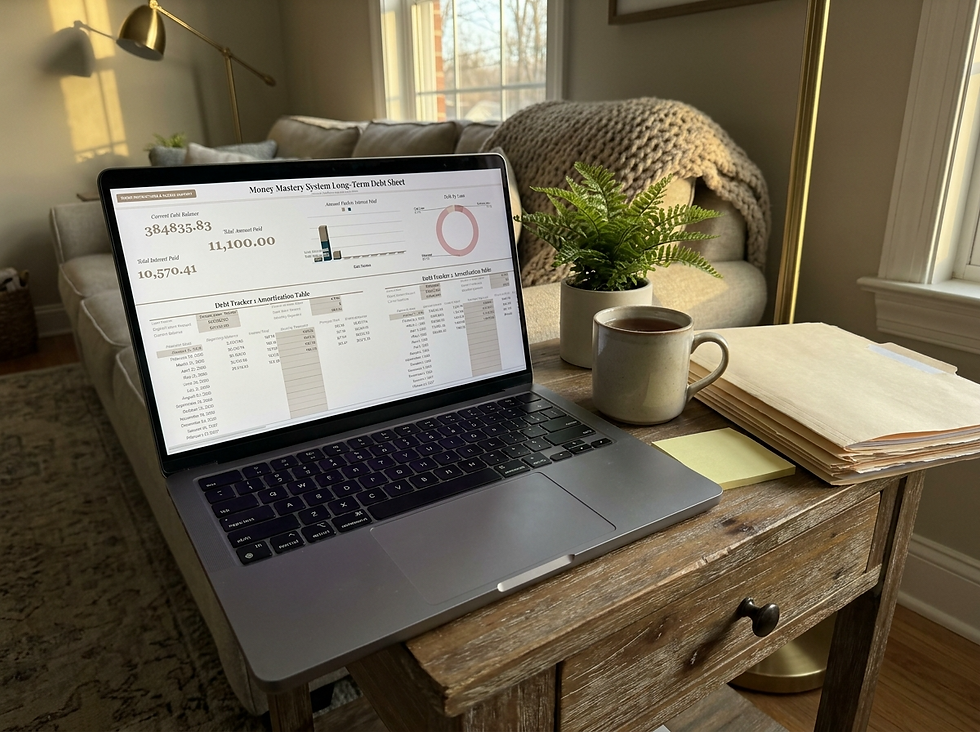
Laptop showing a debt tracker spreadsheet on a cozy living room side table, with coffee mug, plant, folders, and sticky note.

Let me put this into numbers so the plan feels real.


Say you have three business debts: a $1,000 balance at 22 percent interest, a $3,000 balance at 12 percent, and a $500 balance at 8 percent. In a panic, you might drain your cushion and skip your own pay to throw $2,000 at them this month, leaving your business gasping. Instead, you make a plan. After paying yourself a modest amount, covering essentials, and setting aside taxes, you find you can sustainably put $400 a month toward debt beyond the minimums.


You choose the highest-interest-first approach, so all $400 extra goes to the $1,000 debt at 22 percent while you pay minimums on the others. In about three months, that debt is gone, and it was the one growing fastest. Now you roll that entire $400, plus the minimum you were already paying on it, onto the $3,000 debt. Because you are now hitting it with a larger combined payment, it falls much faster than it would have. Then you roll everything onto the last debt and finish it off. Throughout, your business kept running, you kept getting paid, and your taxes stayed covered. You got free without going fragile, and that is the whole point.


A plan like this is far easier to stick to with support and encouragement, which is exactly what the Money Mastery community offers. If you would like help building a payoff plan that fits your real numbers, you can schedule a call with a coach who has 20 years of business coaching experience and map it out together.


Laptop on desk shows Money Mastery System Credit Card Debt Center, beside coffee, books, family photo, plant, and lamp.

To see how your debt fits into your whole financial picture as it shrinks, the free Money Mastery net worth tool shows you the full view, and watching your debt drop against your growing assets is one of the most motivating things you will do.


Debt handled in a panic can quietly wound your business. Debt handled with a plan becomes just another number you steadily shrink while your business keeps growing right alongside. You are not behind, and you are not stuck. You simply need a clear plan and a little support, and both are within reach. If you want help finding where to start, the upcoming Money Clarity Assessment can show you your smartest first move.

About Donna Roggio

Donna Roggio is the founder of the Money Mastery system and has spent 20 years helping women build real financial clarity and confidence in their businesses. She created Money Mastery to give women a supportive community and a simple, learnable way to understand their money, without shame, jargon, or overwhelm. Donna believes every woman can learn to run her numbers with confidence, and she is here to help you do exactly that.

Frequently Asked Questions

How do I pay off business debt strategically?

Start by listing every debt with its balance, interest rate, and minimum payment. Protect your business first by still paying yourself, covering essentials, and setting aside taxes. Then put a sustainable extra amount toward one debt at a time, and address the reason the debt appeared so it does not grow back.


Should I pay off my highest interest debt or smallest balance first?

Both work. Highest interest first saves you the most money over time. Smallest balance first gives you a quick, motivating win. Choose the one that best matches how you stay motivated, and put all your extra payment on that one debt until it is gone.


Should I stop paying myself to pay off business debt faster?

Generally no. Starving your business or skipping your own pay to kill debt quickly often creates a new emergency. A steady, sustainable payoff that keeps your business healthy usually works better than an aggressive one that weakens it.


How do I stop business debt from coming back?

Address the cause while you pay it down. If prices are too low to cover your true costs, or a lack of any buffer sends every surprise onto a card, fixing those gaps prevents the next round of debt. The free Money Mastery Net Worth Tracker helps you find and close those gaps.


bottom of page