top of page

A great money webinar for women business owners can shift your entire month, but only if you show up ready to work. Great news: preparing takes ten minutes, and the payoff is enormous. Instead of leaving with vague inspiration, you leave with a real move you can make this week.
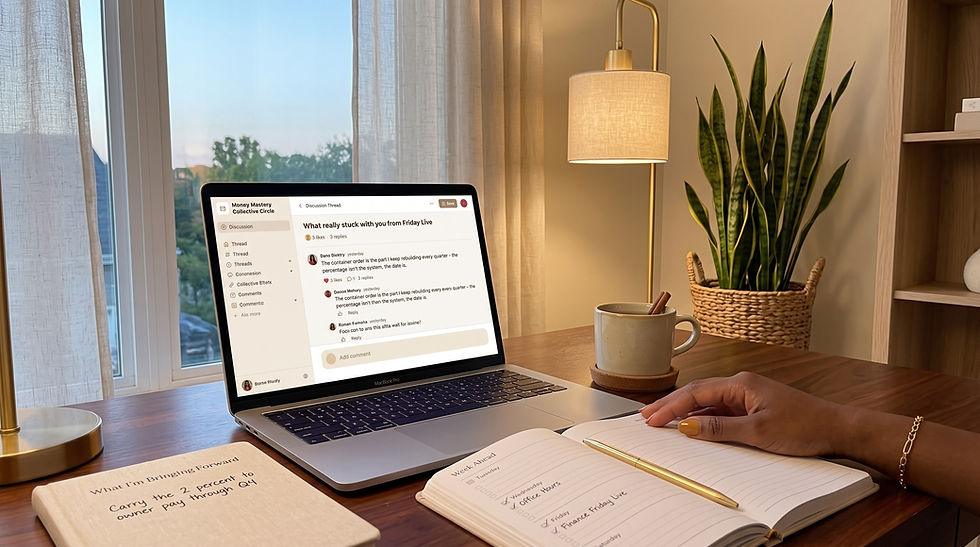

Laptop showing Money Mastery Collective Circle discussion on Friday Live, beside a notebook, mug, and plant on a tidy desk.

Use this six-step guide to get the most out of every session.


The 6 steps that make any money webinar for women business owners actually pay off


  1. Bring your last month's totals so the teaching lands on real numbers

  2. Bring one specific question so you listen with intention

  3. Bring your top three expense categories so decisions feel concrete

  4. Bring your calendar so follow-up gets scheduled in the moment

  5. Bring a notebook or note app for one big idea and one action

  6. Bring an open, hopeful mindset so you leave lifted, not overwhelmed


That is it. Six small steps, one giant lift in outcome.


What to bring to a money webinar for women business owners at a glance

Bring this

Why it matters

Last month's totals

Grounds teaching in your real life

Top three expense categories

Turns ideas into decisions

A specific question

Focuses your listening

Calendar or planner

Books your next money move

Notebook

Captures one big idea and one action

Curious mindset

Keeps the experience uplifting

How to listen during a money webinar for women business owners so ideas actually stick


Laptop in a cozy home office shows a Zoom call over a financial dashboard, with Tonight's Learnings notebook, mug, and plants nearby.

Use a three-column note style:

  1. Idea heard – What Donna taught

  2. How it applies to me – The connection to your business or personal money

  3. Next move – The thing you will do this week


That structure keeps the session from becoming background noise.


An uplifting rhythm to follow after the webinar


The magic of a great webinar is what happens next. Try this exact sequence within twenty-four hours:

  • Reopen your notes

  • Circle the single most important idea

  • Open the Money Mastery system and see the number the idea points to

  • Schedule one next money move

  • Post one takeaway inside the Collective discussion feed

  • Save the replay so future you can revisit it

T

hat is a full learning loop, and it is where excitement turns into real change.


Why Money Mastery + the Collective make webinars land differently


A webinar in isolation can inspire. A webinar inside an ecosystem transforms.

Standalone webinar

Webinar inside the Collective ecosystem

Ends when the recording stops

Continues in the daily blog and discussion feed

Leaves you with notes

Sends you into the Money Mastery system with real questions

Waits until next time

Builds on Finance Friday Live and the Money Reset Call

One-way

Two-way

Inside the Collective, the Money Mastery system helps you see what you kept last month on one screen, alongside other women doing the same work. That means webinar insights turn into real weekly practice, not just good intentions.


A story of a well-prepared attendee

Picture a woman named Priya. She joins a money webinar with her last month's totals, a specific question about pricing, and a fifteen-minute follow-up window blocked on her calendar. Donna's teaching lands on her numbers within the first ten minutes, because Priya is ready to see the connection. During the Q&A, she asks her question and gets a targeted answer. That evening, she opens the Money Mastery system, adjusts her monthly review, and posts one insight in the Collective. By Monday, she has a new pricing plan. All from one webinar.

Preparation is what turns a good session into a life-changing one.


What to do next

Prep once, use forever. Get ready for the next Finance Friday Live inside the Collective at https://moneymasterycollective.circle.so.


Cozy desk with MacBook showing Collective Circle finance posts, planner notebooks, coffee, and potted plants by a sunlit window.

FAQ


What is the biggest mistake people make when attending a money webinar for women business owners?

The biggest mistake is treating the session like passive entertainment. When women arrive with vague hopes and no specific context, even the best teaching bounces off. What works instead is arriving with three simple ingredients: your last month's totals, one focused question, and a follow-up window on your calendar. Those three ingredients transform how the same teaching lands. The exact same words that felt like general inspiration for an unprepared attendee become a targeted answer for a prepared one. That is why the six-step prep guide matters so much. It is not overkill. It is the difference between a good session and a life-changing one.


How long should a money webinar prep take?

Ten minutes is plenty. You are not writing a research paper. You are gathering enough real-life context to make the session feel personal. Pull your monthly totals from your bank app, jot down your three biggest expense categories, and write your one clarifying question at the top of your notes page. If you also want to add a small extra layer, open the Money Mastery system so your working data is one click away during the session. That way, when Donna references a concept, you can see the exact version of it inside your own numbers in real time. Ten minutes of prep is enough to turn a scheduled hour into one of the most valuable hours of your month.


How do I keep the momentum going after the webinar ends?

Momentum comes from converting one idea into one action within the same twenty-four hours. As soon as the session ends, circle the one insight that mattered most, decide the one action you will take this week, and schedule it. Then bring it into the Collective by posting one sentence in the discussion feed and, if you are in Momentum, mentioning it in your next Office Hours or Money Reset Call. That is how a single webinar becomes the seed of a real habit. Money Mastery + the Collective are designed so that the excitement of a live session flows straight into a working rhythm, not into a bookmark folder you never revisit.

If you have ever delayed opening your bank account, postponed a monthly review, or told yourself you would look at your numbers when you felt more ready, you are not alone. The question is not just why money feels stressful. It is why women avoid looking at their finances even when they care deeply about getting things right.


That distinction matters.


Hand writes in notebook beside Money Mastery MacBook showing financial dashboard on a cozy desk with plants, mug, and glasses.

Most women who avoid their numbers are not careless. They are not indifferent. They are often carrying a complicated mix of responsibility, pressure, memory, and self-judgment. They care so much that the act of looking can feel heavier, not lighter.


For women who run businesses, the weight gets even more layered. Now the numbers are not only personal. They are tied to clients, family decisions, taxes, payroll, pricing, savings, retirement, and the question of whether all the work is actually building something stable.


The broader financial environment gives helpful context here. In the Federal Reserve’s 2025 report on household financial well-being, 29% of adults said they were worse off financially than a year earlier. Among adults ages 45 to 59, 70% said they were doing okay or living comfortably, which also means a meaningful minority were not. Federal Reserve household well-being data Those numbers do not prove avoidance, but they do show that financial strain is not imagined. A lot of people are carrying more pressure than their outward lives reveal.


Why why women avoid looking at their finances is usually not about laziness


When people talk about financial avoidance, they often talk as if it is a discipline problem.


It usually is not.


Avoidance often begins as protection. You are tired. You already know money feels tight. You suspect you overspent, or you know you have not reviewed the month properly, or you are worried the numbers will confirm something you do not want to face yet. So your mind makes a deal: not today.


The problem is that “not today” has a way of turning into next week, next month, or next quarter.


And the longer that happens, the more emotionally loaded the numbers become.

That is one reason this topic fits so naturally with What Financial Clarity Actually Means and How to Track Where Your Money Goes in 15 Minutes. Both are useful because they lower vagueness. Vagueness feeds anxiety. Clarity interrupts it.


What financial avoidance can look like in real business life


Hand using a banking app beside a Bills envelope, stacked mail, and a mug on a sunlit kitchen counter.

It does not always look dramatic.


Sometimes it looks like a woman who runs a busy service business and can tell you exactly how many appointments she had last week, but cannot tell you what she kept last month.


Sometimes it looks like someone who is great with clients but avoids reconciling transactions because she already feels behind.


Sometimes it looks like checking the top-line revenue and stopping there because looking further down would mean dealing with what is still owed, what was overspent, or what needs to change.


The Federal Reserve’s 2025 Small Business Credit Survey helps explain why this happens in business too: 75% of small firms cited rising costs as a financial challenge, 56% said paying operating expenses was a challenge, and 51% said uneven cash flow was a challenge. Federal Reserve Small Business Credit Survey If the day-to-day business environment already feels financially tight, it makes sense that looking closely at the numbers can start to feel emotionally threatening.


What actually helps you come back to your numbers

The answer is usually not harsher self-talk.


  1. It is structure.

  2. It is a smaller starting point.

  3. It is language that lowers shame instead of increasing it.


That is why women often do better with a simple money rhythm than with a giant financial overhaul. A short weekly review. A monthly check-in. One question to answer. One pattern to notice. One next step.


If you have ever felt better after finishing a money task you were avoiding, you already know this is true. The fear of looking is often worse than the looking itself.


A more realistic example of what this sounds like

Picture a woman named Andrea who owns a small salon suite and also carries most of the financial planning at home.


She is not ignoring money because she does not value it. She is ignoring it because every time she sits down to review the month, the numbers seem to speak all at once. There is the business card balance. There is the fact that she meant to move more into savings. There is the client who paid later than expected. There is the quiet worry that if she looks too closely, she will confirm she should have handled things differently by now.


So instead of reviewing the whole month, she checks one balance on her phone, tells herself she has a general sense of things, and moves on.


Nothing explodes.


But nothing gets easier either.


What changes things is not a magical productivity burst. It is a more forgiving rhythm. She starts with one 15-minute review. She looks at income, spending, and one category that surprised her. The next week she does it again. Then she reads Why Every Business Owner Needs a Monthly Financial Review Checklist and realizes the process can be taught, not improvised.


That is how avoidance starts to loosen. Not through pressure. Through repeated safe contact with the truth.


Why this matters so much in a second chapter

For Money Mastery readers, financial avoidance is not just inconvenient. It gets expensive.


When you are in your forties, fifties, or early sixties, money usually connects to more than this month. It connects to what retirement might look like, how much cushion you really have, whether the business is sustainable, and whether the next decade is going to feel calmer or more compressed.


Avoidance makes all of that harder because it delays the very clarity that would let you act.


That is why this is not a “mindset only” issue. It is a decision-making issue.

If you want a place where money can be discussed honestly, practically, and without performance, the next step is simple: join the Collective at moneymasterycollective.circle.so.


Woman uses a laptop at a cozy wooden desk; screen shows Money Mastery Community Spaces and a notebook reads This Week’s Money Check-In.

FAQ

Why do I avoid my finances even though I care about them so much?

Because caring deeply can actually increase avoidance when money feels tied to shame, uncertainty, or fear of what the numbers might confirm. A lot of women do not avoid money because they are detached. They avoid it because the emotional meaning of the numbers has gotten too heavy. The goal is not to become emotionless. It is to create a process that makes looking feel safe and manageable again.


Is financial avoidance a sign that I am bad with money?

No. It is often a sign that your current money process is too emotionally loaded, too vague, or too unsupported. Many highly capable women avoid money tasks when the work feels like judgment instead of information. That is why smaller routines, better systems, and a lower-shame environment can change behavior much faster than criticism ever does.


What is the best first step if I have been avoiding my numbers for a while?

Start smaller than your nervous system expects. Do not promise yourself a full financial reset. Review one recent week or one recent month. Look at what came in, what went out, and what needs attention first. The biggest win is not finishing everything. It is breaking the pattern where looking at money feels impossible.

If you have been looking for a money support group for women business owners, there is a good chance you are not actually looking for more information.


You are probably looking for a better experience around money.


Laptop shows a 127-person video call with smiling participants on a Money Mastery Reset Call; coffee mug and notebook on a wooden desk.

You may already know the basics. You know you should review your numbers. You know you should separate business and personal spending. You know you should check what came in, what went out, and what is left. The problem is not usually knowledge. The problem is what happens emotionally the moment you try to sit down and do it.


For a lot of women, especially women running businesses while carrying family, life, and future planning all at once, money can feel heavier in private than it looks from the outside. You open the account and immediately feel behind. You see an expense you forgot about and feel embarrassed. You realize you still have not looked at the full month and promise yourself you will do it when you have more time, more energy, or a little less stress.


That cycle is more common than most people think.


And the broader business environment is not making it easier. In the Federal Reserve’s 2025 Small Business Credit Survey, 57% of small firms said reaching customers and growing sales was a challenge, 75% cited rising costs as a financial challenge, and 51% said uneven cash flow was a challenge. That is a real pressure stack, and it helps explain why so many owners are functioning while still feeling financially tired. Federal Reserve Small Business Credit Survey


Why a money support group for women business owners can change more than motivation


The biggest shift community creates is not inspiration. It is consistency.


When money work only happens in isolation, every task gets heavier. You rely on willpower. You rely on memory. You rely on the version of yourself who is somehow going to feel more emotionally available next week. That approach breaks down fast.


Support changes that.


Person highlighting budget papers at a wooden kitchen table, with a notebook, mug, water jar, and bowl of lemons.

In a good financial community, the pressure lowers because the process becomes shared, structured, and repeatable. You are not the only person trying to look at the truth. You are not the only person who feels a little resistance before opening the bank app. You are not the only person who has ever mixed life, business, stress, and money in the same month.


That matters because shame does not create follow-through. Clarity does.


If you have read What Financial Clarity Actually Means, you already know that clarity is not a mood. It is being able to answer practical questions about your money without digging, guessing, or apologizing. A community can help you get there faster because it gives you rhythm, language, and accountability around the habits that create that kind of visibility.


What a money support group for women business owners gives you that a spreadsheet cannot


A spreadsheet can organize data.


It cannot help you come back to the data when you feel ashamed.


It cannot tell you which number matters most this week.


It cannot normalize the fact that many business owners are carrying more financial pressure than they let people see.


That is where support becomes practical.


The best communities usually give readers and members four things.


First, they give you a regular cadence. That might be a weekly check-in, a monthly review, a live session, or a prompt that gets you back in the room before avoidance grows. This is one reason a post like Why Every Business Owner Needs a Monthly Financial Review Checklist works so well. It gives the reader a repeatable process, not just a good idea.


Second, they give you language that lowers shame. Instead of talking to you like you should already be perfectly organized, they meet you where you are and help you move without making you feel smaller.


Third, they give you interpretation. Numbers are not hard only because of math. They are hard because people do not always know what they mean. A good support space helps translate the numbers into decisions.


Fourth, they give you social proof that honest money work is normal. That can be powerful, especially for women in a second chapter who are thinking not only about the business, but also about savings, retirement, family support, and long-term stability.


The Federal Reserve’s household well-being research adds more context here. In its 2025 report on conditions in 2024, 29% of adults said they were worse off financially than a year earlier, and among adults 45 to 59, only 70% said they were doing okay or living comfortably financially. Federal Reserve household well-being data That is a reminder that many adults who look functional still do not feel fully solid.


Hands use a calculator on a sunlit desk with budget notes, cash, coffee, notebook, and a potted plant.

What this looks like in real life


Imagine a salon owner named Carla.


Carla is not irresponsible. Her business is bringing in money. She is serving clients, paying bills, and doing her best to keep everything moving. But she still feels low-level dread around money because she is never fully sure what the month actually meant. She knows the deposits. She does not always know the story.


On her own, Carla keeps postponing the review.


Inside a stronger support rhythm, something shifts. She reads a post about what to actually check each month. She hears someone explain the difference between what came in and what was actually kept. She realizes she does not need to solve everything at once. She needs one useful next step. Her community hosts a 1-hour session dedicated to reviewing your numbers, and she sees an opportunity.


So she totals the month. She reviews spending. She notices one category that is creeping up. She identifies one financial habit to clean up. Then she comes back the next week and does not have to start from scratch.


That is what support does.


It shortens the distance between avoidance and action.


What to look for if you want support that actually helps


If you are deciding whether a money community is worth your time, ask these questions:


  • Does it help me return to my numbers regularly?

  • Does the tone make honesty easier or harder?

  • Does it teach practical money habits, not just motivation?

  • Does it help me understand my numbers, not just collect them?

  • After I engage with it, do I know exactly what to do next?


Those questions matter more than whether a space looks polished.


Google’s people-first content guidance says strong content should leave someone feeling they learned enough to achieve their goal and had a satisfying experience. Google Search Central That is actually a useful filter for communities too. If you leave feeling more overwhelmed, less clear, or more ashamed, it is probably not the right room.


When support becomes part of the business strategy


This is the part that matters for Money Mastery specifically.


Support is not separate from clarity. It is one of the ways clarity gets built.


Women business owners do not just need a dashboard. They need a structure that helps them use the dashboard. They do not just need categories. They need a reason to keep looking at the categories. They do not just need good advice once. They need enough rhythm that the advice turns into habit.


That is why this topic is not a soft topic. It is a business topic.


When a woman feels less alone with money, she often becomes more consistent with money. And consistency is what makes better decisions possible.


If you want a steadier, shame-free place to stay close to your numbers, the next step is simple: join the Collective.


Money Mastery Clarity Session
30min
Book Now


FAQ

Why is community helpful for money habits?

Because money habits are easier to keep when you have rhythm, support, and a space that makes honesty feel safe instead of embarrassing.


Is a money community the same as hiring a bookkeeper?

No. A bookkeeper helps organize records. A money community helps you stay engaged with your decisions, patterns, and habits.


Who benefits most from this kind of support?

Women business owners who want more consistency, more clarity, and less isolation around money.

bottom of page