top of page

As of the first quarter of 2026, total U.S. credit card debt has climbed to $1.25 trillion, according to Forbes Advisor. A remarkable share of it stays outstanding for years because of one quietly destructive habit: paying only the minimum. The minimum payment exists for the issuer's benefit, not yours. It's the amount engineered to keep your account in good standing while ensuring you stay a paying customer for as long as mathematically possible. Understanding how the minimum payment trap works is the first step to disarming it.


The minimum payment is not a plan to get out of debt. It's a plan to stay in it comfortably, and the discomfort is exactly what would have saved you.

By the end of this guide, you'll understand how the shrinking minimum is designed to work against you, why it feels like responsible money management, what it costs on a real mid-size balance, and the one adjustment (costing you nothing extra in the first month) that collapses the payoff timeline.


Hand using laptop with debt spreadsheet titled Money Mastery System Long-Term Debt Sheet on a home desk beside a mug and notebook

Why the Minimum Payment Trap Is Built to Shrink

Most issuers calculate your minimum as a small percentage of your balance, often 1% to 3%, plus that month's interest and any fees. The consequence is subtle but powerful: as your balance falls, the required minimum falls too. Every month you pay it, next month's minimum is a little smaller, which stretches the payoff timeline out toward the horizon. A payment that gets easier as you go feels like progress, but it's the mechanism that keeps you paying for decades. The declining minimum is the entire trap in one sentence.


Why the Minimum Payment Trap Feels Responsible

Paying the minimum on time keeps your account current, avoids late fees, and protects your credit score, so it genuinely registers as doing the right thing. That's what makes the trap so effective: it hides inside a good habit. But "current" and "making progress" are entirely different states. When nearly all of a payment goes to interest, the principal barely moves, and you can pay faithfully month after month while the balance drifts down by inches. The feeling of responsibility is real. The progress is mostly an illusion.


A Real Dollar Example of the Minimum Payment Trap

Say you're carrying $4,000 on a card at a 22% APR. Following a 2% minimum that starts around $80 and shrinks as the balance falls, that $4,000 takes well over 20 years to clear, and you pay several thousand dollars in interest along the way, often more in interest than the original balance itself. Now change exactly one thing: instead of following the minimum down, you fix your payment at that first $80 every single month and never let it drop. The payoff collapses to roughly six years, and you save thousands in interest. The money you put in during month one is identical. The outcome is a completely different life.


Want to run this exact math on your own balance and APR instead of a hypothetical one? Download the free Money Mastery Net Worth Tracker and see your real payoff timeline while this is fresh.


The Fix: Escape the Minimum Payment Trap by Freezing Your Payment

The escape is disarmingly simple: stop letting your payment shrink. Take the minimum as it stands today, and pay that same fixed dollar amount every month even as the balance falls. Because your payment no longer decreases, a steadily larger share of it attacks the principal instead of interest, and the balance falls faster and faster, the exact opposite of the trap. Layering a payoff order on top, like paying your balances in the right order, accelerates it further, but the fixed payment alone does most of the work.


Laptop on desk shows Money Mastery System credit card debt dashboard beside coffee, books, family photo, plant, and lamp.

Stop Feeding the Balance While You Pay

A fixed payment only works if you're not refilling the balance with new charges. Every new purchase on the card you're paying down resets a piece of your progress and keeps the interest engine running. The cleanest approach is to pause new spending on that card entirely until it's cleared, using a different method for everyday purchases, or better yet, taking advantage of your card's grace period only on a card you pay in full. Payoff and new spending on the same card are a treadmill.


Common Mistakes That Deepen the Minimum Payment Trap

The first mistake is treating the minimum as the expected payment. The fix is to rename it what it is (the least you can pay without penalty) and always pay above it.


The second mistake is letting the payment shrink with the balance. The fix is to lock it at today's minimum and keep it there.


The third mistake is making new charges on the card you're paying off. The fix is to pause spending on it until the balance is gone.


The fourth mistake is not knowing your APR, which keeps the cost abstract. The fix is to read it off your statement once so the number becomes real.


How Money Mastery Helps You Escape the Minimum Payment Trap

The minimum payment trap thrives because a single balance never looks urgent on its own: it's one manageable line on one statement, next to everything else. Money Mastery brings your personal and business finances into one connected view, so a carried balance stops being background noise and becomes a number you can see against your income and your goals. QuickBooks and Mint record what a card did last month, one account at a time. Money Mastery helps you understand what that balance is costing you right now, across every account, so the decision to freeze your payment finally has the context it needs. The tone is grounded and non-judgmental: not guilt over the balance, but a system that quietly clears it.
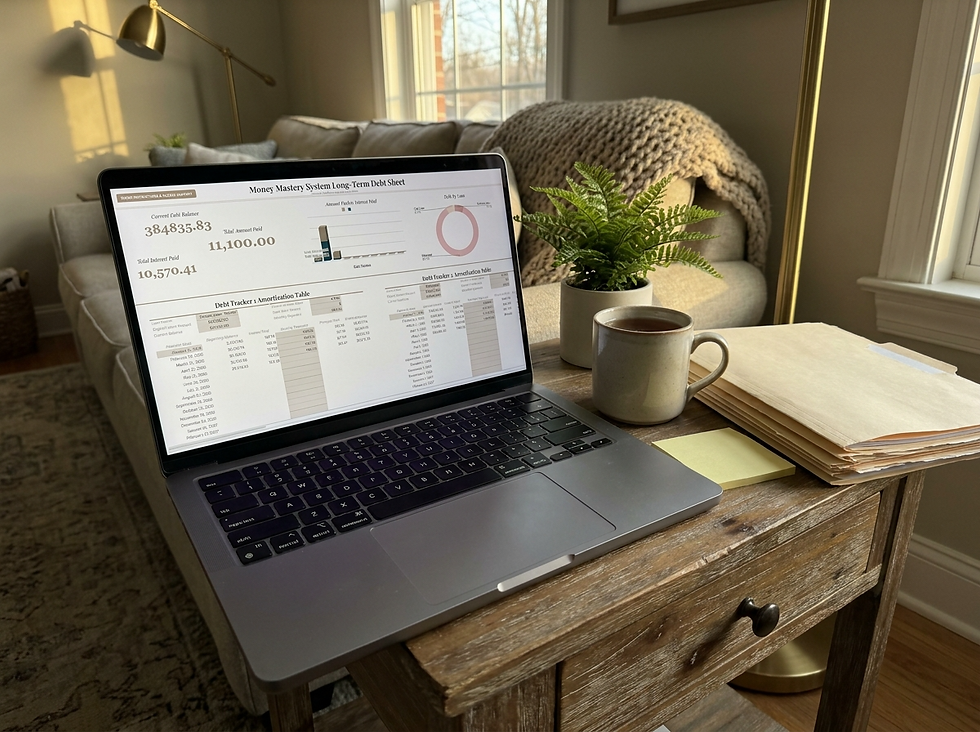

Laptop shows Money Mastery System long-term debt sheet beside a coffee mug, plant, and folders in a cozy sunlit living room.

Your Next Step

This week, pull up your highest-interest card, note today's minimum, and set an automatic payment at that exact amount that never decreases. That one change, made once, does more than years of faithfully paying whatever shrinking figure the statement asks for. Get your free Net Worth Tracker and lock in a fixed-payment payoff plan in 15 minutes: Download the Net Worth Tracker


Frequently Asked Questions About the Minimum Payment Trap


What Is the Minimum Payment Trap?

It's the cycle created by paying only the minimum each month. Because the minimum is a small percentage of your balance plus interest, most of it covers interest, the balance barely falls, and the payoff stretches over decades while you pay far more than you originally borrowed.


Why Does the Minimum Payment Get Smaller Over Time?

Because it's usually calculated as a percentage of your current balance. As the balance drops, the required minimum drops too, which continually extends your payoff timeline. Freezing your payment at today's amount is what stops this from working against you.


Does Paying Only the Minimum Hurt My Credit Score?

Paying the minimum on time keeps your account current and avoids late-payment marks, so it doesn't damage your score the way a missed payment would. The harm is financial: the interest you pay over years, plus the high utilization a large balance can cause.


What's the Fastest Way to Escape the Trap?

Fix your payment at the current minimum and never let it shrink, so more of each payment hits the principal as interest falls. Pausing new charges on the card and adding any extra amount speeds the payoff up further.


How Much Can a Fixed Payment Really Save?

On a mid-size balance at a typical APR, freezing the payment instead of following the shrinking minimum can cut a 20-plus-year payoff to around six years and save thousands in interest, using the same dollar amount you pay in the very first month.


Your credit utilization ratio is the single fastest lever you have on your credit score. Not your payment history. Not your account age. This one, and most people are quietly hurting it without knowing.


As of December 2025, 47% of American cardholders carry a balance from month to month, according to Bankrate's Credit Card Debt Report. And that carried balance does two kinds of damage at once. It costs interest, which everyone knows, and it quietly inflates your credit utilization ratio, which most people never think about until a loan application comes back with a rate higher than they expected. Utilization is one of the biggest single factors in your credit score, and it's also the one you can move the fastest.


Woman in a cream sweater reviews finances on a laptop at a sunny desk, with coffee, plant, books, and papers nearby.

Your credit utilization ratio is not a reflection of how responsible you are. It is a snapshot of one number on one day, and you control when that snapshot gets taken.


By the end of this guide, you'll understand exactly what the utilization ratio measures, the threshold to stay under, why the timing of your payment matters as much as the amount, and a concrete dollar example of how a small change lifts your score without you paying down a single extra dollar of debt.


How Your Credit Utilization Ratio Works

There are really only three things to understand here, and once they click, the rest is just execution.


What the Credit Utilization Ratio Actually Measures

Your credit utilization ratio is simply the percentage of your available credit that you're currently using. If you have a $10,000 total limit across your cards and you're carrying $3,000 in balances, your utilization is 30%. Scoring models look at this both per card and across all your cards combined, and they treat a high ratio as a signal of risk. The reasoning is that someone using most of their available credit may be under financial strain. The key insight is that this is calculated on the balance reported to the credit bureaus, not the balance you eventually pay off.


The Number to Stay Under

The common guidance is to keep utilization under 30%, but that's the ceiling, not the target. The lowest-risk zone sits in the single digits. Under 10% is where the strongest scores tend to live. This doesn't mean you can't use your cards heavily; it means the balance that gets reported should be low. Someone can run thousands through a card every month and still show 4% utilization, simply because of when the balance is measured relative to when they pay.


Why Timing Beats Paying More

Here's the part almost nobody knows: your card issuer reports your balance to the bureaus once a month, usually on your statement closing date, not your due date. If you pay your balance in full by the due date but your issuer already reported the high statement balance two weeks earlier, the bureaus saw the high number. The fix is to pay down most of the balance before the statement closes, so the reported figure is low. Same spending, same money, dramatically different reported utilization.


Woman in a home office drinks coffee while viewing a laptop credit score trend chart, with bookshelves and a plant behind her.

Real Dollar Example: Fixing a Credit Utilization Ratio

Say you have one card with a $5,000 limit and you typically charge about $2,000 a month in normal spending: groceries, gas, a few bills. If you pay it off after the statement closes, your reported balance is $2,000, which is 40% utilization, over the ceiling and dragging your score down. Now change one thing. You make a mid-cycle payment of $1,700 a few days before your statement closing date, leaving just $300 to be reported. Your utilization drops to 6%. You spent the same $2,000 and paid the same total. You just moved most of the payment a week earlier. That single timing shift can lift a score by dozens of points within one or two cycles.


Want to map your statement closing dates against your paydays so you always report a low balance? Download the free Money Mastery Net Worth Tracker and set your timing up while this is fresh.


How Available Credit Changes the Math

Because utilization is a ratio, you can also lower it by raising the denominator: your total available credit. A higher limit on the same spending automatically produces a lower percentage, which is why a thoughtful credit limit increase can help your score, as long as your spending doesn't rise to match. The opposite is also true. Closing an unused card removes its limit from the total and can spike your utilization, which is why the decision to close an old card deserves more thought than most people give it.


Mistakes That Keep Your Credit Utilization Ratio High

The first mistake is believing that paying in full by the due date is enough. The fix is to pay down the balance before the statement closes, since that earlier date is what gets reported.


The second mistake is looking only at total utilization and ignoring individual cards. The fix is to keep every single card low, because one maxed-out card can hurt even if your overall ratio looks fine.


The third mistake is closing cards you no longer use, which shrinks your available credit. The fix is to keep old no-fee cards open and use them occasionally so the limit still counts.


The fourth mistake is chasing a limit increase and then spending up to it. The fix is to treat a higher limit purely as headroom, not permission to carry more.


How Money Mastery Helps You Manage Credit Utilization

Utilization is hard to manage because it lives at the intersection of two things people track separately: how much they spend and when money is available to pay it. Money Mastery brings your personal and business finances into one connected view, so you can see a card's balance against your incoming cash and time a mid-cycle payment with confidence instead of guessing.


QuickBooks and Mint record what a card did last month, one account at a time. Money Mastery helps you understand what's happening across every account right now, so you can act before the statement closes rather than reacting after. This is grounded and practical, not shaming. The point isn't judgment about a balance. It's a system that quietly optimizes it.


Your Next Step

This week, find the statement closing date on your most-used card, then schedule a payment for a few days before it that brings the balance under 10% of the limit. That one recurring habit does more for your score than months of hoping the number improves on its own.


Frequently Asked Questions


What is a good credit utilization ratio?

Aim to keep it under 30% at a minimum, but the strongest scores usually sit under 10%. This applies both to your overall ratio across all cards and to each individual card, so keeping every card low matters, not just the total.


When is my credit card balance reported to the bureaus?

Most issuers report your balance on your statement closing date, not your payment due date. That's why paying in full by the due date doesn't always help your utilization. The high balance may have already been reported weeks earlier.


How can I lower my utilization without paying off debt?

Make a payment before your statement closes so a lower balance gets reported, or raise your available credit with a limit increase while keeping spending the same. Both lower the ratio without requiring you to pay off any additional principal.


Does a higher credit limit help my score?

It can, because utilization is a ratio. More available credit lowers the percentage you're using on the same spending. The risk is spending up to the new limit, which cancels the benefit, so treat the extra room as headroom only.


How fast can fixing utilization improve my score?

Because issuers report monthly, a lower reported balance can show up within one or two billing cycles. Utilization changes are one of the fastest score movers precisely because there's no waiting for old history to age off.


bottom of page