


How to Set Savings Goals With Irregular Income (Without Quitting Every Other Month)
Updated: Sep 17
Savings goals irregular income comes down to one shift: stop saving a fixed dollar amount and start saving a fixed percentage. When your income changes every month, a flat number sets you up to fail in lean months and undersave in strong ones. A percentage-based goal flexes with what you actually earn, so a $4,000 month and a $12,000 month both contribute proportionally. According to the Federal Reserve, roughly 36% of U.S. adults can't cover a $400 emergency in cash, and irregular earners feel that gap hardest.
Flexible savings goals get reached. Rigid ones get abandoned.
If you've ever set a savings goal in January, hit it in February, missed it in March, fallen behind in April, and quit by May, the problem wasn't your discipline. It was the math. A goal built for a salaried paycheck doesn't survive contact with self-employment, freelance work, or seasonal business income. The fix is structural, not motivational.
By the end of this post you'll know exactly how to set a savings rate that flexes with your income, the side-by-side math on percentage vs fixed-amount goals, and how to keep a real-time view of whether you're on track without checking your bank account ten times a day.

Why Fixed-Amount Savings Goals Break for Variable Income
A fixed savings goal sounds clean. "I'll save $1,000 a month." It works beautifully on a spreadsheet and falls apart in real life the first time your income drops 40% in a slow month.
Here's what usually happens. You start strong. Month one is good, you save the $1,000. Month two is great, you save $1,000 with room to spare and feel ahead. Month three is rough. You force the $1,000 anyway and end up short on bills. Month four you skip it entirely to recover. Month five you tell yourself you'll catch up, but you're already behind on the catch-up plan from month four. By month six the goal feels broken, and broken goals get quietly dropped.
The issue isn't your willpower. It's that you tied a constant to a variable. Your income is a variable. Your savings rate should be too. Before you redesign your savings plan, it helps to have a clean view of what your income actually looks like across a year, which is exactly what the how to budget with irregular income guide walks through.
How Percentage-Based Savings Goals Actually Work
A percentage-based savings goal sets aside a fixed share of whatever comes in. Pick a rate, say 15%, and every time money lands in your account, 15% goes to savings. A $4,000 month sends $600 to savings. A $12,000 month sends $1,800. A $2,500 month sends $375.
You never miss a month. You never feel behind. You're saving what you can save, scaled to what you actually earned. And over a year, you almost always end up saving more than the fixed-amount plan, because strong months no longer cap out at a flat dollar number. They contribute their full share.
There's a second benefit that's harder to measure but matters more. You stop dreading slow months from a savings standpoint. Your savings rate isn't asking you to do something impossible during a lean stretch. It's asking you to do the same thing proportionally, which is sustainable.
Percentage vs Fixed-Amount Savings: Side-by-Side
Here's the reference asset to screenshot. Same person, same year, two different methods.
Assumptions:
Self-employed business owner
Variable monthly income across 12 months
Year total: $96,000
Fixed-amount goal: $1,000/month ($12,000/year target)
Percentage-based goal: 15% of each month's income
Month | Income | Fixed Plan ($1,000) | Percentage Plan (15%) |
Jan | $7,500 | $1,000 saved | $1,125 saved |
Feb | $5,200 | $1,000 saved | $780 saved |
Mar | $11,800 | $1,000 saved | $1,770 saved |
Apr | $3,400 | $0 (skipped) | $510 saved |
May | $6,000 | $1,000 saved | $900 saved |
Jun | $9,500 | $1,000 saved | $1,425 saved |
Jul | $4,800 | $0 (skipped) | $720 saved |
Aug | $8,200 | $1,000 saved | $1,230 saved |
Sep | $10,400 | $1,000 saved | $1,560 saved |
Oct | $7,100 | $1,000 saved | $1,065 saved |
Nov | $13,000 | $1,000 saved | $1,950 saved |
Dec | $9,100 | $1,000 saved | $1,365 saved |
Total | $96,000 | $10,000 | $14,400 |
Months skipped | 2 | 0 | |
Effective savings rate | 10.4% | 15.0% |
The percentage plan saved 44% more across the year, never missed a month, and never created the psychological collapse that a "skipped" month produces. Same person. Same income. Just different math.
How to Pick Your Savings Rate
The right percentage depends on your goals, expenses, and risk tolerance. Here's a simple framework.
If you have no emergency fund yet, start at 20% if you can swing it, 15% if 20% would crush your cash flow. The goal at this stage is speed. Three to six months of expenses in a savings account is the foundation everything else sits on.
If you have an emergency fund and you're building other goals (home down payment, business reserve, retirement on top of an emergency fund), 10% to 15% is a sustainable range for most self-employed people.
If you're in a serious debt payoff stretch, drop savings to 5% temporarily and put the rest toward debt. Don't drop it to zero. A small ongoing savings habit keeps the muscle warm and protects you from the next surprise expense restarting the debt cycle. If you're working through a payoff plan, the debt snowball vs debt avalanche breakdown can help you decide which method fits how you actually operate.
Whatever rate you pick, write it down somewhere you'll see it. A rate you can't remember isn't a rate you'll follow.
The 5-Step Setup for Flexible Savings Goals
Work through these in order. This is the part most people skip, and it's the part that makes the difference.
Calculate your last 12 months of total income. Pull bank deposits, not invoices, because invoices don't always become deposits. This is your real number.
Divide by 12 to find your average monthly income. This becomes your planning baseline, not your minimum and not your maximum.
Pick your savings rate. Use the framework above. Write it down.
Open a separate high-yield savings account. Not your operating account. Not your tax savings. Its own account, labeled clearly. The act of moving the money out of view is what makes the system work, and it's the same logic behind needing to separate business and personal finances in the first place.
Transfer your percentage every time income lands. Not at month end. Not "when I have a chance." Within 48 hours of the deposit, while it still feels like the client's money instead of yours.
Halfway through your savings setup, download the free Money Mastery Net Worth Tracker at https://moneymastery-system.com/free. It puts your personal and business accounts side by side across sixty account types and twelve tabs, and it stays yours.
This is educational, not financial advice. For specific guidance on retirement accounts, tax-advantaged savings, or major financial decisions, talk to a fee-only financial planner or CPA.
How Money Mastery Tracks Whether You're On Track
This is where Money Mastery does something genuinely different. Most savings apps show you what you've saved. Money Mastery shows you whether you're on pace to actually hit your goal, in real time, based on what you're earning and spending right now.
The dashboard automatically subtracts your expenses from your income to calculate your net savings each month, then compares it against your target savings rate. You see, at a glance, whether you're on track or at risk, with a clear breakdown of which expense categories are pulling your savings rate down. It's the difference between hoping you're saving enough and knowing you are.

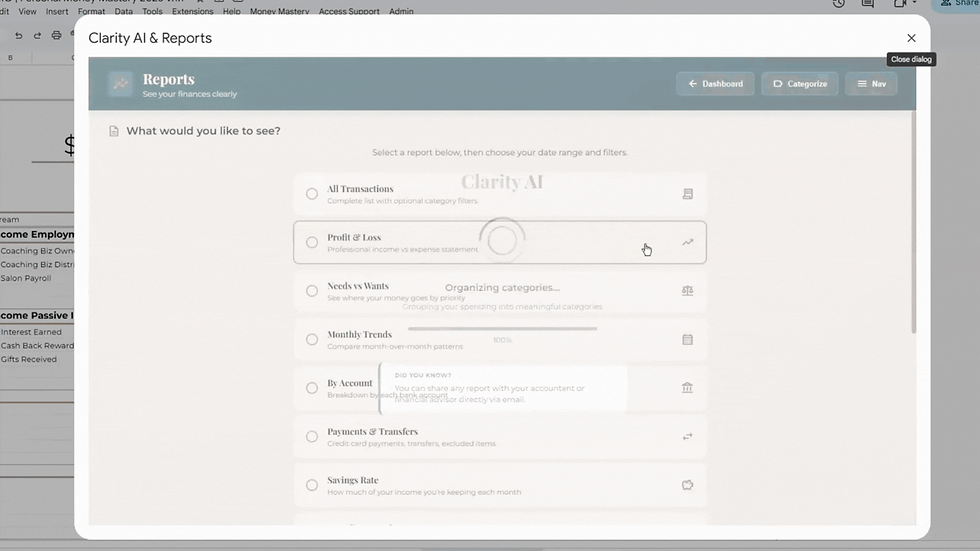
If you want to take it a step further, the Custom Savings Report shows you exactly how much you're saving each month with AI-driven insights into your patterns, like which months consistently underperform and what categories tend to spike right before you fall behind. That's not data you can get from a spreadsheet or a generic budgeting app. That's the kind of visibility that turns a savings goal into a savings habit. And it's the reason most of my clients hit their savings rate within the first three months of using the system, regardless of how irregular their income is.
What to Do When You Have a Bad Month
Bad months happen. The percentage method softens them, but it doesn't erase them. Here's how to handle the worst of them without abandoning the system.
If income is so low that even your percentage doesn't feel possible, lower the rate for that month only. Save 5% instead of 15%. The point is to keep the muscle active, not to hit the perfect number. A 5% save is infinitely better than a $0 save, because $0 breaks the habit.
If you have to skip entirely (rare, but real), name it explicitly. "I'm skipping this month because of X." Then resume the next month at your normal rate. Don't try to catch up. Catch-up plans almost always fail and produce a second wave of failure on top of the first. Resuming clean is the move.
If three months in a row are bad, that's a signal, not a setback. Something structural has changed in your business or your expenses, and your savings plan isn't the problem to solve. Your income or expense plan is. A monthly financial review will surface what's actually happening before three months turns into six.
Your Next Step
Pick a rate this week. Just one number. Open the separate savings account. Move the first transfer the next time income lands. You don't need a perfect plan, you need a started one, and a percentage-based plan started in June will beat a fixed-amount plan abandoned in March every single time.
Get the free Net Worth Tracker here: https://moneymastery-system.com/free
Frequently Asked Questions
What's a realistic savings rate for irregular income?
A realistic savings rate for irregular income is 10% to 20%, depending on your stage. If you have no emergency fund yet, aim for 20% if cash flow allows or 15% if it doesn't. If you have an emergency fund and you're building other goals, 10% to 15% is sustainable for most self-employed people. The right rate is one you can actually maintain through both your strong and lean months, because consistency over time matters more than a high rate you can't sustain.
Should I save a percentage or a fixed amount each month?
For irregular income, save a percentage. A percentage-based goal flexes with your earnings, so you contribute proportionally in every month instead of skipping bad ones and capping good ones. In year-over-year comparisons, percentage savers almost always end up with more saved than fixed-amount savers on the same income, because strong months are no longer limited to a flat dollar number. Fixed-amount goals work fine for salaried earners, but they break the moment income gets variable.
How do I know if I'm on track to hit my savings goal?
The fastest way to know if you're on track is to compare your year-to-date savings against your year-to-date income, then check whether the ratio matches your target savings rate. If your target is 15% and you've saved 12% of what you've earned so far this year, you're behind. Tools like Money Mastery automate this by subtracting expenses from income to show your real net savings rate against your target in real time, with breakdowns of which categories are pulling you off pace.
What if my income changes too much to plan savings goals?
Highly variable income is exactly where percentage-based savings shines. The more your income changes, the worse a fixed-amount goal performs and the better a percentage goal performs. Start by calculating your last 12 months of income to find your average. Pick a percentage that would work even in your worst month. Transfer the percentage within 48 hours of each deposit. You're not predicting future income, you're responding to actual income as it arrives, which is the only sustainable way to save on a variable cash flow.
Can I have multiple savings goals at once with irregular income?
Yes, and most self-employed people should. The cleanest approach is to set one overall savings rate (say 15%) and then split that rate across goals by percentage. For example, 8% to emergency fund, 4% to a business reserve, and 3% to a specific goal like a home down payment. Each transfer automatically funds all three in proportion. Money Mastery's savings tracking can hold multiple goal accounts and show your progress against each one without you having to do the math manually.



Comments