top of page

Savings goals irregular income comes down to one shift: stop saving a fixed dollar amount and start saving a fixed percentage. When your income changes every month, a flat number sets you up to fail in lean months and undersave in strong ones. A percentage-based goal flexes with what you actually earn, so a $4,000 month and a $12,000 month both contribute proportionally. According to the Federal Reserve, roughly 36% of U.S. adults can't cover a $400 emergency in cash, and irregular earners feel that gap hardest.


Flexible savings goals get reached. Rigid ones get abandoned.


If you've ever set a savings goal in January, hit it in February, missed it in March, fallen behind in April, and quit by May, the problem wasn't your discipline. It was the math. A goal built for a salaried paycheck doesn't survive contact with self-employment, freelance work, or seasonal business income. The fix is structural, not motivational.


By the end of this post you'll know exactly how to set a savings rate that flexes with your income, the side-by-side math on percentage vs fixed-amount goals, and how to keep a real-time view of whether you're on track without checking your bank account ten times a day.


Self-employed woman calculating her savings rate for irregular income at a sunlit kitchen table

Why Fixed-Amount Savings Goals Break for Variable Income


A fixed savings goal sounds clean. "I'll save $1,000 a month." It works beautifully on a spreadsheet and falls apart in real life the first time your income drops 40% in a slow month.


Here's what usually happens. You start strong. Month one is good, you save the $1,000. Month two is great, you save $1,000 with room to spare and feel ahead. Month three is rough. You force the $1,000 anyway and end up short on bills. Month four you skip it entirely to recover. Month five you tell yourself you'll catch up, but you're already behind on the catch-up plan from month four. By month six the goal feels broken, and broken goals get quietly dropped.


The issue isn't your willpower. It's that you tied a constant to a variable. Your income is a variable. Your savings rate should be too. Before you redesign your savings plan, it helps to have a clean view of what your income actually looks like across a year, which is exactly what the how to budget with irregular income guide walks through.


How Percentage-Based Savings Goals Actually Work


A percentage-based savings goal sets aside a fixed share of whatever comes in. Pick a rate, say 15%, and every time money lands in your account, 15% goes to savings. A $4,000 month sends $600 to savings. A $12,000 month sends $1,800. A $2,500 month sends $375.


You never miss a month. You never feel behind. You're saving what you can save, scaled to what you actually earned. And over a year, you almost always end up saving more than the fixed-amount plan, because strong months no longer cap out at a flat dollar number. They contribute their full share.


There's a second benefit that's harder to measure but matters more. You stop dreading slow months from a savings standpoint. Your savings rate isn't asking you to do something impossible during a lean stretch. It's asking you to do the same thing proportionally, which is sustainable.


Percentage vs Fixed-Amount Savings: Side-by-Side


Here's the reference asset to screenshot. Same person, same year, two different methods.


Assumptions:

  • Self-employed business owner

  • Variable monthly income across 12 months

  • Year total: $96,000

  • Fixed-amount goal: $1,000/month ($12,000/year target)

  • Percentage-based goal: 15% of each month's income

Month

Income

Fixed Plan ($1,000)

Percentage Plan (15%)

Jan

$7,500

$1,000 saved

$1,125 saved

Feb

$5,200

$1,000 saved

$780 saved

Mar

$11,800

$1,000 saved

$1,770 saved

Apr

$3,400

$0 (skipped)

$510 saved

May

$6,000

$1,000 saved

$900 saved

Jun

$9,500

$1,000 saved

$1,425 saved

Jul

$4,800

$0 (skipped)

$720 saved

Aug

$8,200

$1,000 saved

$1,230 saved

Sep

$10,400

$1,000 saved

$1,560 saved

Oct

$7,100

$1,000 saved

$1,065 saved

Nov

$13,000

$1,000 saved

$1,950 saved

Dec

$9,100

$1,000 saved

$1,365 saved

Total

$96,000

$10,000

$14,400

Months skipped


2

0

Effective savings rate


10.4%

15.0%


The percentage plan saved 44% more across the year, never missed a month, and never created the psychological collapse that a "skipped" month produces. Same person. Same income. Just different math.


How to Pick Your Savings Rate


The right percentage depends on your goals, expenses, and risk tolerance. Here's a simple framework.


If you have no emergency fund yet, start at 20% if you can swing it, 15% if 20% would crush your cash flow. The goal at this stage is speed. Three to six months of expenses in a savings account is the foundation everything else sits on.


If you have an emergency fund and you're building other goals (home down payment, business reserve, retirement on top of an emergency fund), 10% to 15% is a sustainable range for most self-employed people.


If you're in a serious debt payoff stretch, drop savings to 5% temporarily and put the rest toward debt. Don't drop it to zero. A small ongoing savings habit keeps the muscle warm and protects you from the next surprise expense restarting the debt cycle. If you're working through a payoff plan, the debt snowball vs debt avalanche breakdown can help you decide which method fits how you actually operate.


Whatever rate you pick, write it down somewhere you'll see it. A rate you can't remember isn't a rate you'll follow.


The 5-Step Setup for Flexible Savings Goals


Work through these in order. This is the part most people skip, and it's the part that makes the difference.


  1. Calculate your last 12 months of total income. Pull bank deposits, not invoices, because invoices don't always become deposits. This is your real number.

  2. Divide by 12 to find your average monthly income. This becomes your planning baseline, not your minimum and not your maximum.

  3. Pick your savings rate. Use the framework above. Write it down.

  4. Open a separate high-yield savings account. Not your operating account. Not your tax savings. Its own account, labeled clearly. The act of moving the money out of view is what makes the system work, and it's the same logic behind needing to separate business and personal finances in the first place.

  5. Transfer your percentage every time income lands. Not at month end. Not "when I have a chance." Within 48 hours of the deposit, while it still feels like the client's money instead of yours.


Halfway through your savings setup, download the free Money Mastery Net Worth Tracker at https://moneymastery-system.com/free. It puts your personal and business accounts side by side across sixty account types and twelve tabs, and it stays yours.


This is educational, not financial advice. For specific guidance on retirement accounts, tax-advantaged savings, or major financial decisions, talk to a fee-only financial planner or CPA.


How Money Mastery Tracks Whether You're On Track


This is where Money Mastery does something genuinely different. Most savings apps show you what you've saved. Money Mastery shows you whether you're on pace to actually hit your goal, in real time, based on what you're earning and spending right now.


The dashboard automatically subtracts your expenses from your income to calculate your net savings each month, then compares it against your target savings rate. You see, at a glance, whether you're on track or at risk, with a clear breakdown of which expense categories are pulling your savings rate down. It's the difference between hoping you're saving enough and knowing you are.


SaaS dashboard graphic showing on-track savings rate progress ring for variable income with expense breakdown

If you want to take it a step further, the Custom Savings Report shows you exactly how much you're saving each month with AI-driven insights into your patterns, like which months consistently underperform and what categories tend to spike right before you fall behind. That's not data you can get from a spreadsheet or a generic budgeting app. That's the kind of visibility that turns a savings goal into a savings habit. And it's the reason most of my clients hit their savings rate within the first three months of using the system, regardless of how irregular their income is.
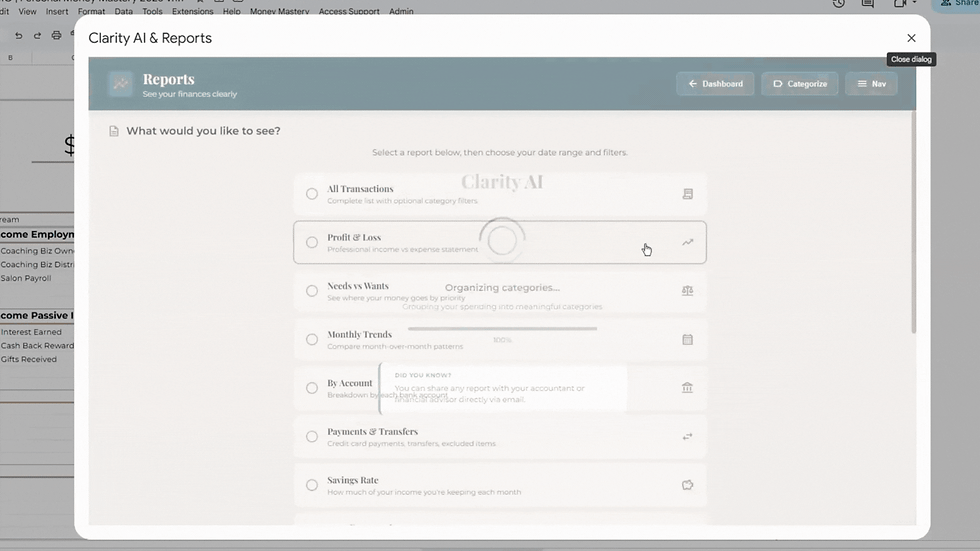

Money Mastery AI Savings and Reports feature

What to Do When You Have a Bad Month


Bad months happen. The percentage method softens them, but it doesn't erase them. Here's how to handle the worst of them without abandoning the system.

If income is so low that even your percentage doesn't feel possible, lower the rate for that month only. Save 5% instead of 15%. The point is to keep the muscle active, not to hit the perfect number. A 5% save is infinitely better than a $0 save, because $0 breaks the habit.


If you have to skip entirely (rare, but real), name it explicitly. "I'm skipping this month because of X." Then resume the next month at your normal rate. Don't try to catch up. Catch-up plans almost always fail and produce a second wave of failure on top of the first. Resuming clean is the move.


If three months in a row are bad, that's a signal, not a setback. Something structural has changed in your business or your expenses, and your savings plan isn't the problem to solve. Your income or expense plan is. A monthly financial review will surface what's actually happening before three months turns into six.


Your Next Step


Pick a rate this week. Just one number. Open the separate savings account. Move the first transfer the next time income lands. You don't need a perfect plan, you need a started one, and a percentage-based plan started in June will beat a fixed-amount plan abandoned in March every single time.


Get the free Net Worth Tracker here: https://moneymastery-system.com/free


Frequently Asked Questions


What's a realistic savings rate for irregular income?

A realistic savings rate for irregular income is 10% to 20%, depending on your stage. If you have no emergency fund yet, aim for 20% if cash flow allows or 15% if it doesn't. If you have an emergency fund and you're building other goals, 10% to 15% is sustainable for most self-employed people. The right rate is one you can actually maintain through both your strong and lean months, because consistency over time matters more than a high rate you can't sustain.


Should I save a percentage or a fixed amount each month?

For irregular income, save a percentage. A percentage-based goal flexes with your earnings, so you contribute proportionally in every month instead of skipping bad ones and capping good ones. In year-over-year comparisons, percentage savers almost always end up with more saved than fixed-amount savers on the same income, because strong months are no longer limited to a flat dollar number. Fixed-amount goals work fine for salaried earners, but they break the moment income gets variable.


How do I know if I'm on track to hit my savings goal?

The fastest way to know if you're on track is to compare your year-to-date savings against your year-to-date income, then check whether the ratio matches your target savings rate. If your target is 15% and you've saved 12% of what you've earned so far this year, you're behind. Tools like Money Mastery automate this by subtracting expenses from income to show your real net savings rate against your target in real time, with breakdowns of which categories are pulling you off pace.


What if my income changes too much to plan savings goals?

Highly variable income is exactly where percentage-based savings shines. The more your income changes, the worse a fixed-amount goal performs and the better a percentage goal performs. Start by calculating your last 12 months of income to find your average. Pick a percentage that would work even in your worst month. Transfer the percentage within 48 hours of each deposit. You're not predicting future income, you're responding to actual income as it arrives, which is the only sustainable way to save on a variable cash flow.


Can I have multiple savings goals at once with irregular income?

Yes, and most self-employed people should. The cleanest approach is to set one overall savings rate (say 15%) and then split that rate across goals by percentage. For example, 8% to emergency fund, 4% to a business reserve, and 3% to a specific goal like a home down payment. Each transfer automatically funds all three in proportion. Money Mastery's savings tracking can hold multiple goal accounts and show your progress against each one without you having to do the math manually.

Related Posts

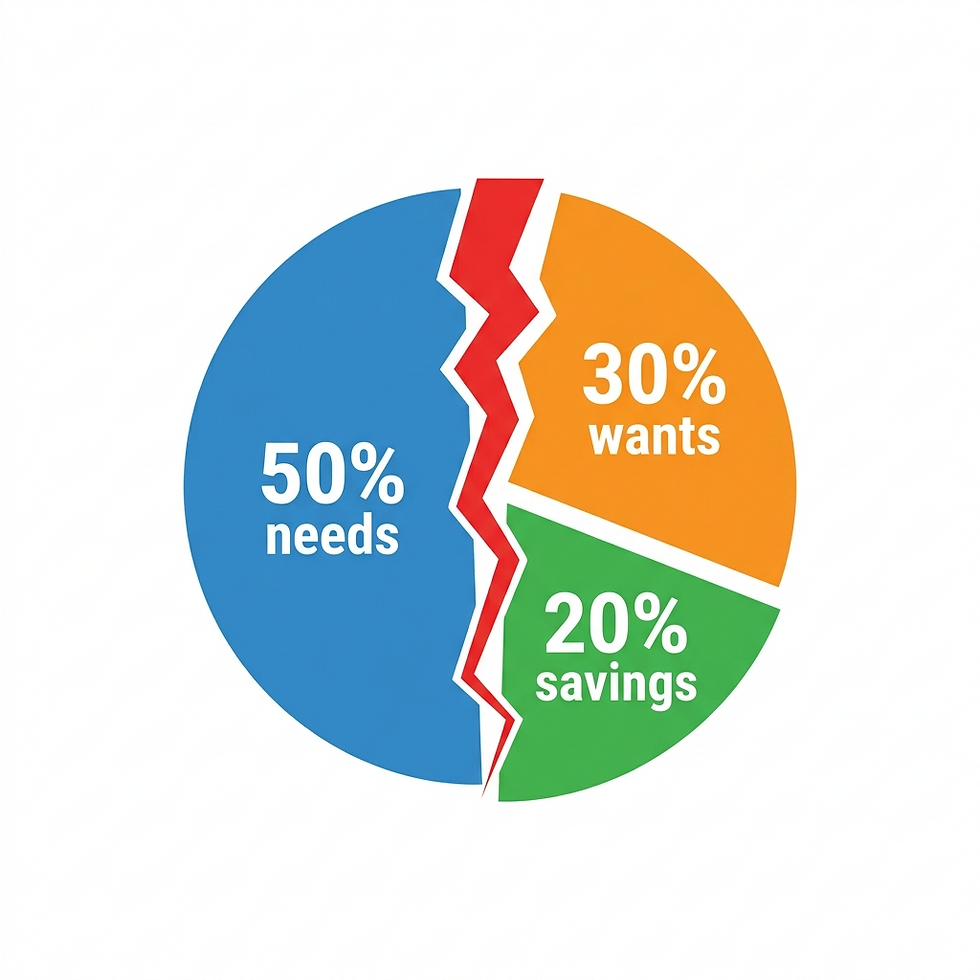
If you have ever searched "how to budget," you have probably been told to follow the 50/30/20 rule. Spend 50% of your after-tax income on needs, 30% on wants, and 20% on savings or debt repayment. It is clean, simple, and fits nicely on an Instagram infographic.

50 30 20 budget rule

But here is the uncomfortable truth that nobody posts about: the 50/30/20 rule was designed for people with a steady, predictable paycheck. If you are self-employed, freelancing, or running your own business, your income does not arrive in tidy biweekly deposits. It arrives in waves, droughts, and surprises. And trying to force a cookie-cutter formula onto that reality can leave you stressed, broke, and wondering what you are doing wrong.


You are not doing anything wrong. You just need a different framework.


In this post, we are going to break down exactly what the 50/30/20 rule is, why it falls apart for self-employed earners, and what to use instead. Because popular advice is not always the right advice, especially when your financial life does not look like everyone else's.


Self-employed small business owner reviewing budget spreadsheets and bank statements at a modern desk with warm natural lighting

What Is the 50/30/20 Rule (and Where Did It Come From)?


The 50/30/20 rule was popularized by Senator Elizabeth Warren and her daughter Amelia Warren Tyagi in their 2005 book All Your Worth: The Ultimate Lifetime Money Plan. The idea is elegantly simple. Take your after-tax income and divide it into three buckets:


Needs (50%) cover the non-negotiables. Housing, utilities, groceries, insurance, minimum debt payments, transportation, and anything else you truly cannot function without.


Wants (30%) cover the nice-to-haves. Dining out, entertainment, streaming subscriptions, gym memberships, vacations, and upgrades to things you already own.


Savings and Debt Repayment (20%) covers your future. Emergency fund contributions, retirement savings, extra payments on loans, and investments.


The appeal is obvious. You do not need a spreadsheet, you do not need an app, and you do not need to track every single dollar. Just keep your spending roughly within those three zones, and you are budgeting.


For a salaried employee earning a consistent paycheck, this can be a solid starting point. A 2024 Talker Research and EarnIn survey found that average Americans earning $75,000 or less actually spend about 64% on needs, 16% on wants, and 16% on savings. That means most people are already overshooting needs and undershooting both wants and savings, even with stable income. The 50/30/20 rule at least gives them a target to move toward.


But what happens when your income is not stable at all?


Why the 50/30/20 Rule Breaks Down When You Are Self-Employed


Self-employment changes everything about how money flows. According to the Federal Reserve's 2025 Economic Well-Being of U.S. Households report, 58% of self-employed adults say their income varies from month to month. That is more than double the rate for traditional employees.


And that monthly variation is not a minor inconvenience. It fundamentally undermines the math behind the 50/30/20 rule.


Here is why.


Problem 1: You do not have a consistent "after-tax income" to split.

The 50/30/20 rule starts with your after-tax income. But when you are self-employed, your taxes are not automatically withheld from a paycheck. You owe self-employment tax of 15.3% (covering both the employer and employee share of Social Security and Medicare), plus federal and state income taxes on top of that. Most tax professionals recommend setting aside 25% to 35% of your gross income for taxes alone. That money needs to come out before you even think about needs, wants, or savings. The 50/30/20 rule does not account for this at all.


Problem 2: Your "needs" percentage changes every month.

When you earn $8,000 in March and $3,000 in April, your rent does not shrink accordingly. Your fixed costs stay the same, but the percentage they consume swings wildly. In the $8,000 month, rent might be 20% of income. In the $3,000 month, it could be 50% all by itself. Trying to maintain a consistent 50% needs allocation when your income fluctuates this much is not just impractical. It is impossible.


Problem 3: Business expenses blur the lines between "needs" and "wants."

Is your coworking space membership a business need or a personal want? What about your phone bill that serves both personal and business purposes? Your laptop? Your internet service? When you run a business, the line between personal and business expenses gets blurry fast. The 50/30/20 rule was not built for that complexity. (If you have ever struggled with this, our post on how to tell the difference between a business expense and a personal expense can help.)


Problem 4: 20% savings may not be enough (or may be too ambitious) depending on the month.

In a strong revenue month, you should probably be saving far more than 20%. That surplus needs to cover the lean months ahead. And in a slow month, even 5% toward savings might feel like a stretch. A flat percentage does not adapt to the peaks and valleys of self-employed life.


Problem 5: It ignores the feast-or-famine cycle entirely.

Self-employment income is not just variable. It is often seasonal or project-based. A freelance designer might earn 60% of their annual revenue in Q4. A landscaping business might earn almost nothing from December through February. The 50/30/20 rule treats every month like it exists in isolation, when in reality, each month is funding the next.


As personal finance expert Bobbi Rebell put it, the rigid split "reflects the tough reality for many Americans in what is a very expensive inflationary environment." And when you add income volatility on top of that, the cracks get even wider.


Cracked pie chart showing the 50 30 20 budget rule breaking apart, illustrating why the traditional budgeting method does not work for self-employed earners

The Real Numbers: What Self-Employment Actually Costs


Before we talk about a better framework, it helps to understand the financial reality that self-employed earners face. These numbers show why a one-size-fits-all budget rule simply cannot hold:


Self-employment tax alone takes 15.3% of net earnings right off the top (IRS). That is money a W-2 employee never sees because their employer pays half. When you combine self-employment tax with federal and state income taxes, the recommended set-aside is 25% to 35% of gross revenue (ADP Tax Calculator, TurboTax).


Housing costs are consuming more than ever. Monthly mortgage payments now average about 35% of median household income on their own (Reddit/Infographics analysis of 2025 data, Harvard Joint Center for Housing Studies). For renters, nearly 90% of families earning below $20,000 spend more than 30% of income on housing (U.S. Treasury Department).


Income volatility is the norm, not the exception. Fifty-eight percent of self-employed adults report month-to-month income variation, compared to roughly 29% of all adults (Federal Reserve SHED 2025). The difference in income growth between the 90th and 10th percentiles of self-employed workers is 2.5 to 3 times larger than for salaried workers (Minneapolis Federal Reserve, 2025).


Self-employment hit a record high of 16.77 million Americans in 2025 (Small Business & Entrepreneurship Council, citing BLS data). That means more people than ever are trying to budget with income that does not cooperate with textbook rules.


A Better Framework: The Priority Percentage Method for Self-Employed Earners


Instead of splitting your income into three neat buckets, self-employed earners need a framework that adapts to what actually comes in each month. We call this the Priority Percentage Method, and it works in layers rather than fixed slices.


Think of it like this. The 50/30/20 rule is a pie chart. Every month, the pie is the same size and every slice is the same proportion. The Priority Percentage Method is more like a waterfall. Money flows in, and you fill the most important buckets first. When more money flows in, the lower-priority buckets get filled too. When less money flows in, those lower buckets wait.


Here is how it works.

Waterfall infographic showing the Priority Percentage Method for self-employed budgeting with five layers from taxes at the top to savings and growth at the bottom

Layer 1: Taxes (25% to 30% of gross revenue)

This is always the first allocation. Before you pay rent, before you buy groceries, before you celebrate a big invoice payment. Move 25% to 30% of every dollar that hits your business account into a separate tax savings account. The IRS does not care whether you had a good month or a bad month. Quarterly estimated taxes are due regardless, and underpayment penalties add up quickly.


If you are already using the method we described in our post on small business tax deductions, you know that deductions can lower your effective rate. But it is always better to over-save for taxes and get a pleasant surprise than to scramble in April.


Layer 2: Business Operating Costs (actual cost, not a percentage)

Your business costs what it costs to run. Software, insurance, supplies, contractors, rent on a workspace. These are real, non-negotiable numbers, not a percentage you can adjust. List them, track them, and pay them.

This is where reviewing your spending leaks regularly matters. If your operating costs are creeping up and you have not noticed, every other layer suffers.


Layer 3: Owner's Pay (a set baseline amount)

Instead of taking a percentage of each month's revenue, set a baseline "salary" you pay yourself. This should be the minimum amount you need to cover your personal needs and essentials. Use your monthly financial review to determine this number.


In a $3,000 month, your baseline pay keeps you afloat. In an $8,000 month, you still take the same baseline. The difference goes to the next layers.


Layer 4: Emergency and Runway Fund (until you reach 3 to 6 months of combined expenses)

Every self-employed person needs a financial runway. Not just a personal emergency fund, but a business emergency fund. If a client ghosts, if a project falls through, if an unexpected expense lands on your desk, this is the money that keeps the lights on without forcing you into debt.


We covered this in depth in our post on building an emergency fund for your small business. Until this fund is fully stocked, surplus money from strong months should flow here before it goes anywhere else.


Layer 5: Savings and Growth (whatever remains)

This is where retirement contributions, investments, business expansion, skill-building courses, and financial goals live. In lean months, this layer might get nothing, and that is okay. In strong months, this is where you build real wealth.


The key difference from the 50/30/20 rule is that this layer is not a fixed 20%. It is whatever is left after the priorities above are handled. Some months it will be 30% or more. Other months it will be zero. And that flexibility is exactly the point.


A quick comparison:

With the 50/30/20 rule, a self-employed person earning $5,000 in a given month would allocate $2,500 to needs, $1,500 to wants, and $1,000 to savings. But that math ignores the $1,250 to $1,500 that needs to go to taxes, the business expenses that might eat another $1,000, and the fact that the "wants" bucket might need to shrink to zero in a tight month so the emergency fund can grow.


With the Priority Percentage Method, that same $5,000 flows like this: $1,375 to taxes (27.5%), $900 to business operating costs (actual), $1,800 to owner's pay (baseline), $625 to the emergency fund, and $300 to savings and growth. The numbers flex with reality instead of fighting it.


How the Profit First Method Complements This


If the Priority Percentage Method resonates with you, you will love the Profit First method created by Mike Michalowicz. Profit First flips traditional accounting on its head. Instead of Sales minus Expenses equals Profit, it uses Sales minus Profit equals Expenses.


The framework uses five dedicated bank accounts (Income, Profit, Owner's Pay, Taxes, Operating Expenses), and you allocate a set percentage of every deposit into each account. For businesses earning under $250,000 annually, Michalowicz recommends starting with 5% to profit, 50% to owner's pay, 15% to taxes, and 30% to operating expenses.


What makes Profit First powerful is the behavioral principle behind it. When money is separated into specific accounts, you naturally spend less because you only see what is available in each bucket. It is like the envelope method for your business, but with real bank accounts instead of cash-stuffed envelopes.


The Priority Percentage Method we outlined above aligns naturally with Profit First, and Money Mastery's tracking tools help you monitor all of these allocations in one place without managing five separate spreadsheets.


What About Other Budgeting Methods? A Quick Breakdown


You might be wondering how other popular budgeting methods stack up for self-employed earners. Here is an honest look.


Zero-Based Budgeting assigns every single dollar a job. Income minus all allocated spending equals zero. This method works beautifully for people who love detail, but it requires knowing your income in advance. For self-employed earners with variable revenue, it can be exhausting to rebuild the budget from scratch every month. That said, if you pair it with the lowest-income-month approach (budget based on your worst recent month and treat anything above that as surplus), it becomes much more manageable.


The Envelope Method divides cash into physical or digital envelopes for each spending category. It is fantastic for controlling discretionary spending, but it does not address tax savings, business costs, or the layered priorities that self-employed earners need to manage. Think of it as a great tactic inside a larger strategy.


The 80/20 Rule is simpler than 50/30/20. Save 20%, spend 80% however you want. For a salaried employee who just wants to make sure they are saving, this can work. For a self-employed person who needs to juggle taxes, business costs, personal needs, and irregular income, it is too vague to be useful.


The Pay-Yourself-First Method is the closest relative to what we are recommending. Savings comes out first, then you live on the rest. The Priority Percentage Method essentially takes this principle and expands it into multiple priority layers, making it specific enough for self-employed complexity.


None of these methods are bad. They just were not designed with your reality in mind. The best budget is the one you will actually use, and it needs to account for the way your money actually works.


How to Get Started This Week


Hands on laptop showing split-screen banking dashboard and budget tracker, representing setting up separate accounts for self-employed budgeting

You do not need to overhaul your entire financial life by Friday. But you can take three concrete steps right now.


Step 1: Know your baseline. Look at the last three to six months of income. What was your lowest month? That is your planning floor. Build your budget around that number, and treat anything above it as surplus to allocate to Layers 4 and 5.


If you need help pulling this together, our post on how to budget with irregular income walks you through the entire process.


Step 2: Separate your money. At minimum, open a dedicated tax savings account and a dedicated emergency fund account. When income arrives, move 25% to 30% into taxes immediately. Non-negotiable. No exceptions. If you want the full Profit First setup, open all five accounts and start with even 1% to profit. The habit matters more than the amount.


Step 3: Track for 30 days using the Priority Percentage Method. Write down every dollar that comes in and assign it to a layer. Taxes first, then operating costs, then owner's pay, then emergency fund, then savings and growth. At the end of 30 days, you will have a clear picture of where your money actually goes and how much flex you have.


Money Mastery's dashboard makes this ridiculously simple. It auto-categorizes your transactions, shows you month-over-month changes, and lets you set custom allocation layers that match this exact framework. No more guessing, no more spreadsheet gymnastics, just clarity.


Ready to get your budget working for the way you actually earn? Download our free Net Worth Tracker and get a 15-minute financial clarity guide, a priority allocation worksheet, and a monthly review template built specifically for self-employed earners.


Frequently Asked Questions


Is the 50/30/20 rule completely useless?

Not at all. For someone with a stable salary and straightforward finances, it is a perfectly fine starting point. The problem is not the rule itself. The problem is applying it to a financial situation it was never designed for. If your income is variable, your expenses blur between personal and business, and your tax obligations are complex, you need something more flexible.


What percentage should self-employed people save?

There is no single right answer because it depends on your income level, your business stage, and how padded your emergency fund already is. A general starting point: aim to save a minimum of 20% of your gross revenue across taxes, emergency fund, and long-term savings combined. In strong months, push that to 30% or more. The Priority Percentage Method helps you prioritize where those savings go.


How do I budget when I genuinely have no idea what next month's income will be?

Use your lowest recent month as the baseline. Budget as if that is all you will earn. Anything above that number gets distributed to your emergency fund and savings layers. Over time, as you track your income patterns, you will start to see seasonal trends that make planning easier. Our post on budgeting with irregular income goes deep on this.


Should I use Profit First or the Priority Percentage Method?

They are not competing systems. Profit First gives you the account structure and the behavioral framework (separate the money so you do not spend it). The Priority Percentage Method gives you the allocation logic (which layers to fill first when income fluctuates). Used together, they are powerful. Start with whichever feels more approachable and layer in the other over time.


What if I have already been using 50/30/20 and it is not working?

You are not failing. The framework is failing you. Take 30 minutes this week to map your last three months of income and expenses using the Priority Percentage Method layers. You will likely discover that you have been trying to fit variable reality into a fixed formula, and the relief of switching to something that actually fits can be immediate.

If you have ever earned $8,000 one month and $2,400 the next, you already know that most financial advice was not written for you. The standard guidance assumes a predictable paycheck that hits the same account on the same day every two weeks. When your income moves up and down with your client load, your seasonal cycles, or the timing of invoices actually getting paid, that advice falls apart fast.


Learning how to budget with irregular income is not about forcing your unpredictable earnings into a predictable system. It is about building a system that expects the unpredictability and works with it instead of against it.


The Consumer Financial Protection Bureau found that small business owners are over 30 percentage points more likely to report volatile income than people who do not own a business. And 57% of business owners said their income varies "somewhat" or "a lot" from month to month. That is not a character flaw. It is the financial reality of running a business. And it means you need a different approach than someone collecting a W-2.


This post gives you that approach. It is called the baseline method, and it works by building your entire plan around your lowest earning month, not your average and definitely not your best.


Small business owner reviewing irregular monthly income chart on laptop while planning a variable income budget

Why Traditional Money Advice Fails for Irregular Income


Most financial frameworks start with one number: your monthly income. Then they tell you to divide it into categories, usually something like 50% for needs, 30% for wants, and 20% for savings.


That works beautifully when your income is $5,500 every single month. It breaks the moment your income is $9,200 in March, $3,100 in April, and $6,800 in May.


A Bluevine survey of over 750 U.S. small business owners (2026) found that 71% report moderate to extremely high financial stress, and 41% said their biggest source of financial anxiety is the gap between money coming in and bills being due. Not debt. Not taxes. Not payroll. Timing. That is a variable income problem, and no fixed-percentage framework can solve it.


The JPMorgan Chase Institute studied 2.5 million accounts and found that 55% of their customers regularly experienced more than a 30% change in income from one month to the next. They also found that the typical middle-income household needed approximately $4,800 in liquid assets to weather those monthly swings, but only had $3,000. That $1,800 gap is what makes one slow month feel like a crisis.


If you have been trying to follow standard money advice and feeling like you are failing, you are not. The advice just was not built for your reality. What follows is a method that was.


Step One: Find Your Baseline Number


Your baseline is the lowest realistic monthly income your business has produced in the last 12 months. Not your average. Not your best month. Your floor.


Pull up 12 months of income data. If you have been doing a monthly financial review, this information is already organized. If not, go through your bank statements and add up what actually hit your account each month. Not what was invoiced, but what was deposited.


Write down all 12 numbers. Find the lowest one. That is your baseline.

For example, if your income over the last year looked like this: $7,200 / $4,800 / $6,100 / $3,400 / $8,900 / $5,500 / $7,700 / $3,100 / $9,200 / $6,600 / $4,200 / $8,000, your baseline is $3,100. That is the number your entire spending plan is built on.


This might feel uncomfortable. $3,100 is far less than your average of roughly $6,200. But here is why it works: if you can cover your essential expenses at $3,100, then every month above that number creates breathing room instead of anxiety. You stop needing a good month to survive and start using good months to get ahead.


Inside Money Mastery, you can see your monthly income broken down in a single view. Instead of manually searching through bank statements, the dashboard shows what came in each month, categorized by source, so identifying your lowest month takes seconds instead of hours. That same view is what makes the cash flow management process we covered earlier so much more practical.


Step Two: Build Your Baseline Spending Plan


Once you know your floor, the next step is to list every expense your life and business absolutely require. These are your non-negotiable costs, the things that must be paid even in your worst month.


Start with your personal essentials: housing, utilities, groceries, transportation, insurance, minimum debt payments, and any dependent care costs. Then add your business essentials: software you use daily, any required subscriptions or memberships, contractor payments, and business insurance.


This is where the needs vs wants framework becomes especially useful. In that post, we broke spending into three categories: needs, intentional desires, and unconscious spending. For your baseline plan, you are only including needs. Everything else waits for the months when income exceeds the baseline.


Small business owner reviewing irregular monthly income chart on laptop while planning a variable income budget

Add up your needs total. If it is less than your baseline income, you have a working plan. If it exceeds your baseline, you have two options: find expenses to reduce (the spending leaks audit is a good place to start) or acknowledge that your lowest month requires drawing from a buffer, which we will set up in the next step.


A quick note about the word "budget." Throughout this blog series, we use the phrase conscious spending instead, because that is what this process actually is. You are not restricting yourself. You are making intentional decisions about where your money goes based on what you actually have, not what you hope to have.


Download the free Money Mastery Net Worth Tracker to get a baseline spending worksheet and a monthly income tracker that simplifies this process.


Step Three: Create a Buffer Account


Money Mastery savings goal tracker showing progress toward an income buffer account target for irregular income management

The buffer account is what makes the entire baseline method work. It is a separate savings account (not your checking account, not mixed in with business funds) that serves one purpose: absorbing the gap between your baseline plan and your actual expenses during slow months.


Think of it as your personal income smoother. In a good month, the surplus above your baseline goes into the buffer. In a slow month, you pull from the buffer to cover any shortfall.


The JPMorgan Chase Institute research estimated that a typical middle-income household needs roughly 14% of their annual after-tax income in liquid assets to weather normal monthly swings. For someone earning $75,000 per year after taxes, that translates to approximately $10,500. You do not need to build that overnight. You just need to start.


Here is the simplest way to begin. After every month where your income exceeds your baseline, calculate the difference. If your baseline is $3,100 and you earned $7,200, the surplus is $4,100. Move that surplus, or a significant portion of it, into your buffer account before you spend it on anything else. The goal is to build the buffer to a level that could cover two to three months of baseline expenses.


This approach directly addresses what we covered in the cash flow management guide. Cash flow problems are not always about earning too little. They are about timing. The buffer is what turns unpredictable timing into a manageable system.


If you have been mixing personal and business money in the same account, this is also a good time to revisit the post on separating business and personal finances. The buffer only works if you can clearly see what is personal surplus versus what the business needs to keep operating.


In Money Mastery, you can track your buffer as a savings goal. The system lets you set a target amount, monitor your progress, and see at a glance whether your buffer is growing or shrinking alongside the rest of your financial picture. That visual tracking is the difference between "I think I'm saving" and "I can see exactly where my buffer stands this month."


Step Four: Pay Yourself a Consistent Amount


This is the step that transforms how being a business owner feels day to day.


According to CNBC and Wave Financial, 26% of small business owners do not pay themselves a salary at all. And the Bluevine survey found that 62% of owners have reduced or skipped their own pay at least once in the past year to cover business expenses. For 21%, it happened four or more times.


When you skip your own pay, two things happen. First, your personal finances become unpredictable, which creates the exact stress that makes running a business harder. Second, you lose visibility into what the business actually costs to operate, because your labor is not reflected in the numbers.


The baseline method solves this. Once you know your baseline and your needs total, set a fixed monthly transfer from your business account to your personal account. This is your "salary." It should cover your personal baseline expenses and nothing more during the foundational phase.


In good months, the business keeps the extra. In slow months, you still get paid the same amount because the buffer absorbs the difference on the business side. You stop being the shock absorber for every dip in revenue.

The goal, as one small business advisor quoted by CNBC put it, is to "get to a survival wage where you can cover your basic expenses. The next step is to get to a market wage that's comparable to what others in the industry are making." The baseline method gives you a framework for reaching both milestones, in order, without putting the business at risk.


Money Mastery tracks this transfer as part of your overall income and expense picture. Because the system separates personal and business views while keeping everything in one dashboard, you can see exactly how much you are paying yourself each month, how it compares to prior months, and whether your buffer is growing or shrinking. It is the kind of visibility that turns "Am I okay?" into "Here is exactly where I stand."


Step Five: Build Spending Tiers for Good Months


The baseline plan covers survival. But you also need a plan for what happens when income exceeds your baseline, because without one, that surplus tends to disappear into unplanned spending. This is how $9,000 months still end up feeling tight by the 25th.


Create two additional tiers above your baseline.


Whiteboard showing three spending tiers for variable income budgeting: baseline, comfortable, and growth levels

Tier two: Comfortable. This is the spending you add back in when income exceeds your baseline by a moderate amount. It might include things like dining out, a gym membership, a slightly higher marketing spend, professional development, or upgrading a business tool. These are the intentional desires from the needs vs wants framework. They are not luxuries. They are things that matter to you, funded only when the numbers support them.


Tier three: Growth. This is what you invest in when you have a genuinely strong month after your buffer is funded and your tier two expenses are covered. It might include hiring a contractor, increasing your ad spend, purchasing equipment, enrolling in a course, or making an extra debt payment. This tier is where your business actually moves forward.


The key is making these decisions before the money arrives. When $9,200 hits your account after two months of $3,500, it feels like abundance. That feeling is temporary and often leads to spending that does not reflect your actual financial position. The tiers keep you grounded. You check which tier your income falls into, spend accordingly, and move on.


Here is a simple way to define your tiers using actual numbers. If your baseline is $3,100 and your baseline expenses are $3,000, tier two activates when monthly income hits $5,000 or above, and tier three activates when monthly income hits $7,500 or above and your buffer is at its target level. Write these thresholds down. Tape them to your monitor if you need to. The tiers only work if you know what they are before you start spending.


What to Do About Taxes When Income Is Irregular


One of the most stressful parts of variable income is the tax obligation that comes with it. Self-employment tax alone is 15.3% of net earnings (12.4% for Social Security and 2.9% for Medicare), on top of your regular income tax bracket.


The general guideline is to set aside 25% to 30% of every dollar of net income for taxes in a separate account. Not 25% of your gross revenue. Not 25% of what is in your checking account. 25% to 30% of net income, meaning revenue minus legitimate business expenses.


Open a separate savings account and label it "Taxes." Every time income comes in, transfer 25% to 30% of the net amount into that account before you do anything else. This money is not yours to spend. It belongs to the IRS. Treating it that way from the start prevents the quarterly scramble that so many self-employed business owners experience.


If that sounds like a lot to track manually, it is. This is one of the reasons the nine financial mistakes post listed "no tax savings strategy" as one of the most common and expensive mistakes small business owners make. The IRS charges a 20% accuracy-related penalty on underpaid taxes, and only 48% of small business owners feel confident they are paying their taxes correctly, according to QuickBooks.


The baseline method helps here because you are tracking income monthly and paying yourself a consistent amount. That consistency makes estimating your quarterly tax payments more predictable. And because Money Mastery categorizes every transaction, your net income is visible in the system rather than buried in a pile of unsorted bank statements. The profit and loss view shows exactly what came in, what went out as a business expense, and what is left as taxable income.


This is general information about tax planning, not tax advice. Consult a tax professional for guidance specific to your situation.


How to Handle Months That Fall Below Your Baseline


It will happen. You will have a month where income drops below even your lowest historical number. The baseline method does not prevent bad months. It prevents bad months from becoming financial emergencies.


If your buffer is funded, you draw from it. That is exactly what it is there for. You still pay yourself your fixed amount. You still cover your essential expenses. And you do not make panicked business decisions from a place of scarcity.


If your buffer is not yet funded, or if a prolonged slow period depletes it, you drop to baseline spending only. Every non-essential expense pauses. Marketing spend that is not producing measurable ROI pauses. Tier two and tier three spending pauses. You operate on needs only until income recovers.


This is not a crisis. This is the plan working as designed. The fact that you have a clear framework for how to respond to a slow month is itself a form of financial stability that most business owners do not have. You are not reacting. You are executing a plan you already made.


If you find yourself consistently earning below your baseline for three or more consecutive months, that is a signal to re-evaluate. Either your baseline needs to be recalculated with more recent data, or there is a structural issue in the business that a deeper review can help you identify. The monthly financial review checklist is your starting point for that deeper look. And if you want personalized support, Donna offers coaching through her Fierce Financials plan that pairs financial strategy with the Money Mastery system so you are not figuring it out alone.


A Real Example: The Baseline Method in Practice


Let's walk through a complete example so you can see how all the pieces fit together.


Say you are a freelance web designer. Over the past 12 months, your monthly income ranged from $2,800 to $11,400. Your lowest month was $2,800. That is your baseline.


Your personal needs total $2,600 per month: rent, utilities, groceries, car payment, insurance, and minimum debt payments. Your business needs total $400 per month: design software, hosting, and your phone plan. Combined baseline expenses: $3,000.


Your baseline income ($2,800) does not quite cover your baseline expenses ($3,000). That $200 gap means your buffer needs to cover one month of shortfall at $200. You should also look for one expense to reduce or one small recurring project to pick up that closes that gap permanently.


You set your monthly "salary" at $2,600. Every month, that amount moves from your business account to your personal account on the same day.

In a month where you earn $7,500, here is what happens. You pay yourself $2,600. You cover the $400 in business expenses. You set aside $1,875 for taxes (25% of $7,500). That leaves $2,625 in surplus. You move that into your buffer account.


After three strong months like that, your buffer holds roughly $7,000, enough to cover more than two full months at baseline with no income at all.


Now a $2,800 month hits. You are not stressed. You draw $200 from the buffer to cover the gap between your baseline income and baseline expenses. You pay yourself your usual $2,600. You cover your business costs. You set aside $700 for taxes (25% of $2,800). And you move on to the next month knowing exactly where you stand.


That is what stability as a system looks like. Not a salary. Not a guarantee that every month will be good. A plan that works regardless of which kind of month shows up.


Money Mastery monthly income breakdown showing variable income amounts across several months for a small business owner

Putting It All Together: The Monthly Flow


Here is the sequence you follow every single month, regardless of what your income does.


First, record your total income for the month.


Second, set aside 25% to 30% for taxes immediately and transfer it to your tax savings account.


Third, pay yourself your fixed amount and transfer it to your personal account.

Fourth, cover your business baseline expenses.


Fifth, check which tier your remaining income falls into. If there is surplus after all of the above: fund your buffer first until it reaches target, then allocate to tier two or tier three spending.


Sixth, review your numbers. Compare this month to last month. Notice any categories that shifted. Flag anything that does not look right. This is the same 15-minute review process from the monthly financial review checklist, and it is the habit that holds the entire system together.


Your Action Step for This Week


Pull up the last 12 months of income deposits from your bank accounts. Write down each month's total. Circle the lowest number. That is your baseline.


Then list your essential monthly expenses, personal and business combined. Compare the two numbers. If your baseline covers your essentials, you have the foundation of a working plan. If it does not, identify the gap and start building your buffer by setting aside surplus from your next above-baseline month.


If you want to see all 12 months of income in a single view with categories and source breakdowns, Money Mastery's dashboard does exactly that. The 45-minute onboarding call walks you through how to set up your income tracking, expense categories, and savings goals so the baseline method is visible and manageable from day one.


In our next post, we will walk through how to set savings goals that actually work when your income is not consistent, and why the approach most people use sets them up to quit.


Get your free Net Worth Tracker and see where your money actually goes, in 15 minutes. https://moneymastery-system.com/free


Frequently Asked Questions


How do you budget with irregular income as a business owner?

The most effective approach is the baseline method. Find your lowest monthly income from the past 12 months, build your spending plan around that number, and use a separate buffer account to absorb the difference during slow months. Pay yourself a fixed monthly amount from the business that covers your personal essentials. In good months, the surplus funds your buffer first, then tiers of additional spending. This creates consistency without requiring consistent income.


How much should I set aside for taxes with irregular income?

A general guideline is 25% to 30% of your net income (revenue minus business expenses) set aside in a separate account for taxes. Self-employment tax alone is 15.3% of net earnings, and your income tax obligation is on top of that. Because income varies month to month, setting aside the percentage from every payment you receive prevents a large surprise at tax time. Consult a tax professional for advice specific to your situation.


What is a buffer account and how much should be in it?

A buffer account is a separate savings account dedicated to smoothing out income fluctuations. The goal is to build it to cover two to three months of your baseline expenses. The JPMorgan Chase Institute estimated that a typical middle-income household needs roughly 14% of annual after-tax income in liquid assets to weather normal monthly swings. Start by moving surplus income from above-baseline months into the account until you reach your target.


Should I pay myself a salary as a business owner?

Yes. Paying yourself a consistent amount each month creates personal financial stability and gives you accurate data about what the business actually costs to operate. According to CNBC and Wave Financial, 26% of small business owners do not pay themselves at all, which masks the true health of the business and creates personal financial stress. Set your salary at a level that covers your personal baseline expenses, then increase it as your buffer grows and the business stabilizes.


Can Money Mastery help me manage irregular income?

Yes. Money Mastery shows your monthly income broken down by source and category, making it straightforward to identify your lowest month and track your baseline over time. The dashboard separates personal and business views within one system, so you can see exactly what you are paying yourself, what your business retains, and how your buffer is growing. Savings goal tracking lets you set and monitor your buffer account target alongside your other financial goals. And because every transaction is categorized with the help of Clarity AI, your net income and tax obligations are visible without manual calculation.


Related Posts:

bottom of page